
01Definition
What a sausage filler does
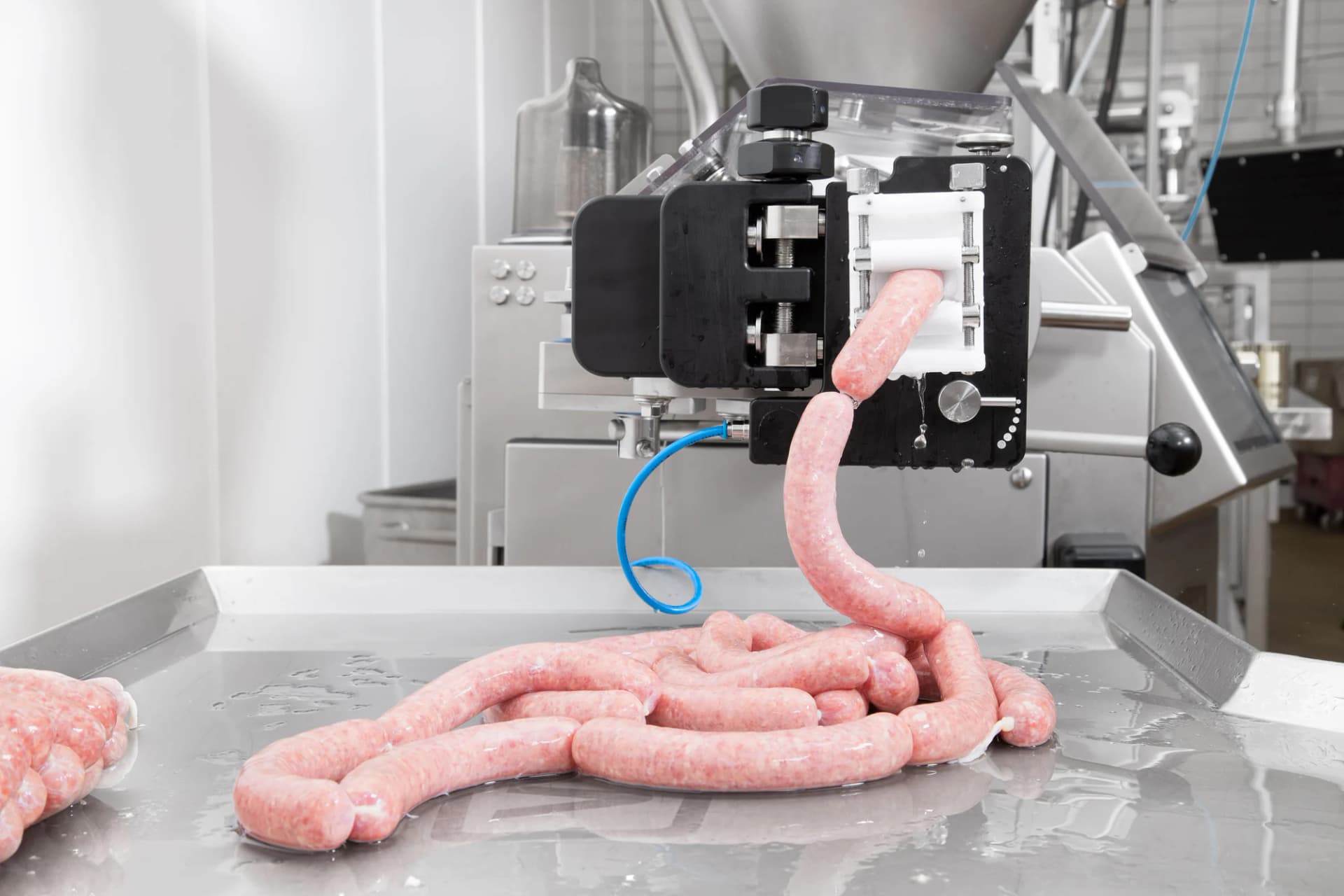
A sausage filler is a machine that pushes prepared sausage meat from a hopper or cylinder through a filling horn into a casing at a controlled rate. Vacuum fillers and some piston models also meter each portion to a set weight, and many pass the filled string straight to a linker, cutter or hanger.
The trade in Australia and New Zealand says filler; “sausage stuffer” is the American name. Sausage filling machines range from a hand-cranked cylinder on the bench to a vacuum filler driving an automatic linking line.
02Filler types
Types of sausage filler
Fillers differ in how the meat is pushed and how often the machine has to stop. Manual and piston fillers push a loaded cylinder of meat with a piston; vacuum fillers draw it continuously from a hopper through a metering pump.
01Shown for comparison
Manual (hand-crank) fillers
A manual filler is a steel cylinder whose piston is driven by a hand crank through gearing. The operator packs the cylinder, fits horn and casing, then cranks with one hand and guides the casing with the other. Speed, fill and link length all depend on the operator, and the cylinder is refilled after every batch. It needs no power and suits trial batches and small speciality runs.
02Shown for comparison
Hydraulic and electric piston fillers
Piston fillers use the same cylinder and piston, but a hydraulic ram or electric motor does the pushing, usually worked by a knee lever or foot pedal so both hands stay on the casing. They fill faster and with far less effort. Cylinder size sets the batch: when the piston reaches the end of its stroke, filling stops while the operator reloads. Some electric models can meter a set volume per portion.
Vacuum fillers
A vacuum filler is fed from an open hopper that can be topped up while it runs. A feeder carries the mass into a metering pump — a double screw or a rotary vane pump — while a vacuum draws air from it, and the drive turns the pump a set amount per portion. With no stops to reload, it can feed linking, hanging and cutting machines. The trade-off is more parts to strip and clean.
| Row | Manual | Hydraulic or electric piston | Vacuum |
|---|---|---|---|
| How it is fed | Cylinder packed by hand, one batch at a time | Cylinder loaded in batches; a ram or motor drives the piston | Open hopper topped up while running; a feeder supplies the pump |
| Air in the mix | Depends on how firmly the cylinder is packed | Depends on how the cylinder is loaded | Vacuum draws air from the mass as it enters the pump |
| Portioning | Judged by the operator at the crank | Operator-controlled; some electric models meter a set volume | Metered by the pump, portion by portion |
| Linking integration | Links twisted by hand | Usually by hand or on a separate machine | Linking devices on the horn, or length portioners alongside |
| Continuous running | Stops to refill after every batch | Pauses whenever the cylinder needs reloading | Runs while the hopper is kept supplied |
| Cleaning | Few parts: cylinder, piston and horn | Cylinder, piston, seals and horn | Hopper, feeder, pump and horn stripped and washed |
| Typical user | Trial batches and small speciality runs | Butcher shops and delis filling in batches | Butcher shops filling daily, through to smallgoods and industrial plants |
The fillers in the Vemag Australia catalogue are all vacuum fillers; manual and piston machines appear here for comparison only. The full vacuum filler range shows the same machines at work beyond sausages.
03How it works
How a vacuum sausage filler works
Whichever pump it uses, a vacuum sausage filler moves product along the same path. The drawing numbers its six main parts, and the steps below explain each one.
Hopper and feeder
Mince or batter goes into the open hopper, where a feed scroll or feed curve turns near the base and keeps the mass moving into the pump inlet, so the pump stays evenly charged.
Vacuum
A vacuum pump lowers the pressure where the mass enters the pump. Much of the air trapped between pieces of meat is drawn off there, so the pump chambers fill more densely and more evenly.
Metering pump
The pump is a rotary vane pump or a double screw. Each revolution carries a fixed volume from inlet to outlet, which makes the filler a metering machine rather than a simple pusher.
Servo drive and controls
A servo motor — a hydraulic drive on some models — turns the pump through an exact angle per portion. Portion weight and speed are set on the control panel and stored as a program for each product.
Horn and casing
The metered mass leaves through a filling horn sized to the casing calibre. A casing holder on the horn controls how the casing pays off, so it fills to an even diameter.
At the outlet
Next comes whatever is fitted: a linking gear twists the string, a length portioner divides it, a cutter separates sausages, a hanger loads smoke sticks, or a clipping machine closes large calibres.
Feed systems
Double screw or vane pump?
VEMAG fillers use one of two pump designs. Each is a positive-displacement pump that meters by volume; they carry the mass differently, and neither is right for every product or plant.
Double screw
Two intermeshing screws turn in a close-fitting housing. The mass is drawn in at one end and carried forward between the flights, so product that goes in first comes out first, with few places to linger. Screw pitch and diameter set the volume per turn, and screws can be changed to suit the product. On VEMAG fillers the double screw comes out in one piece.
Named in the manufacturer’s data
Rotary vane pump
A rotor carrying sliding vanes turns off-centre in its housing. The vanes divide the space into cells that widen at the inlet, fill with product drawn in under vacuum, then narrow towards the outlet and push it out. Each cell delivers the same volume on every turn, which gives the pump its metering action in a compact layout.
Named in the manufacturer’s data
04Sizing
Sizing a sausage filler for your output
Size from the output you need on an ordinary day, not the data-sheet figure. A published filling rate is a maximum for a given product, pump and portion; in practice the filler also stops for casing changes, product changeovers and cleaning, and waits whenever the hopper runs short of meat. The model comparison gives the published maximum for each VEMAG filler that has one.
For linked sausages, count portions per minute too. A thin chipolata in sheep casing needs far more portions a minute than a thick sausage in hog casing to move the same weight, and the linker, not the pump, often sets the pace.
Then check hopper volume against your usual batch, the products and calibres you run, the power supply to the room, and floor space for a linker, hanger or conveyor.
Tier 12–2.7 t/h
Sausage fillers for butcher shops and delis
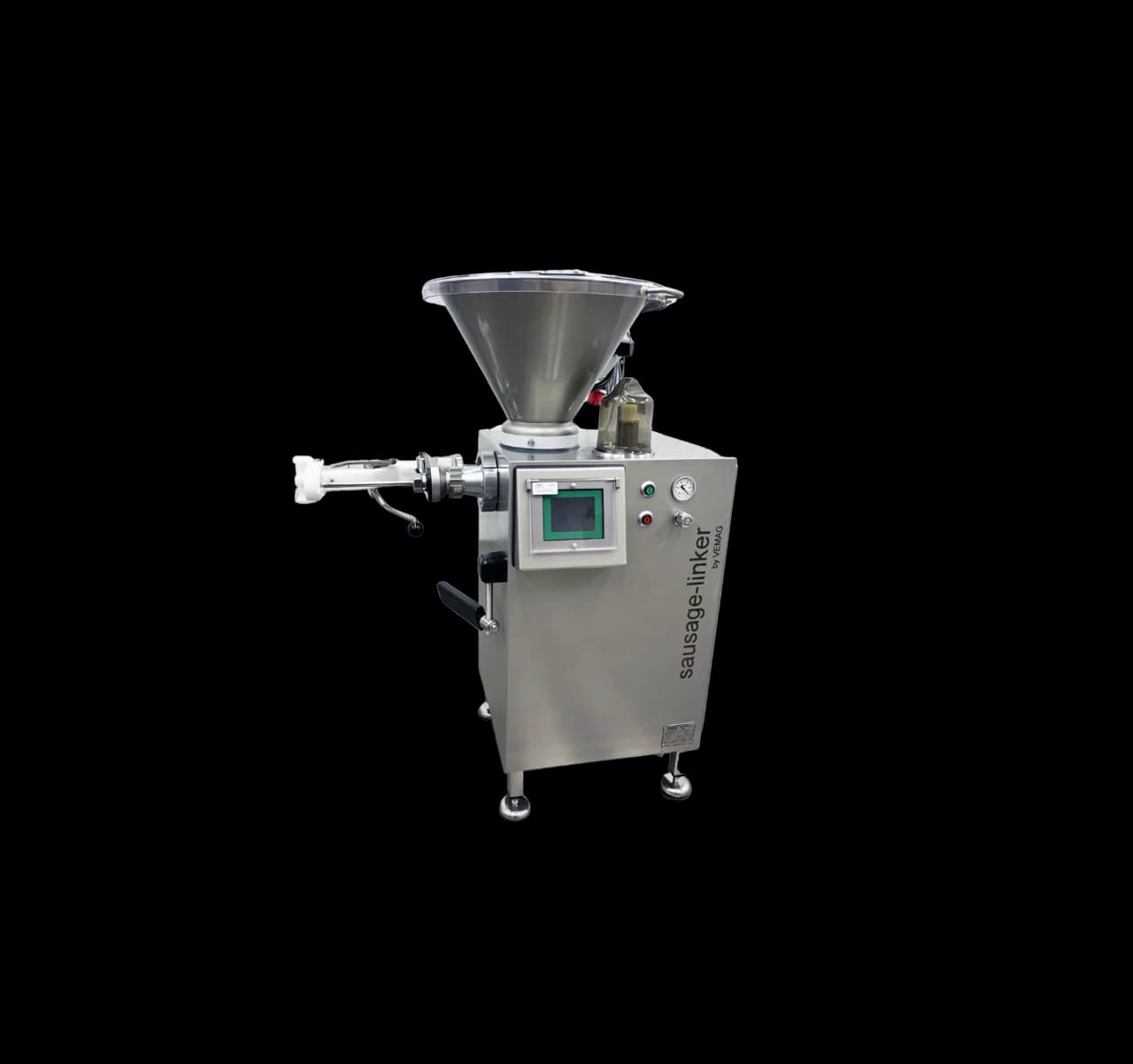
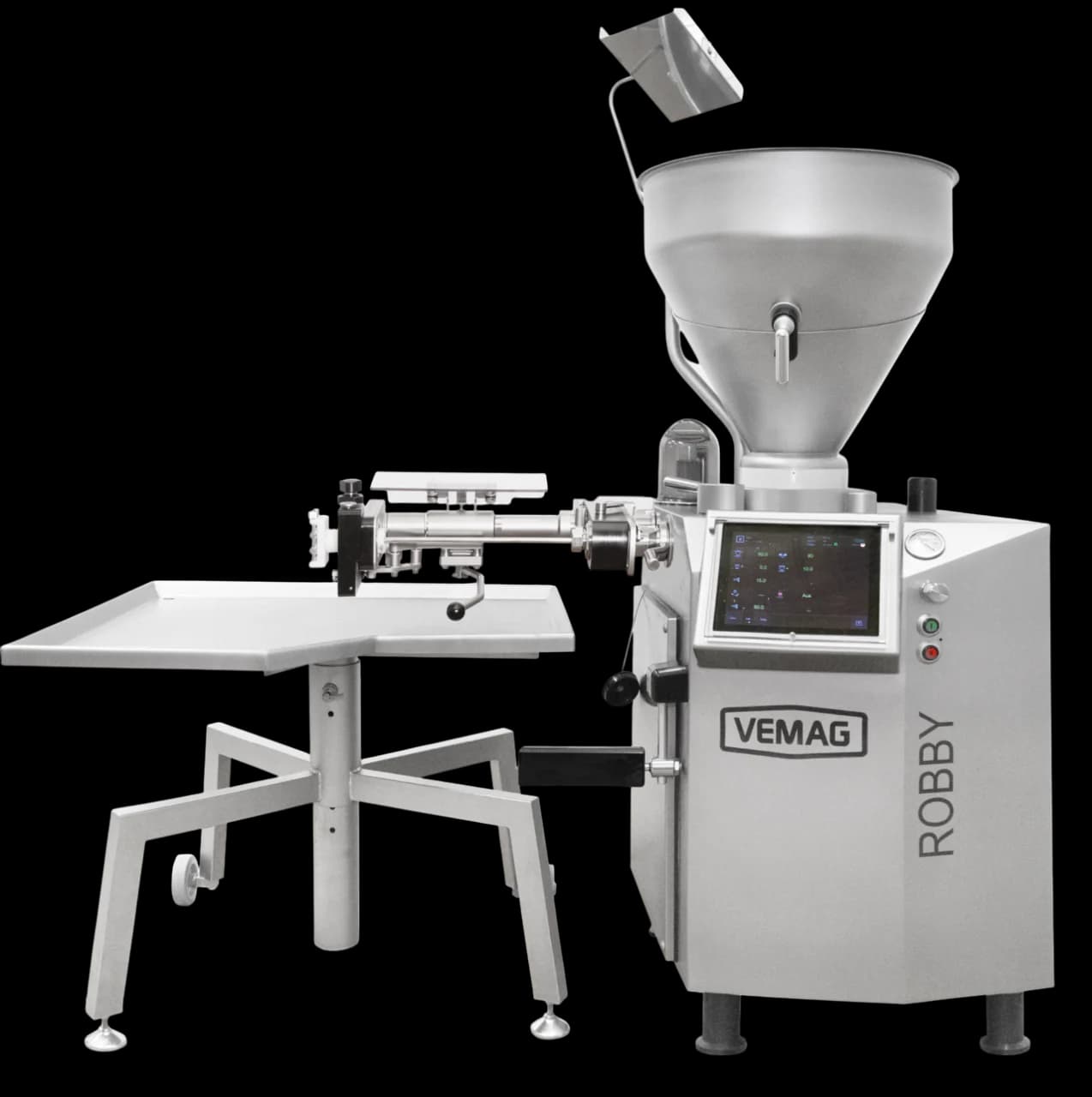
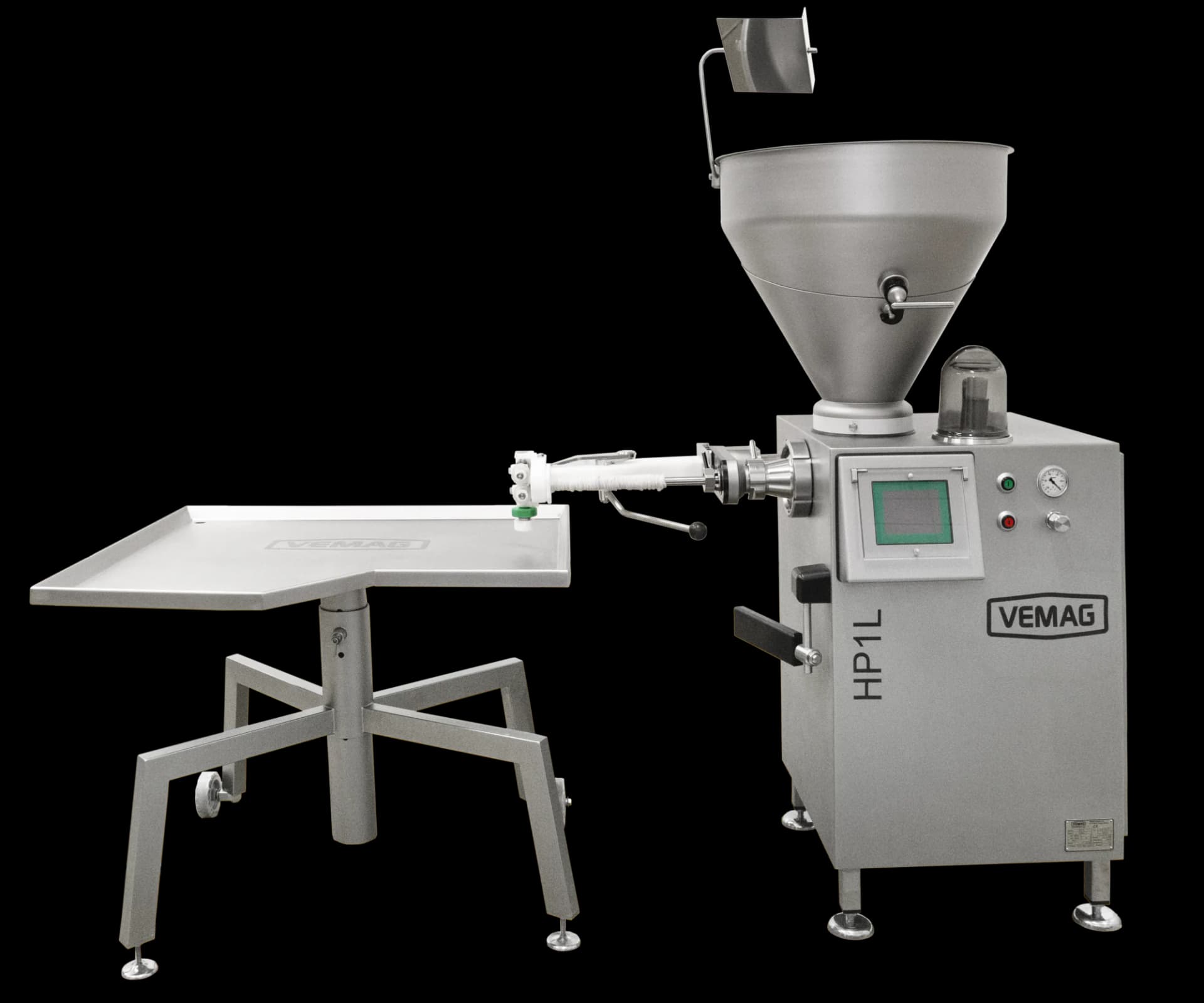
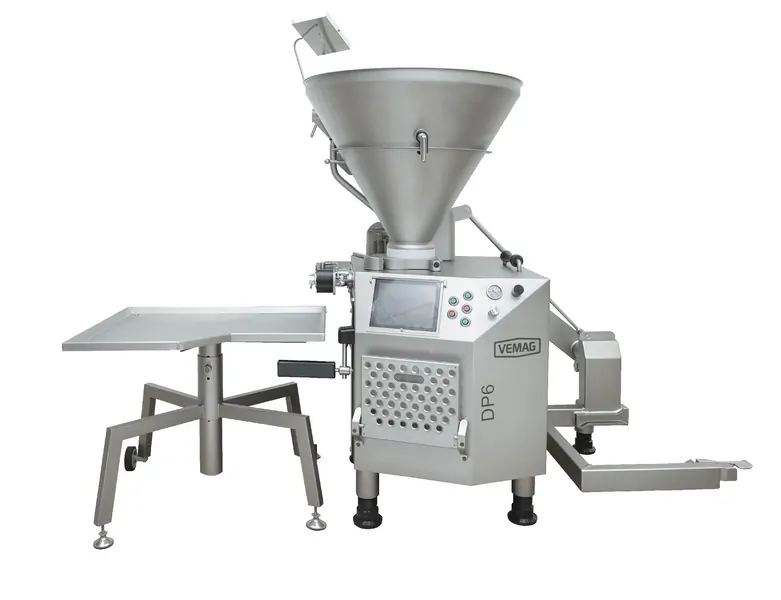
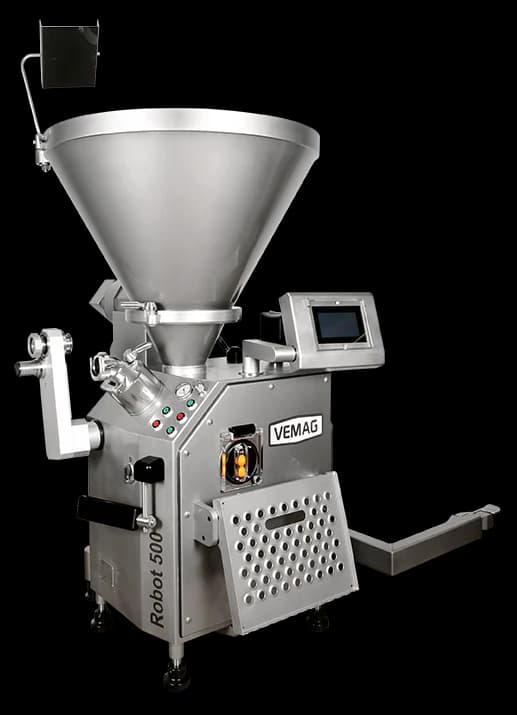
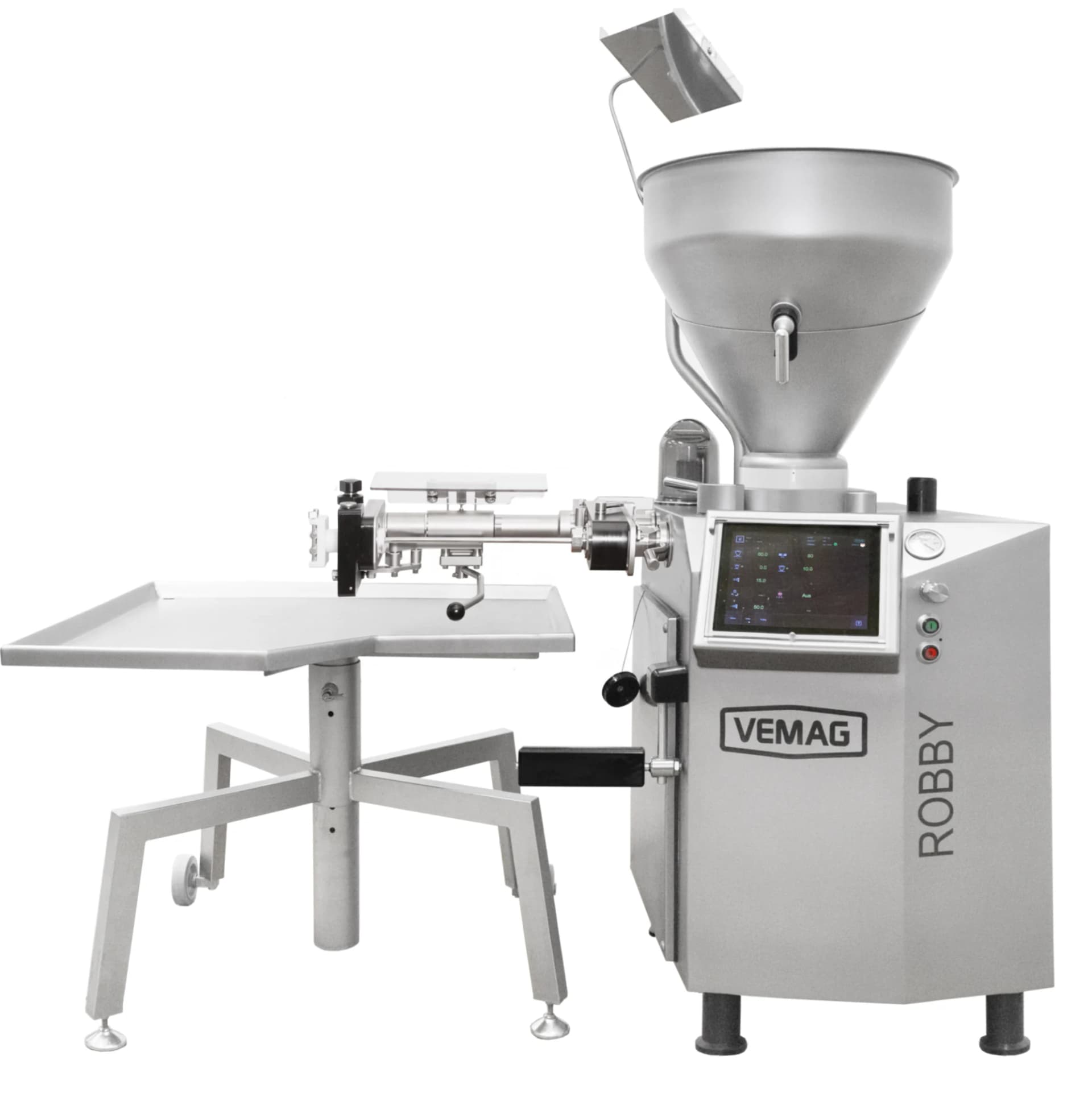
For a shop filling for its own counter, the questions are batch size, how often the flavour changes and how much floor space is free. The Lucky Linker combines a 40 l hopper with built-in linking. Robby, with a rotary vane pump, is designed for smaller batches and frequent product changes. The HP1 is made for the butcher’s trade, with a 105 l split hopper. The DP6 was developed together with master butchers. The Robot 500 pairs VEMAG double screw technology with a hydraulic system and uses the VEMAG standard connection for attachments.
Robot 500
VEMAGProcessing
Tier 24.3–7 t/h
Sausage fillers for smallgoods producers
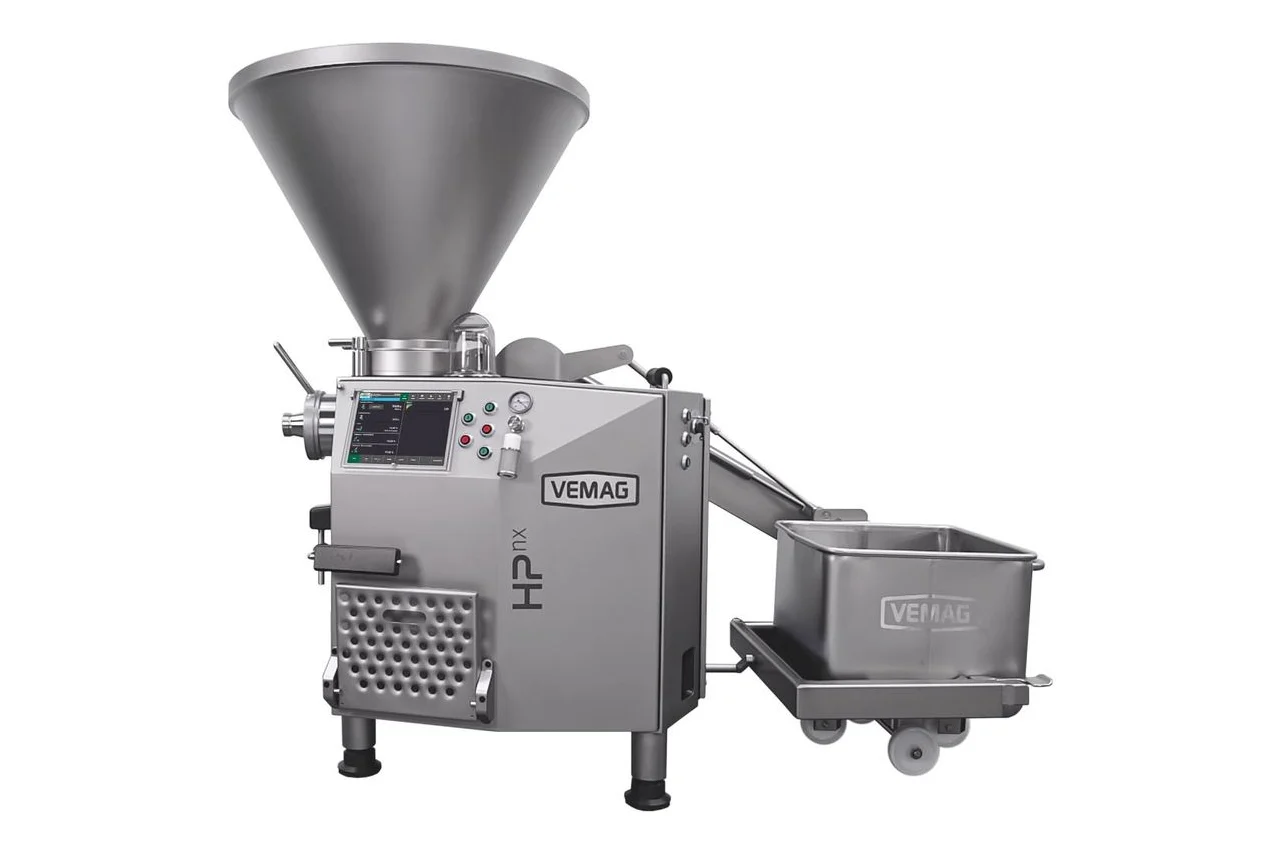
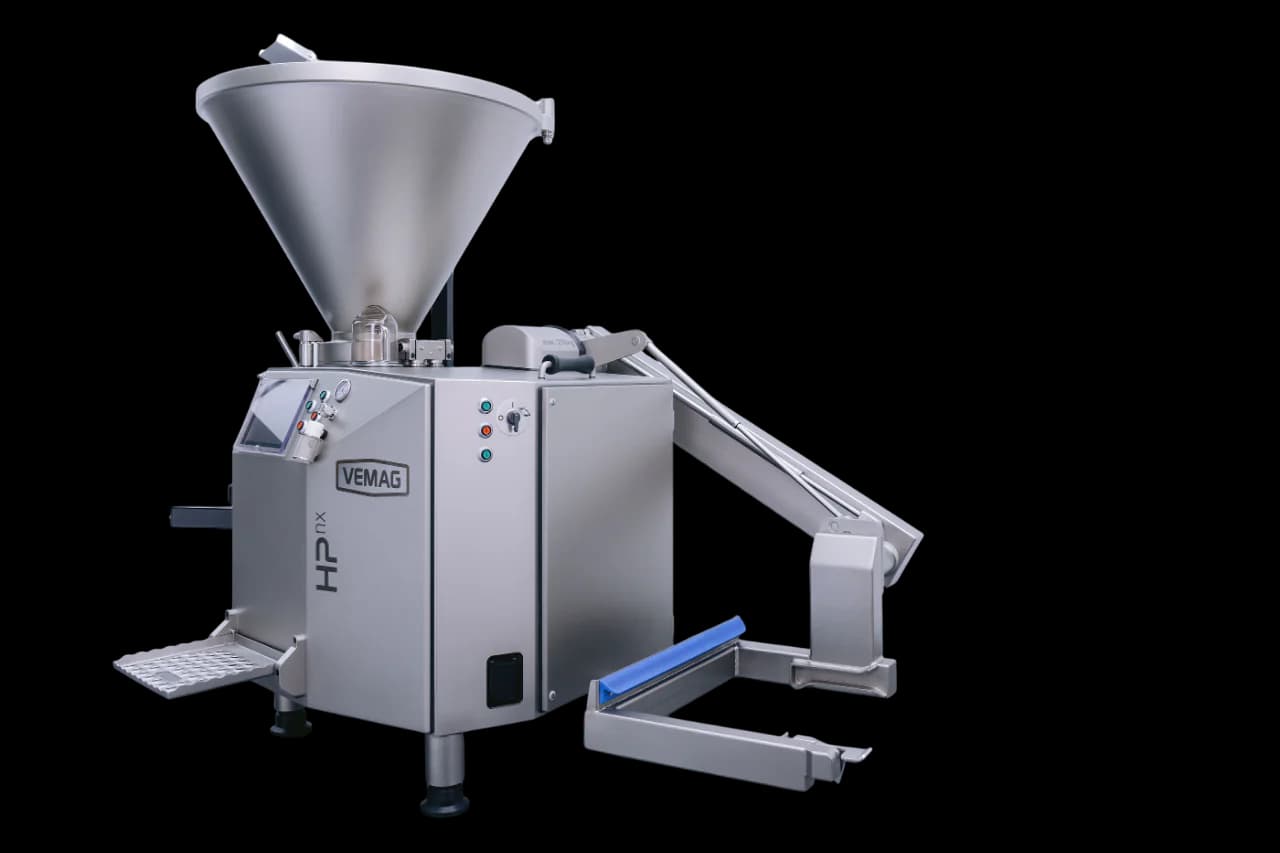
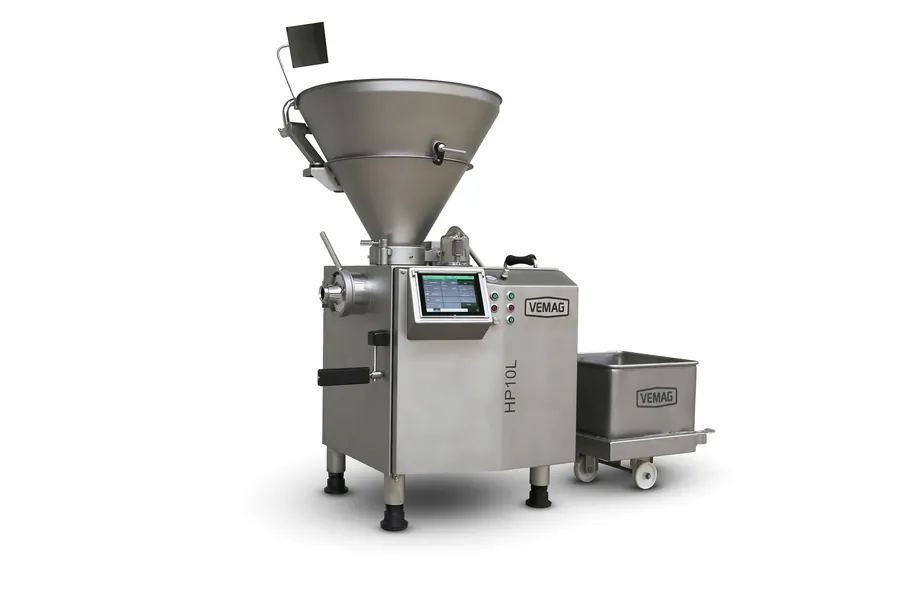
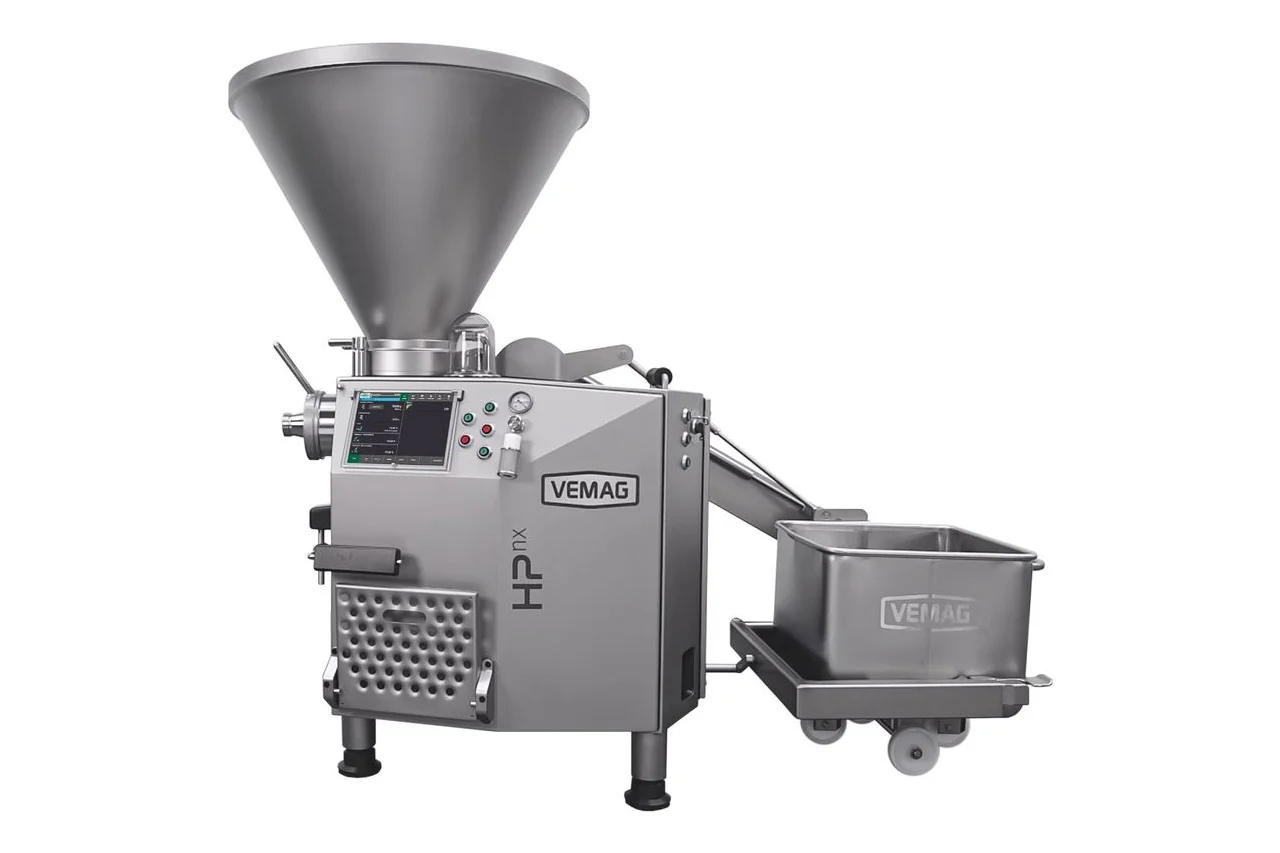
Once sausages go to other shops, supermarkets or food service, the filler runs longer shifts and feeds a linker or hanger. The HP10L is VEMAG’s sausage specialist: a compact filler with the double-screw feed system of VEMAG’s larger industrial fillers, and a published portioning speed of up to 820 portions/min depending on product, casing and portion size. The HP Sausage works with the LPG218 or LPG238 and the AH219 or AH239 on hot dogs, with or without inserts. The HP10NX brings the HPnx double screw and flushable vacuum channel to this tier.
Tier 37.6–25 t/h
Industrial sausage fillers
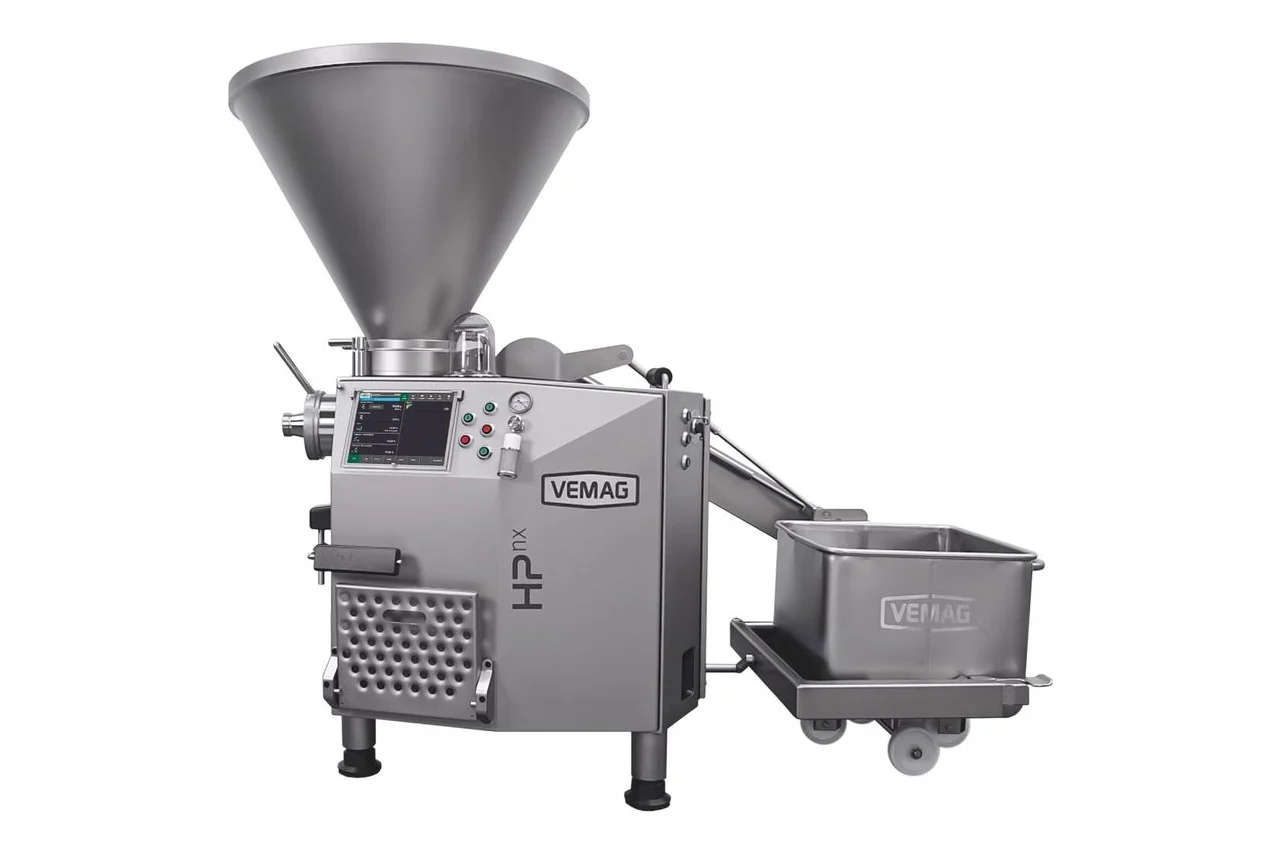
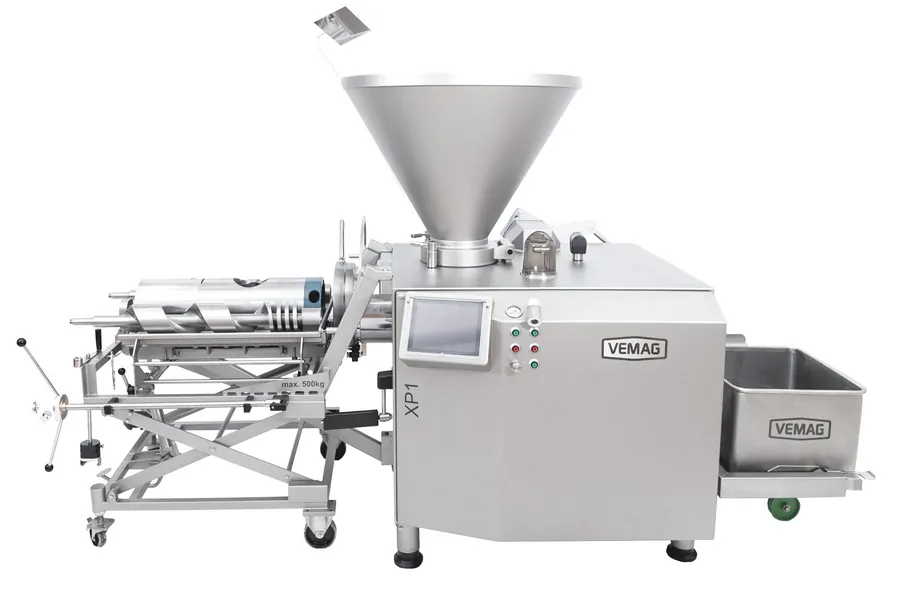
In a plant running a line all day, the filler is sized together with everything after it — linkers, hangers, cutters and packing — so no station holds up the rest. The HP20NX and HP30NX take the HPnx design to 350 l hoppers. The XP1, built for large quantities, suits ham, whole-muscle products and boiled sausage, carries an inline grinder and has a published filling capacity of 25 t/h. The XP2, which also has an inline grinder, is mainly used for grinding in minced-meat production and in salami production, and also fills cooked ham and cooked sausage; continuous running needs product fed by belts or worm conveyors.
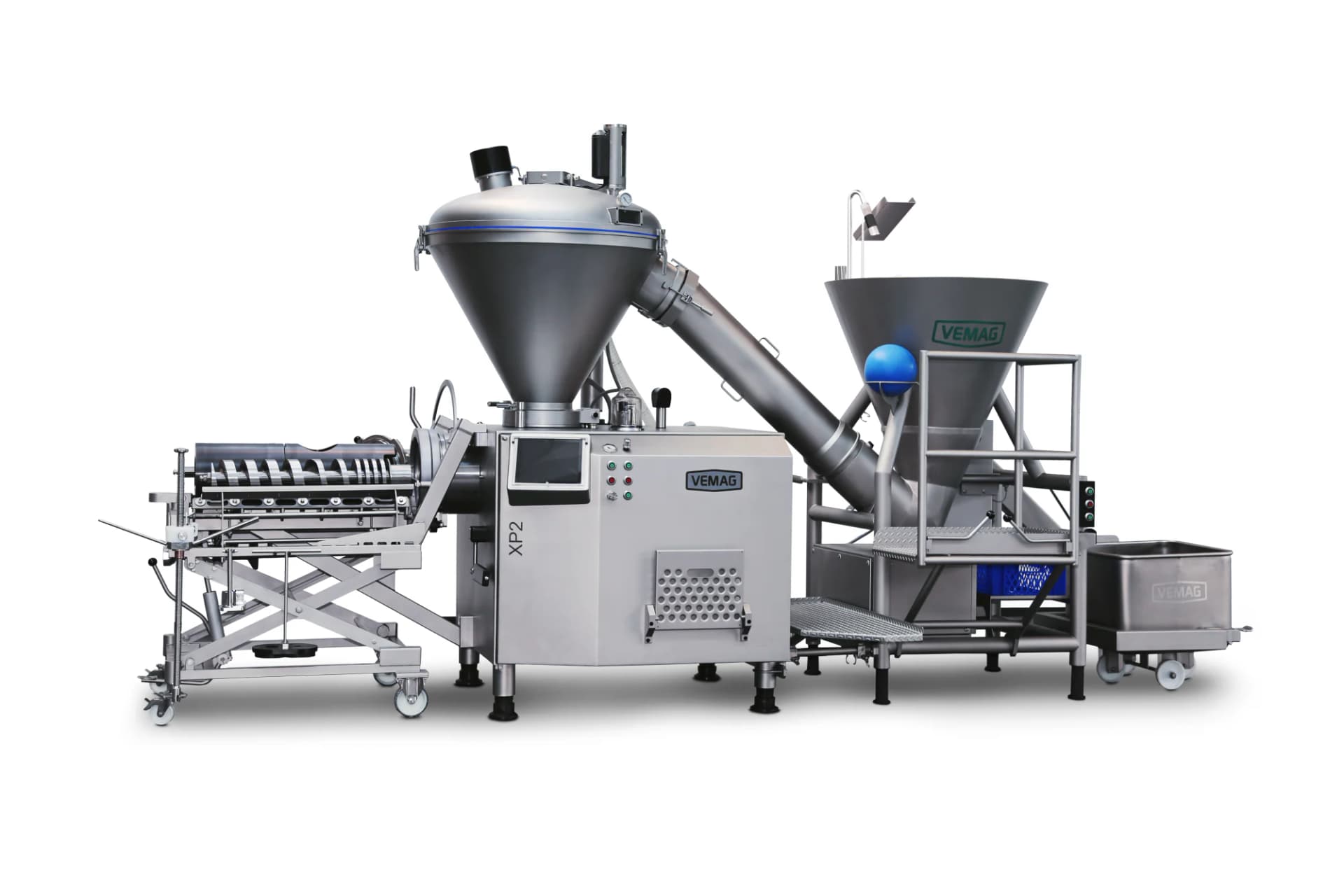
XP2
VEMAGProcessing
Before you buy
Sausage filler buying checklist
- Real output: the kilograms you need on an ordinary day, after casing changes, changeovers and cleaning.
- Portions per minute for your thinnest product, not only kilograms an hour.
- Hopper volume against your usual batch, and whether a split or divided hopper suits your changeovers.
- The casings and calibres you run now, and any you plan to add.
- What follows the filler: twist-linking at the horn, a length portioner, a hanger or a cutter.
- Attachments you may want later, such as a grinding head on the outlet or co-extrusion.
- Strip-down and rebuild time for the pump and hopper, timed in front of you.
- Power supply to the room, and floor space for the filler and everything after it.
- A trial with your own mix and casings before you commit.
- Servicing, operator training and spare parts in Australia and New Zealand.
05The range
VEMAG sausage fillers, from shop to plant
The table sets every VEMAG vacuum filler in the Vemag Australia catalogue side by side, in the tiers above: published filling rate, hopper, portion weight range, power and a distinguishing note. Power figures come in different kinds — servo drive, power input, nominal output, rated power or connected load — so each cell names its kind, and where a figure is missing from the published data, the cell says so rather than guessing.
Butcher shops and delis
Smallgoods and regional producers
Industrial sausage plants
| Model | Filling rate | Hopper | Portions | Power | Of note |
|---|---|---|---|---|---|
| Butcher shops and delis | |||||
| Lucky Linker | Up to 2,000 kg/h | 40 l | Not published | 2.75 kW servo drive | Linking built in |
| Robby | Up to 2,300 kg/h | 105 l | 0–100,000 g | 5.8 kW nominal, total | Rotary vane pump; up to 410 portions/min at 25 g |
| HP1 | 2,000–2,600 kg/h | 105 l, split | Not published | 2.75 kW servo drive | Double screw |
| DP6 | Up to 2,700 kg/h | 250 l, divided | 0–100,000 g | 8.9 kW nominal, total | Developed with master butchers |
| Robot 500 | Not published | 110 l, divided | Not published | 5.5 kW input | Double screw; hydraulic system |
| Smallgoods and regional producers | |||||
| HP10NX | 4,300 kg/h | 250 l | 1–99,000 g | 15 kW rated | Rate depends on the feeding element |
| HP Sausage | Up to 5,000 kg/h | 250 l or 350 l | Not published | 18 kW connected load | Hot dogs, with or without inserts |
| HP10L | Up to 7,000 kg/h | 250 l | Not published | 12.5 kW input | Up to 820 portions/min |
| Industrial sausage plants | |||||
| HP30NX | 7,600 kg/h | 350 l | 1–99,000 g | 36 kW rated | 40 m³ vacuum system; rate depends on the feeding element |
| HP20NX | 8,900 kg/h | 350 l | 1–99,000 g | 23 kW rated | Rate depends on the feeding element |
| XP1 | 25,000 kg/h | Not published | Not published | 38 kW nominal | 160 mm double screw; inline grinder |
| XP2 | Not published | 350 l | Not published | 70 kW nominal | 160 mm double screw; inline grinder |
Filling rates are VEMAG’s published maxima and depend on the pump fitted, the product, the casing and the portion size; a working line produces less. To see the rate your own product reaches, trial it at the Customer Centre.
06Giveaway
Portion accuracy and giveaway
Pre-packed sausages are sold against the weight printed on the label. If portions vary widely, the usual response is to set the target higher so the light packs still make that weight. That margin, repeated across every link and pack, is giveaway: meat you bought and processed, then handed over unpaid. It rarely shows on a single pack, but it adds up over a year of production.
A vacuum filler narrows the spread in two ways. Its positive-displacement pump delivers close to the same volume each time it turns through the same angle. And because much of the trapped air is drawn off as the mass enters the pump, each volume holds a denser, more even fill, so equal volumes weigh much the same. A tighter spread lets the target sit closer to the labelled weight.
Natural casings add variation of their own, since their diameter changes along the length. The LPV802 length portioning device is VEMAG’s approach for them, aiming to hold length, weight and calibre together. To learn the spread your own product will give, test it rather than rely on a brochure.
07Casings
Casings and calibres
The casing decides which horn you fit, which linker suits and how fast the line runs. Natural casings vary from hank to hank; manufactured casings come at a set calibre, usually shirred onto sticks that load in one movement.
Calibre is the casing’s diameter in millimetres. In the VEMAG range, the LPG208 and LPG209 take natural, collagen and cellulose casings at 13–40 mm, the VS227 and CHL234 handle 13–60 mm, the DHV841 covers 16–42 mm, and the CC215 co-extrudes alginate at 8–32 mm.
| Casing | What it is | On the filler | Typical products |
|---|---|---|---|
| Natural (sheep) | Cleaned sheep intestine, sold in hanks and graded by calibre | Soaked, then threaded onto the horn by hand or with a casing applier; diameter varies along each length | Chipolatas, thin breakfast sausages, cocktail frankfurts |
| Natural (hog) | Cleaned pig intestine, wider than sheep casing | Loaded like sheep casing, onto a wider horn | Thick fresh sausages, bratwurst, Italian-style links |
| Collagen | Manufactured from collagen at a uniform calibre; usually edible | Shirred sticks slide onto the horn in one go, keeping casing changes short | Fresh sausages, snack sticks |
| Cellulose (peelable) | Manufactured cellulose casing, removed after cooking | Shirred sticks; filled, linked and cooked, then peeled before packing | Skinless frankfurts and hot dogs |
| Co-extruded alginate | A gel extruded around the meat as it fills, then set | No casing to load; needs a co-extrusion line instead | Long runs of uniform fresh, cooked and plant-based sausages |
Casing and calibre also change throughput: the LPG208 length portioning machine’s published rates, shown below, climb steeply from thin sheep casings to wide cellulose ones.
| Casing | Calibre | Portion | Filling rate, up to |
|---|---|---|---|
| Sheep | 16/18 | 30 g | 300 kg/h |
| Sheep (overlapped) | 16/18 | 30 g | 450 kg/h |
| Sheep | 20/22 | 60 g | 500 kg/h |
| Sheep (overlapped) | 20/22 | 60 g | 700 kg/h |
| Hog | 30/32 | 90 g | 1,300 kg/h |
| Hog | 34/37 | 120 g | 1,600 kg/h |
| Collagen | 21 | 45 g | 1,800 kg/h |
| Collagen | 28 | 75 g | 2,500 kg/h |
| Cellulose | 21 | 45 g | 1,900 kg/h |
| Cellulose | 32 | 100 g | 4,400 kg/h |
08On the outlet
From filler to finished link
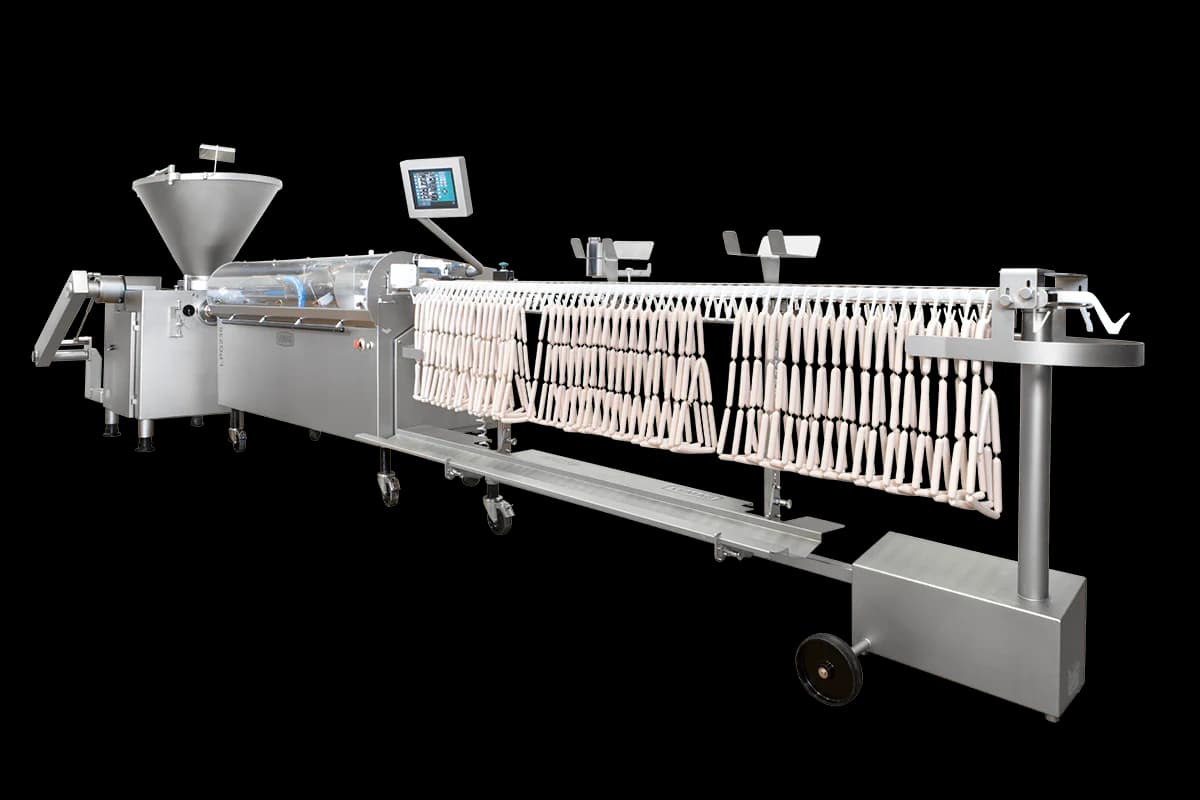
The filler meters; the machines on its outlet make finished sausages. A shop may twist-link straight off the horn, while a plant runs a length portioner feeding a hanger or a cutter. The sausage linking and hanging range covers each machine in detail.
Linking and length portioning
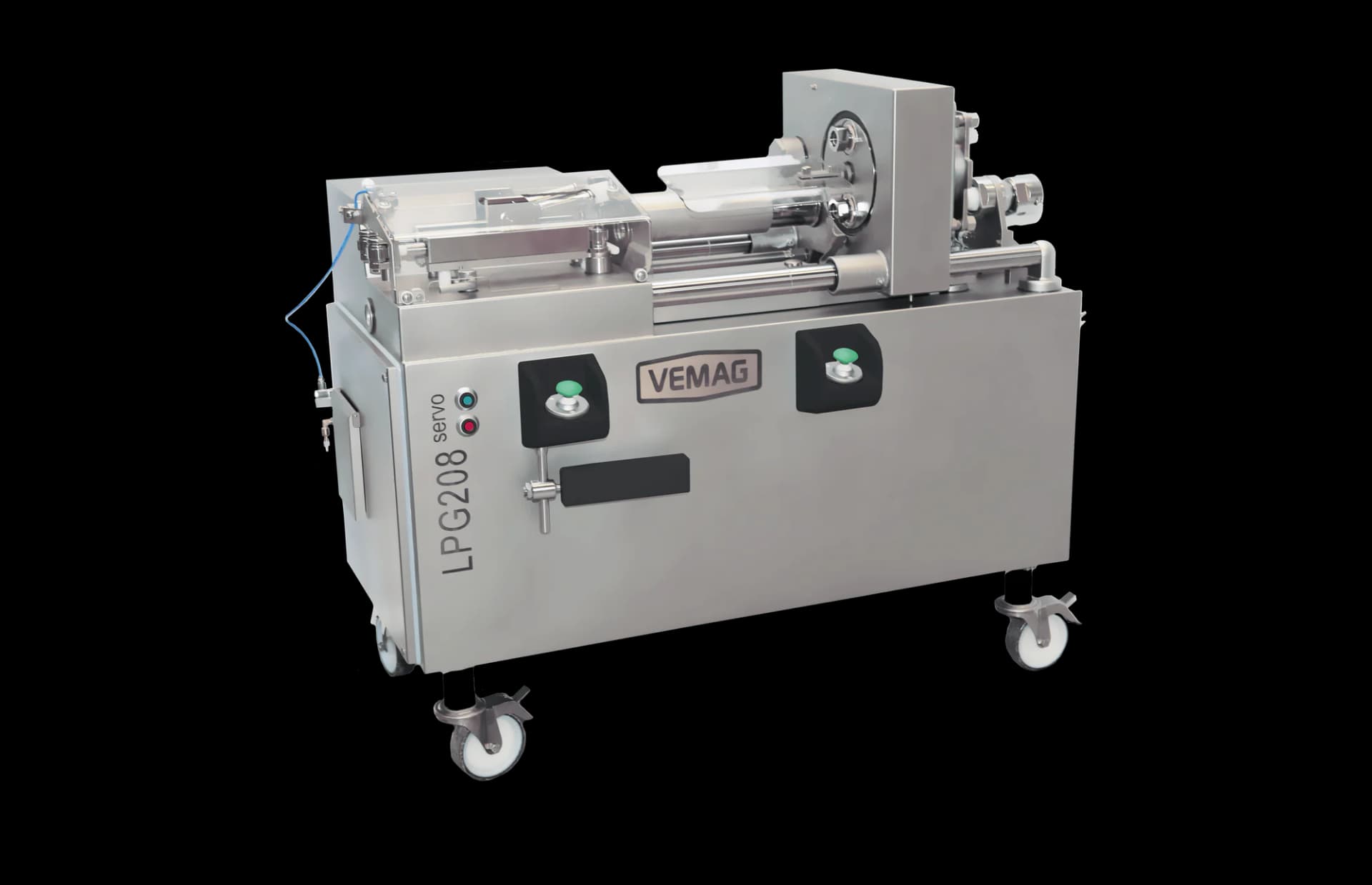
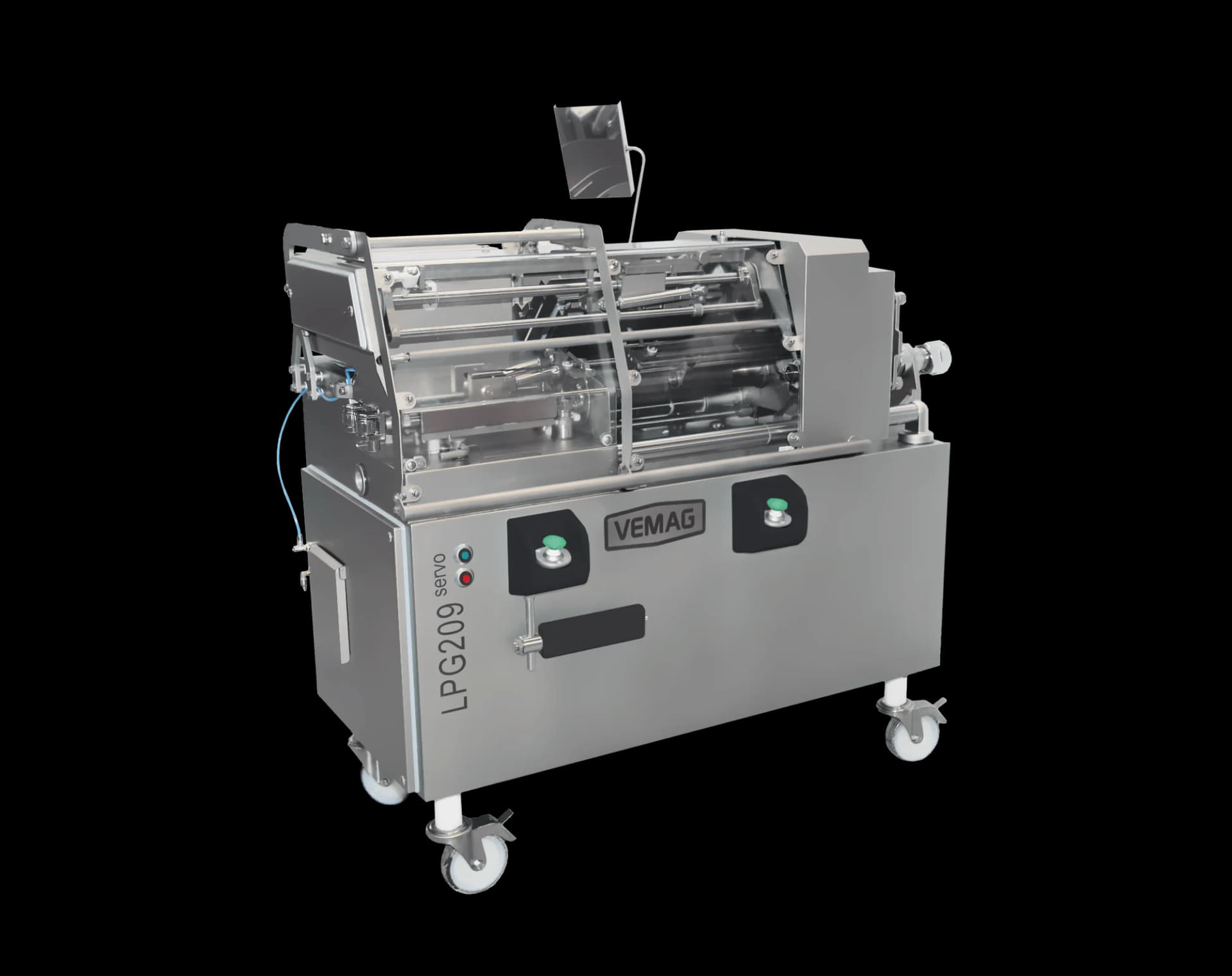
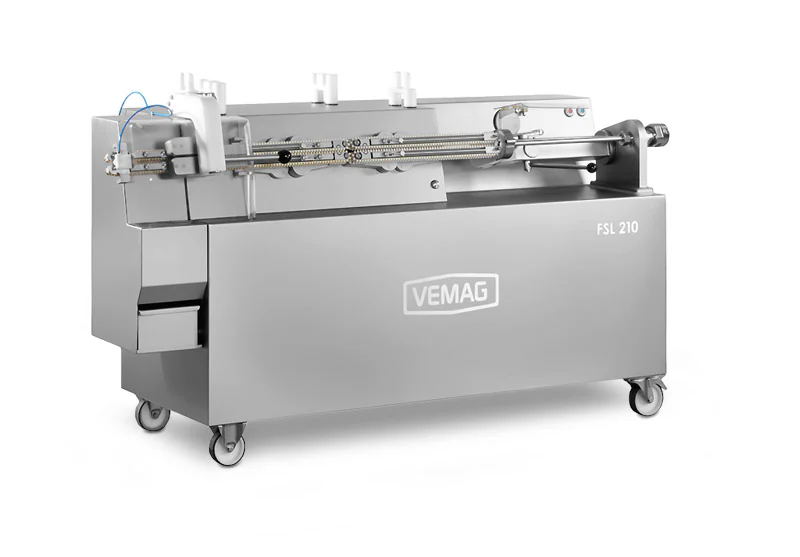
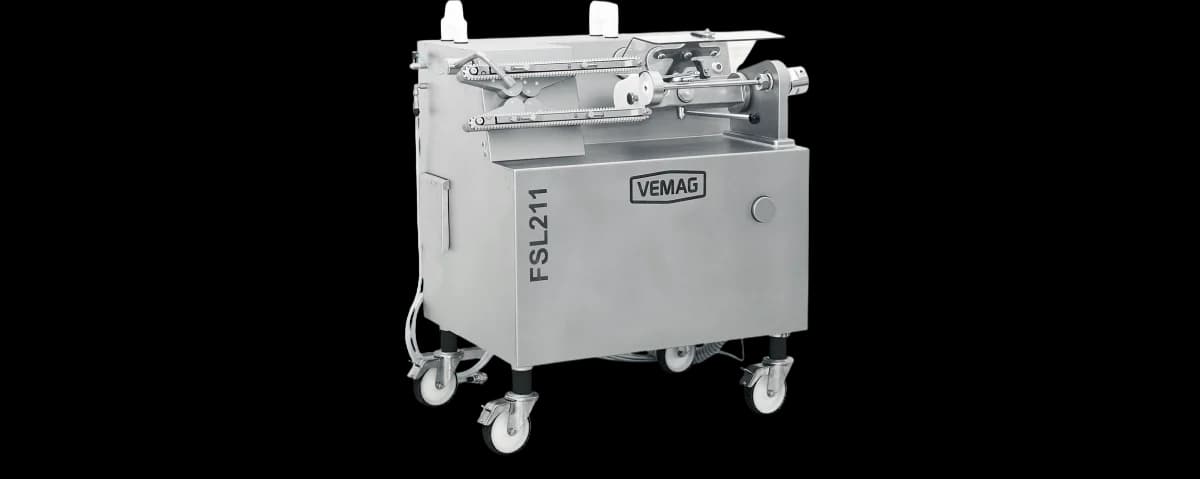
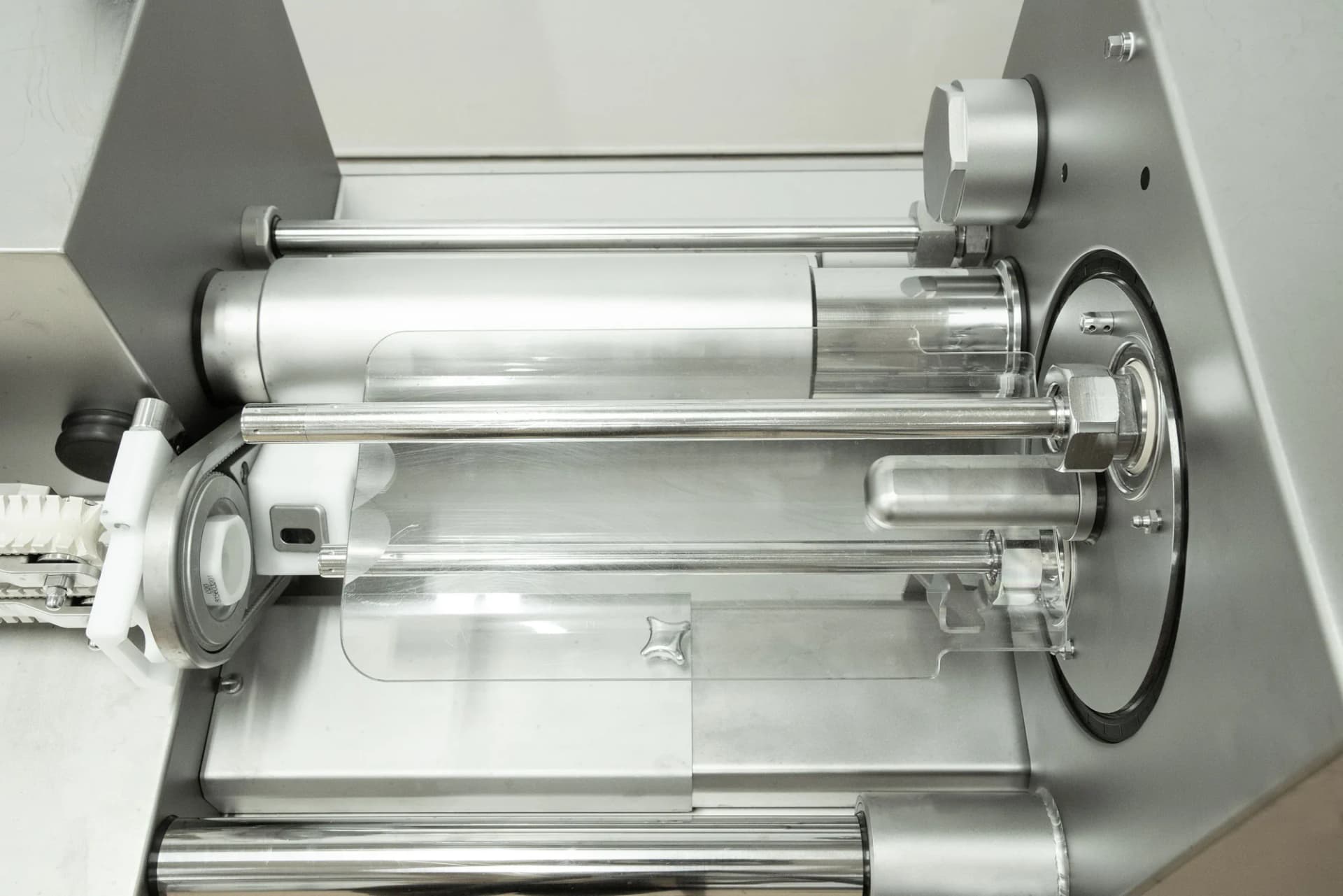
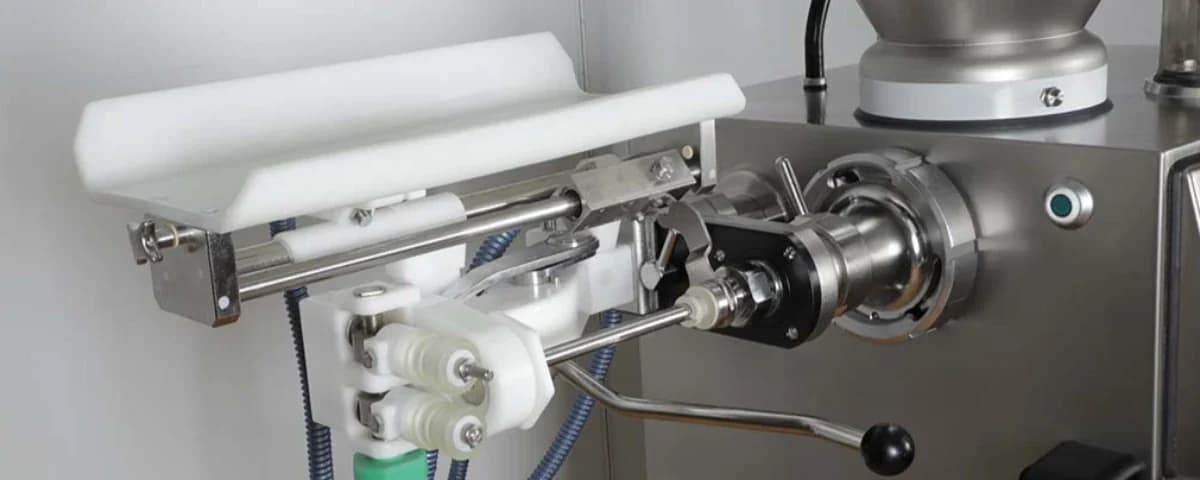
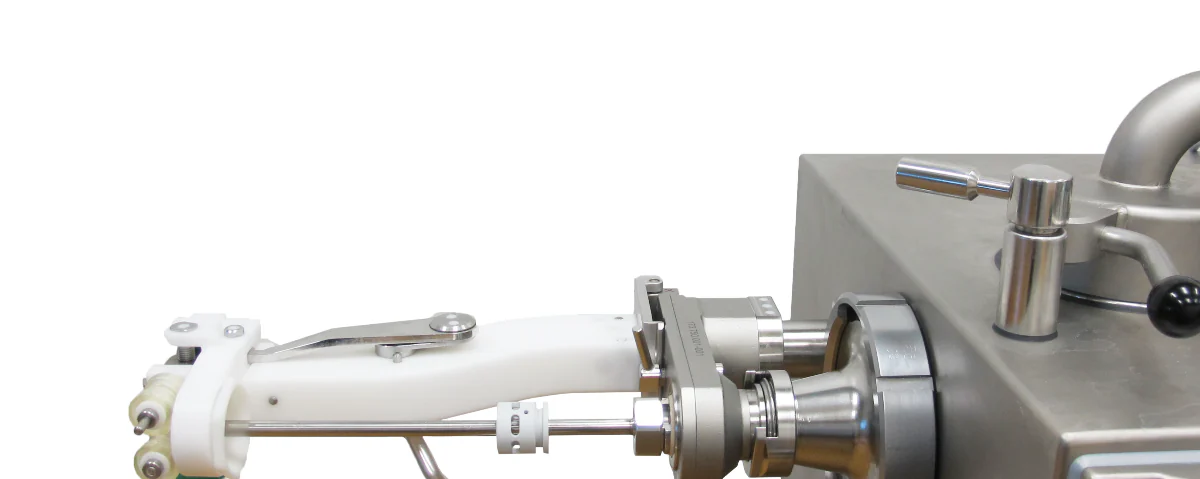
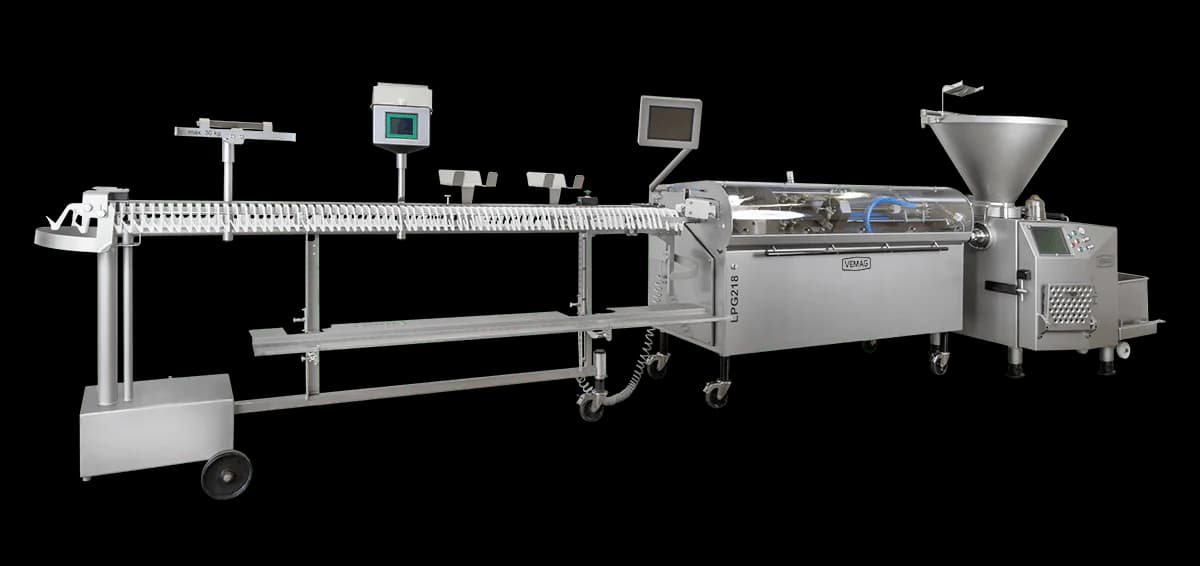
Twist-linking at the horn is the simplest set-up. The LPV802 brings length portioning to the filling table. The LPG208 and LPG209 portion sausages by length in natural, collagen and cellulose casings, the LPG209 adding an automatic casing magazine; the VS227 takes natural, artificial and collagen casings at 13–60 mm, and the LPG238 artificial, polyamide and collagen casings. The FSL210 and FSL211 suit plants making many products.
Casing holding and loading
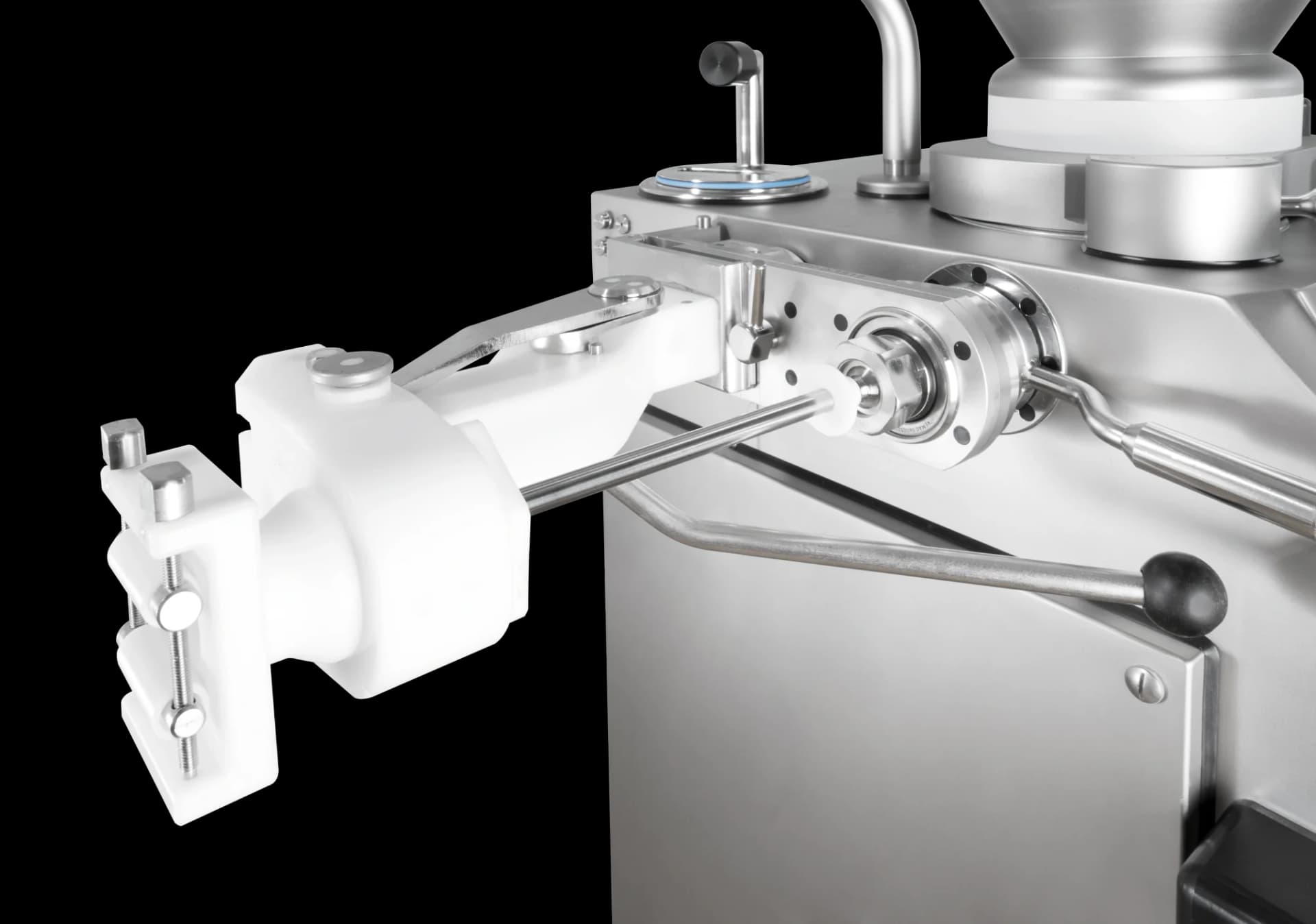
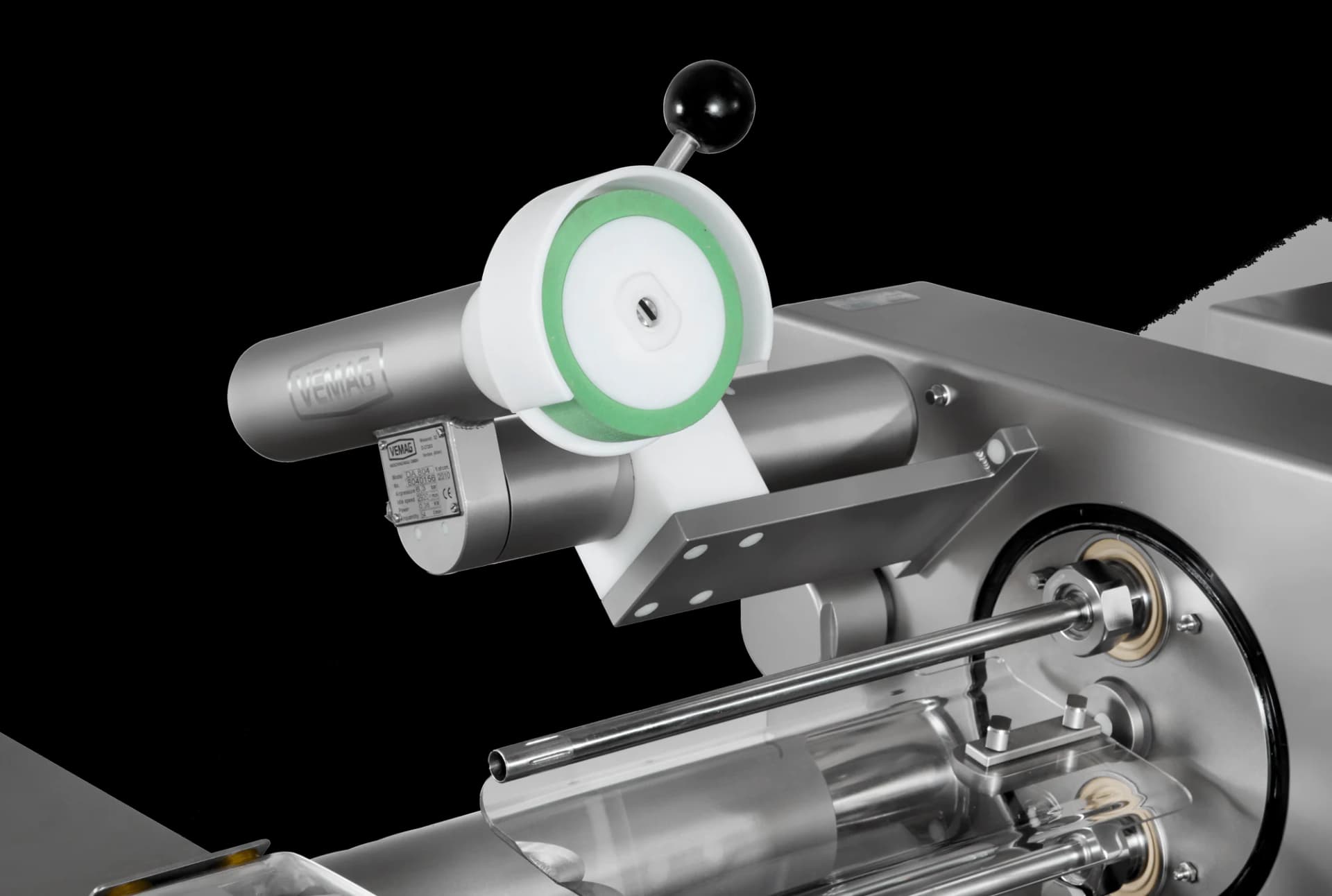
Casing holders on the horn control the casing as it fills. The DHV815 is VEMAG’s universal holder; the DHV841 adds a casing pusher and casing-end detection for collagen and cellulose; the DHV937 suits sheep and hog casings. The DAG804 applies natural casings to the horn.
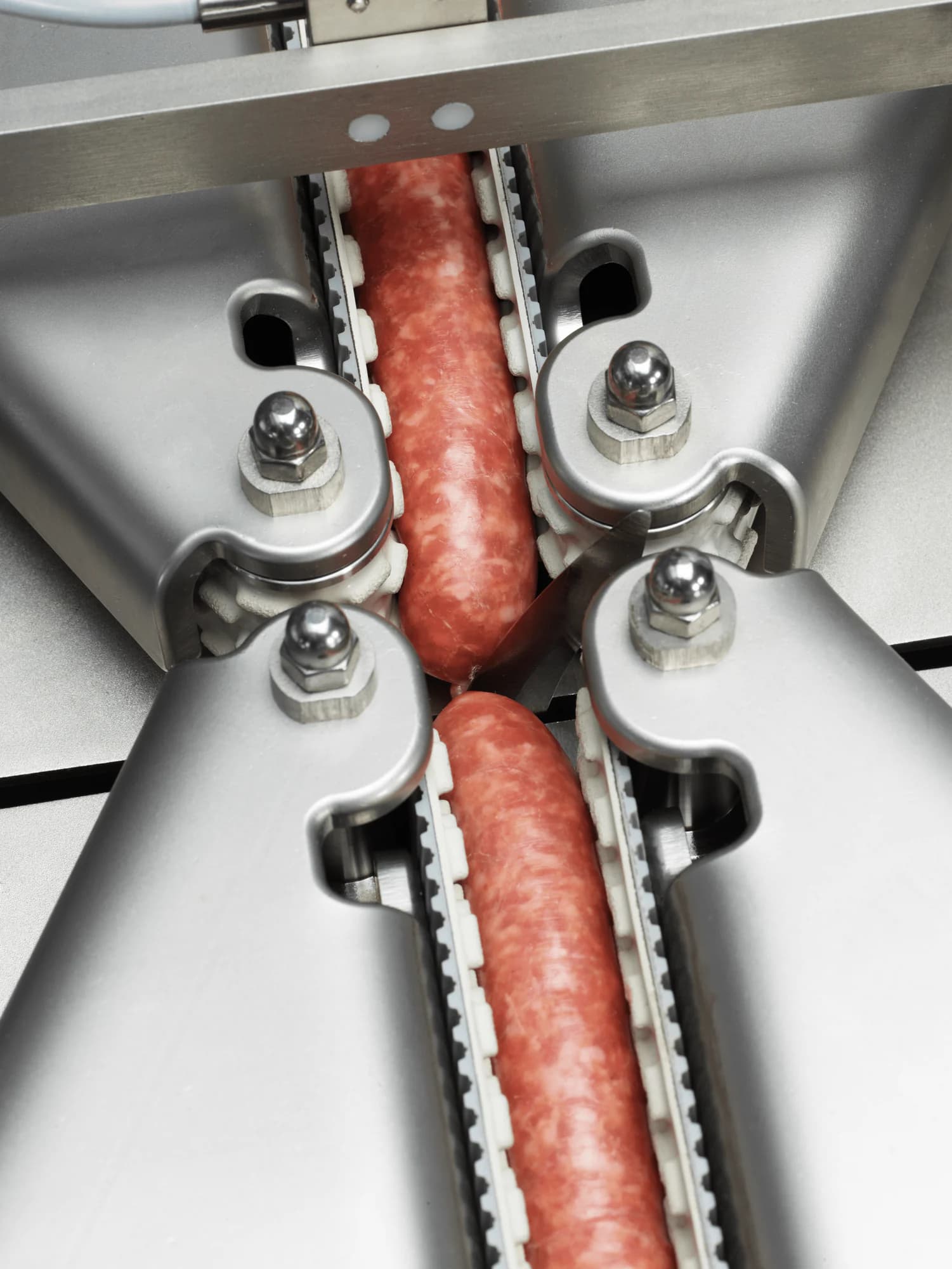
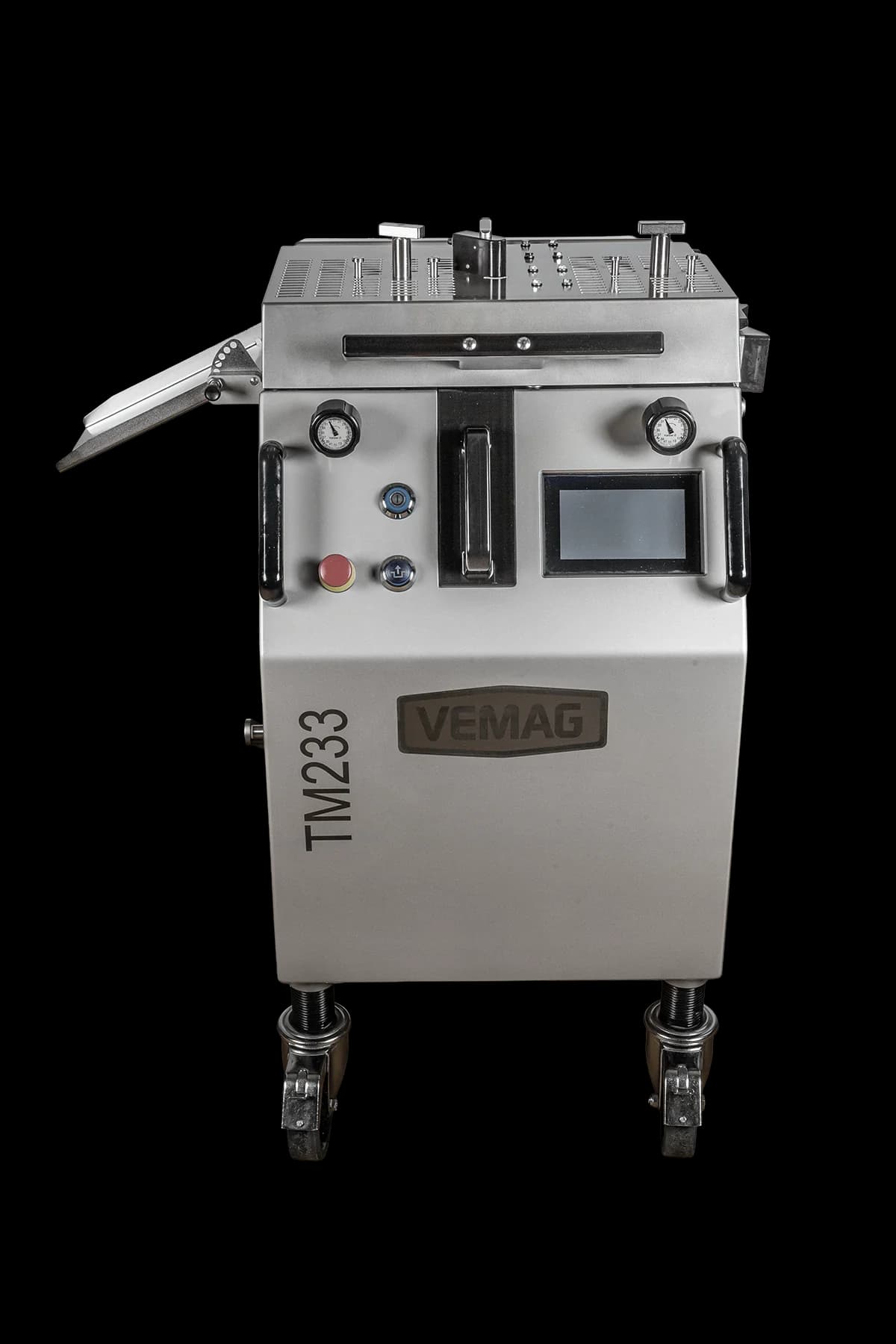
Cutting strings into singles
A cutter turns a linked string into single sausages. The TM203 works at the filling table with a VEMAG filler and LPV802, or with an LPG208 or LPG209; the TM233 also cuts artificial casings and can join an LPG208 in a fully automatic line.
Hanging for the smokehouse
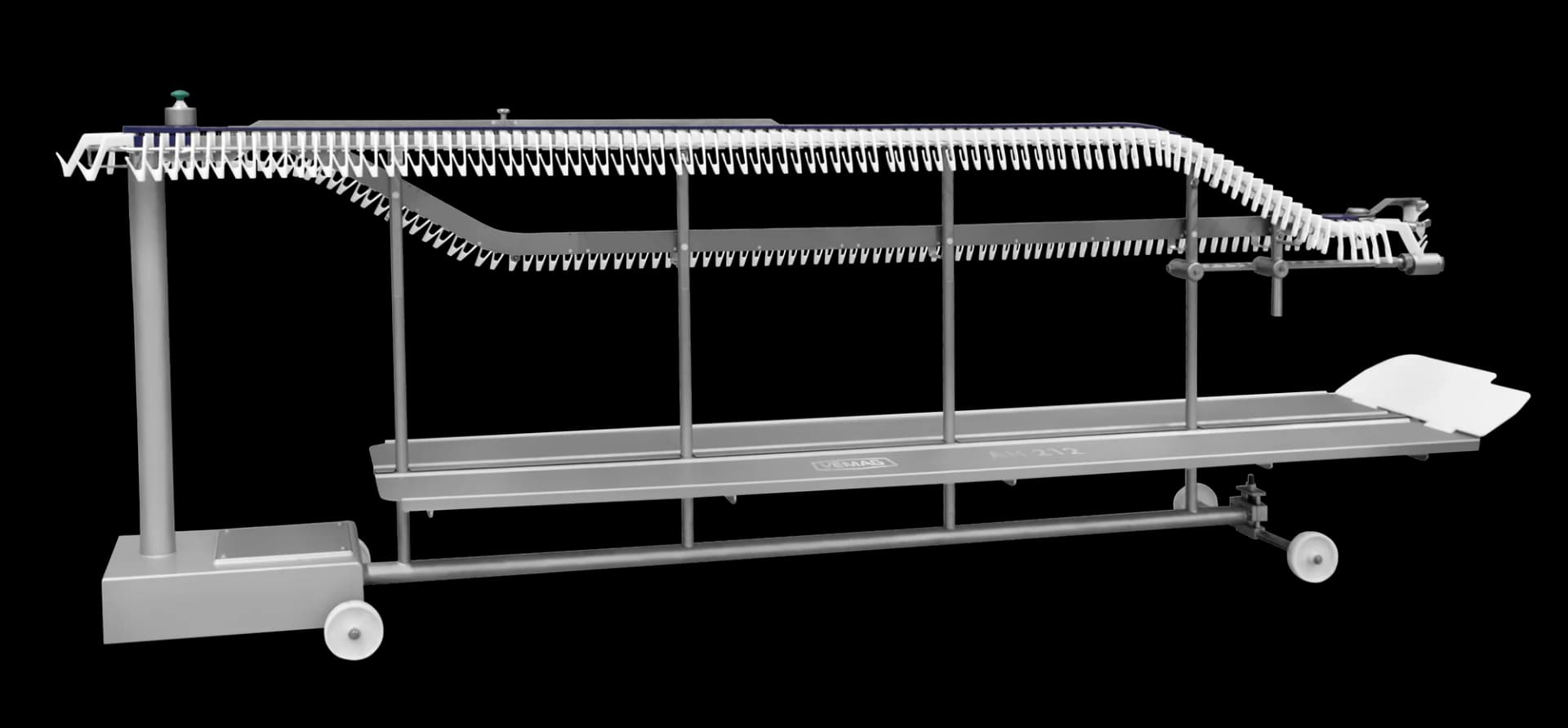
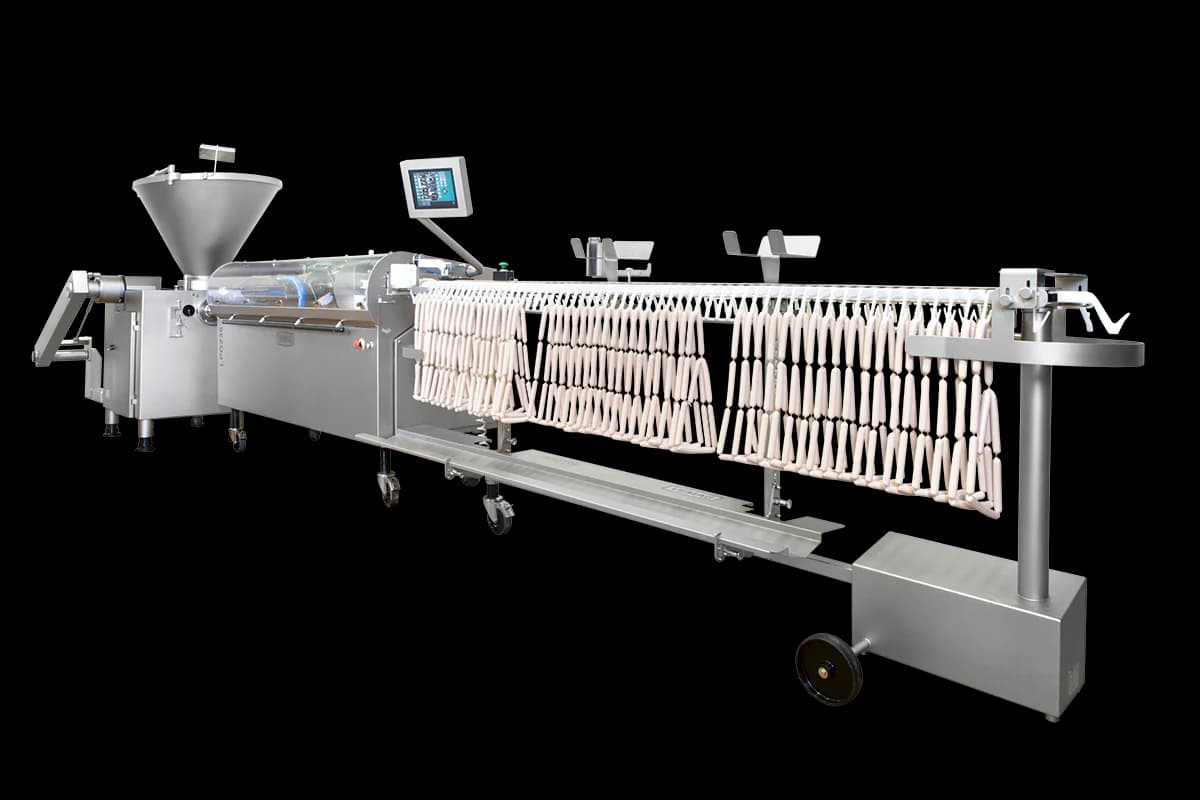
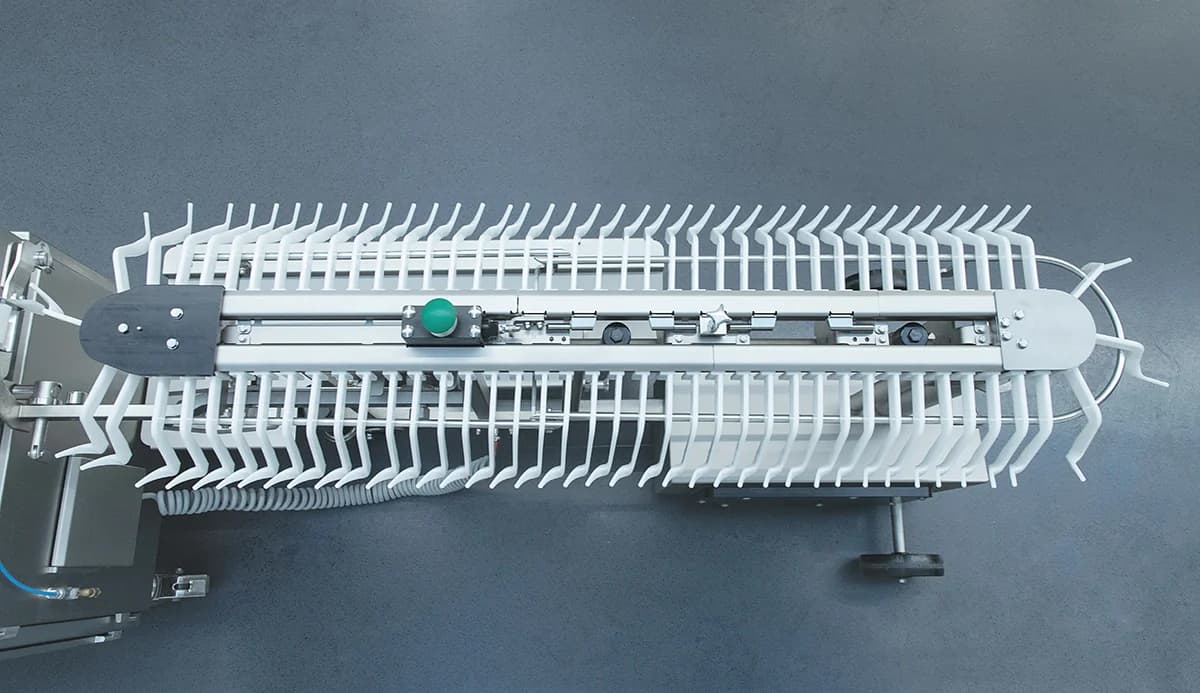
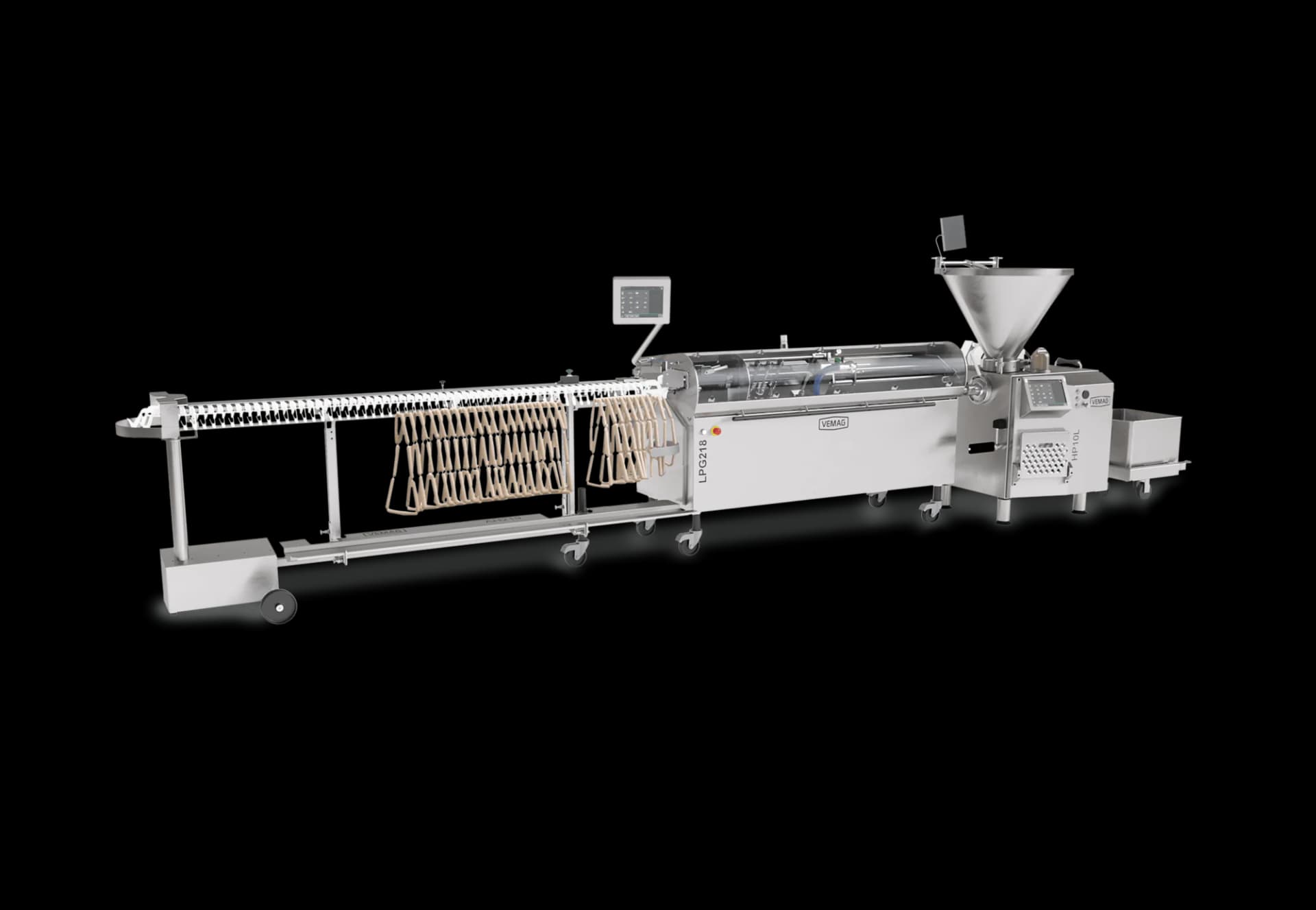
Hangers place linked strings on smoke sticks at a set spacing, so trolleys go into the smokehouse evenly loaded. The AH212, AH219, AH239 and AH249 are the hanging machines in the range, most with adjustable hook spacing; the CHL234 handles natural, collagen and peelable casings at 13–60 mm; the LPG218-AH219 pairs with the HP Sausage.
Co-extrusion in alginate
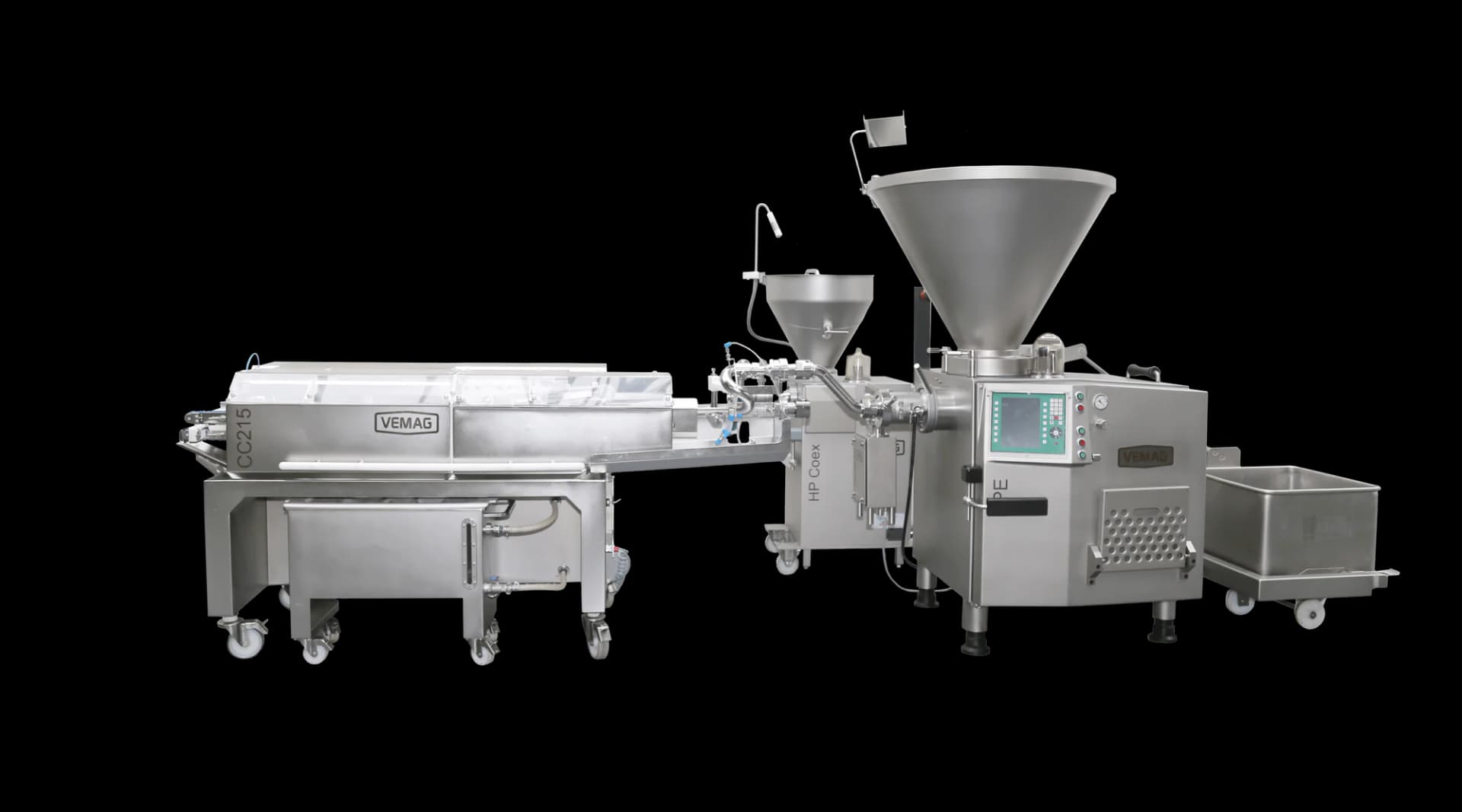
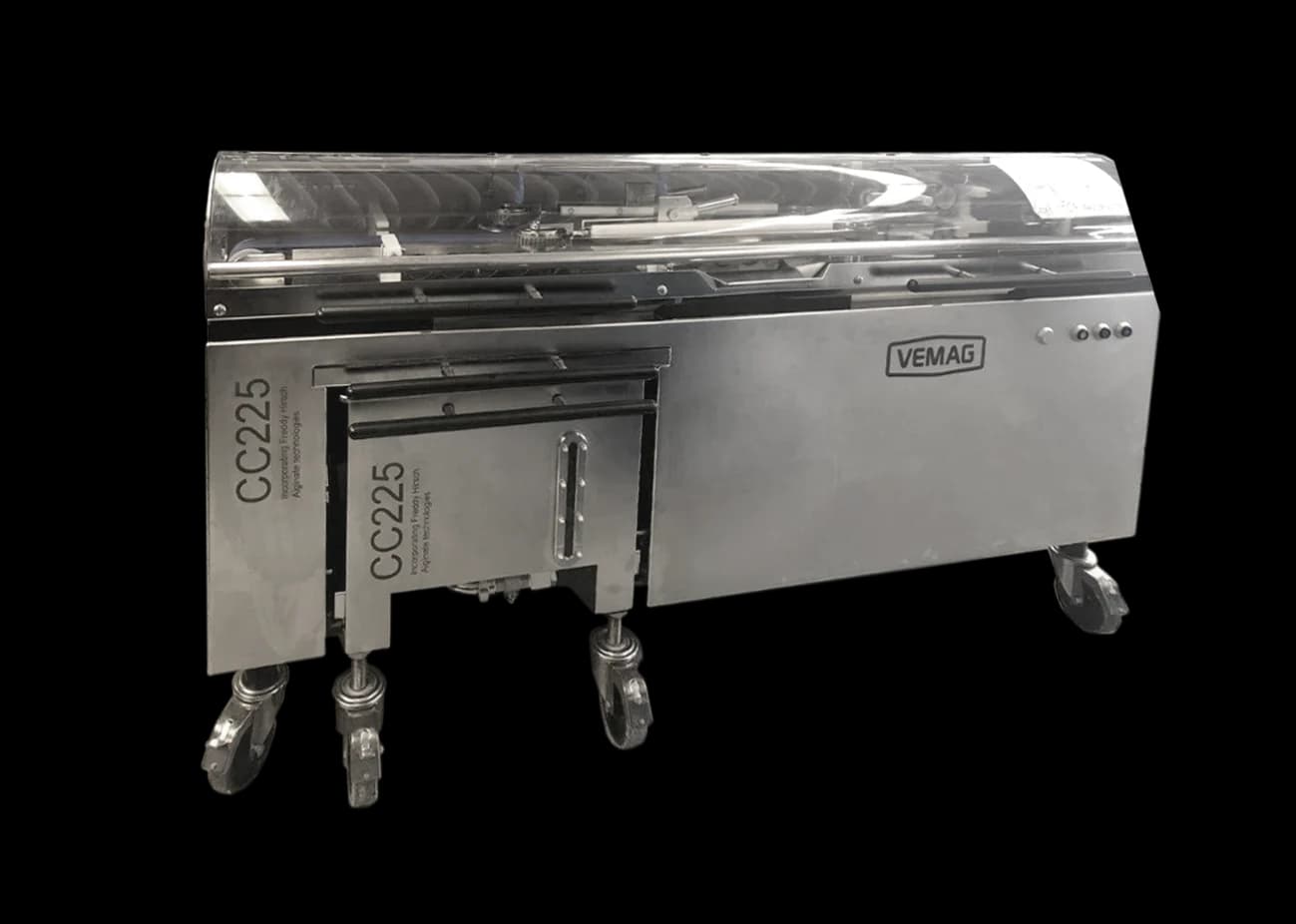
A co-extrusion line forms the casing around the meat as it fills, so there are no casing changes. The CC215 works at calibres of 8–32 mm; the CC225 uses extra-long dividing belts and is intended for cooked and heat-treated products.
Loading into packs
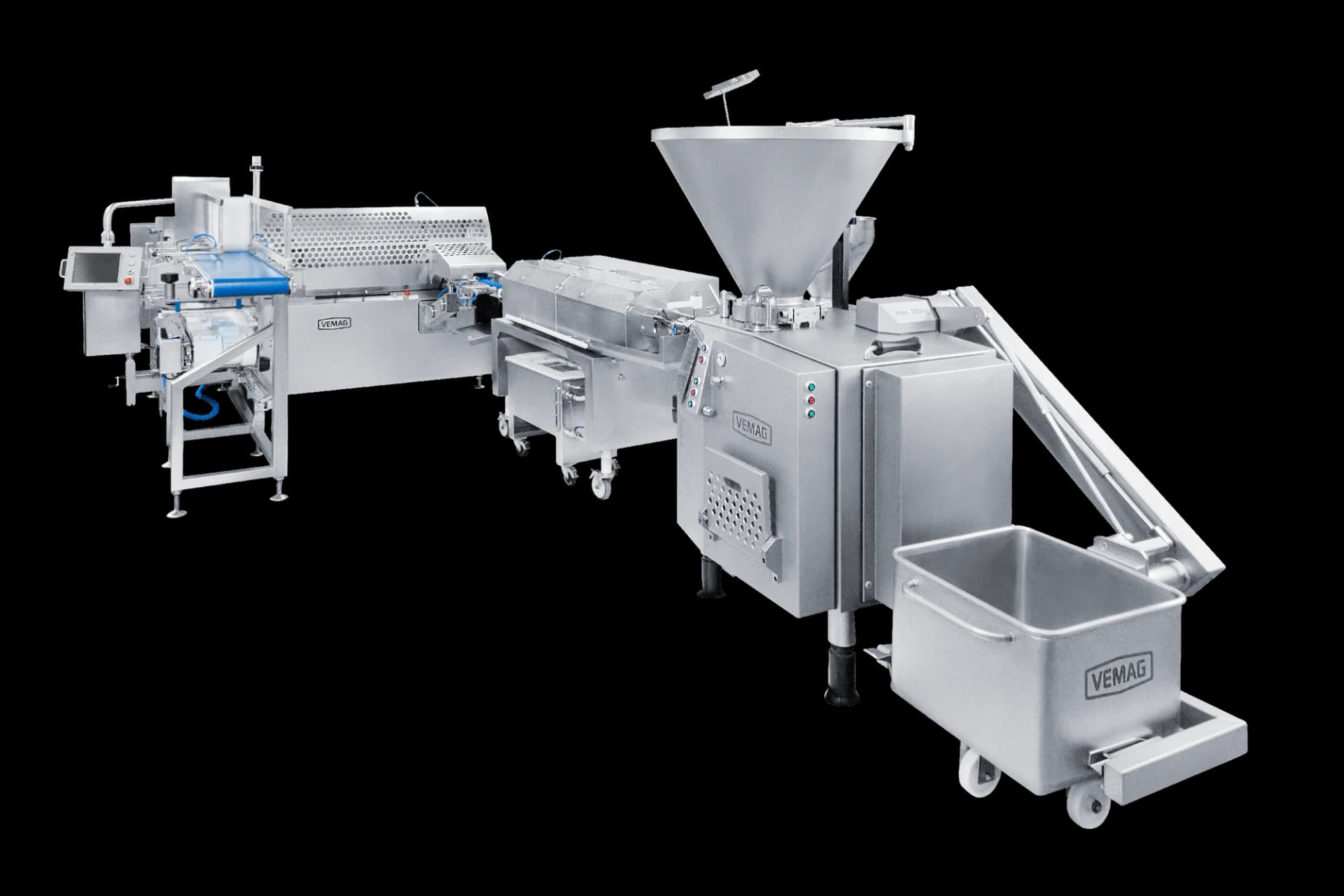
The LL335 link loader takes cut fresh sausages from the line, discharges broken portions and lays the rest in groups into trays or thermoformed pouches, with no manual handling before the pack.
- LL335Link Loader
Grinding on the filler
A grinding head on the filler outlet grinds to final particle size in the same pass as filling. The 980 fits the HP series and Robot 500, depending on product, and the 982 the HP series; both can separate bone and sinew, the 982 rind as well. See the filler attachments.
- Grinder 980Grinder Attachment
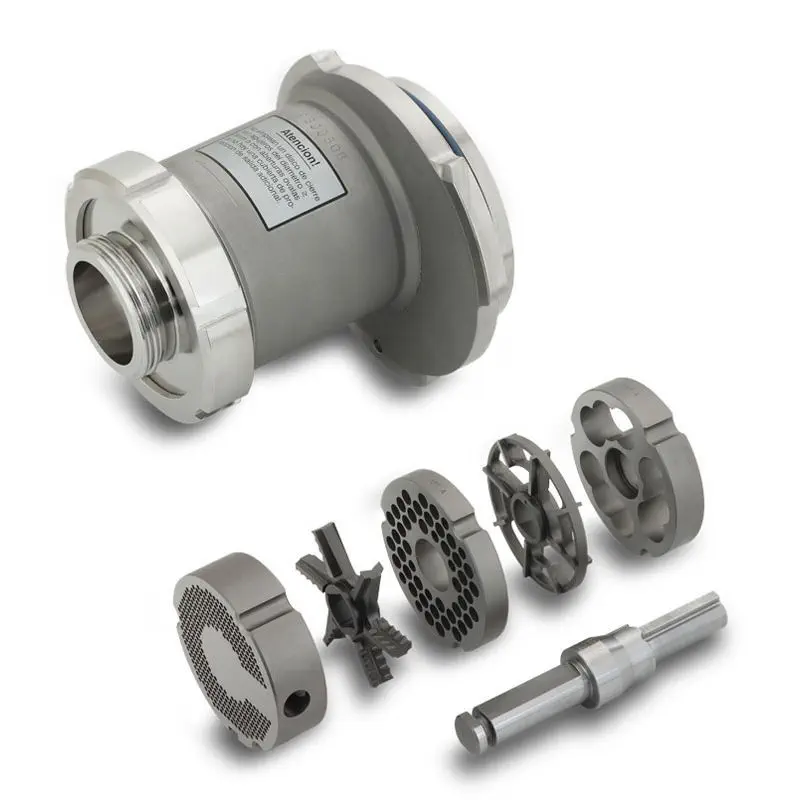
- Grinder 982Grinder Attachment
Video
See VEMAG sausage machines at work
These videos show the HP10L sausage filler and the LPG208 length portioning machine running.
VEMAG HP10LVacuum Filler
VEMAG LPG208Sausage Linking Machine
09The line
The rest of the line: from mincing to packing
A filler is one station in a longer process: meat is ground or cut before the hopper, and sausages are cooked, smoked or packed after the outlet. The food processing equipment guide covers the brands Vemag Australia represents across the whole line.
Upstream, Seydelmann grinders and bowl cutters prepare the meat, and on double-screw fillers a Grinder 980 or 982 head, or the inline grinder on the XP1 and XP2, can take on part of that work. Vemag Australia is the official distributor of VEMAG and Seydelmann in Australia and New Zealand.
Stage 01
Grinding
Grinders reduce trimmed meat and fat to the particle size the recipe needs, from coarse country-style mince to a fine grind ahead of the cutter.
9 machinesStage 02
Cutting and emulsifying
Bowl cutters chop, mix and emulsify meat into batter for frankfurts, kransky and other cooked sausages; many can work under vacuum, which reduces the air cut into it.
5 machinesStage 03Covered here
Filling and portioning
The vacuum filler takes the prepared mass, reduces trapped air and meters each portion into the casing or on to the next machine.
12 machinesStage 04
Linking, cutting and hanging
Linkers, length portioners, cutters and hangers turn the filled string into separate sausages, then load them onto smoke sticks or send them on towards packing.
22 machinesStage 05
Cooking, smoking and drying
Smokehouses and cooking chambers colour, flavour and cook the hung product, while climate chambers dry and ferment salami over much longer cycles.
2 machinesStage 06
Packing
Thermoformers and vacuum packaging machines seal fresh and cooked sausages into retail packs or bulk food-service packs, ready for chilled distribution.
18 machines
Where sausage meat is seasoned and minced in one step, the meat mixer grinder guide compares the Seydelmann mixing grinders by batch size and output.
10Hygiene
Hygiene, cleaning and changeovers
Every part that touches product — hopper, feeder, pump, vacuum path and horn — is cleaned at the end of each production day, and again at any changeover where one product must not carry into the next. Most of those parts come apart for washing, so over a year, how quickly a filler strips down and goes back together can matter as much as its rated output.
- Hoppers differ: the HP1 has a 105 l split hopper as standard, the DP6 a 250 l divided hopper (one-piece optional), and the HP10L offers a split hopper as an option.
- On VEMAG double-screw fillers, the double screw is removed and refitted in one piece.
- The HPnx fillers (HP10NX, HP20NX and HP30NX) have a flushable vacuum channel, and an optional cleaning station can be fitted on the outlet.
- For allergen changeovers, or a switch to a gluten-free or meat-free run, plan a full strip-down and wash, and schedule allergen-free products first.
- Before buying, ask to see the pump and hopper taken apart and reassembled, and time it: that is your daily routine.
11Applications
Fillers by sausage product
Each kind of sausage asks something different of the filler and the machines after it. These pages list the machines matched to each product, within the wider sausage processing equipment range.
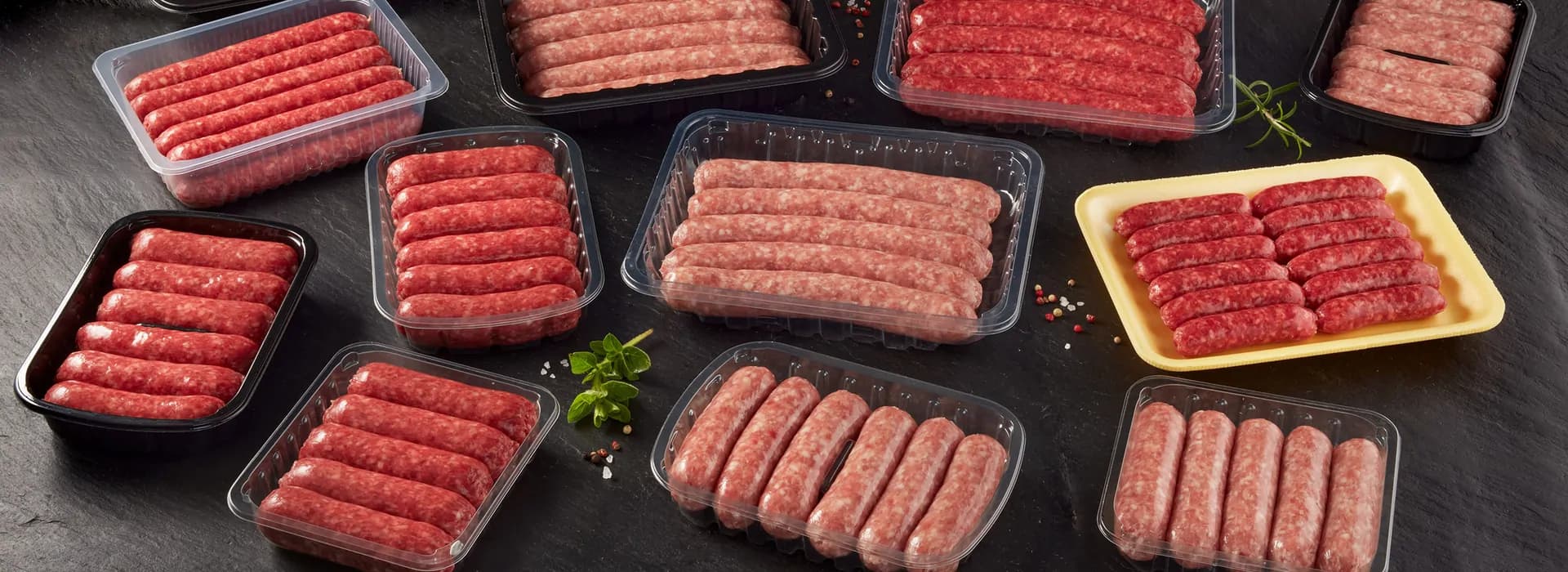
Fresh sausage
Raw links in natural or collagen casings for the counter and the supermarket, where even length, weight and fill are what shoppers notice.
45 machines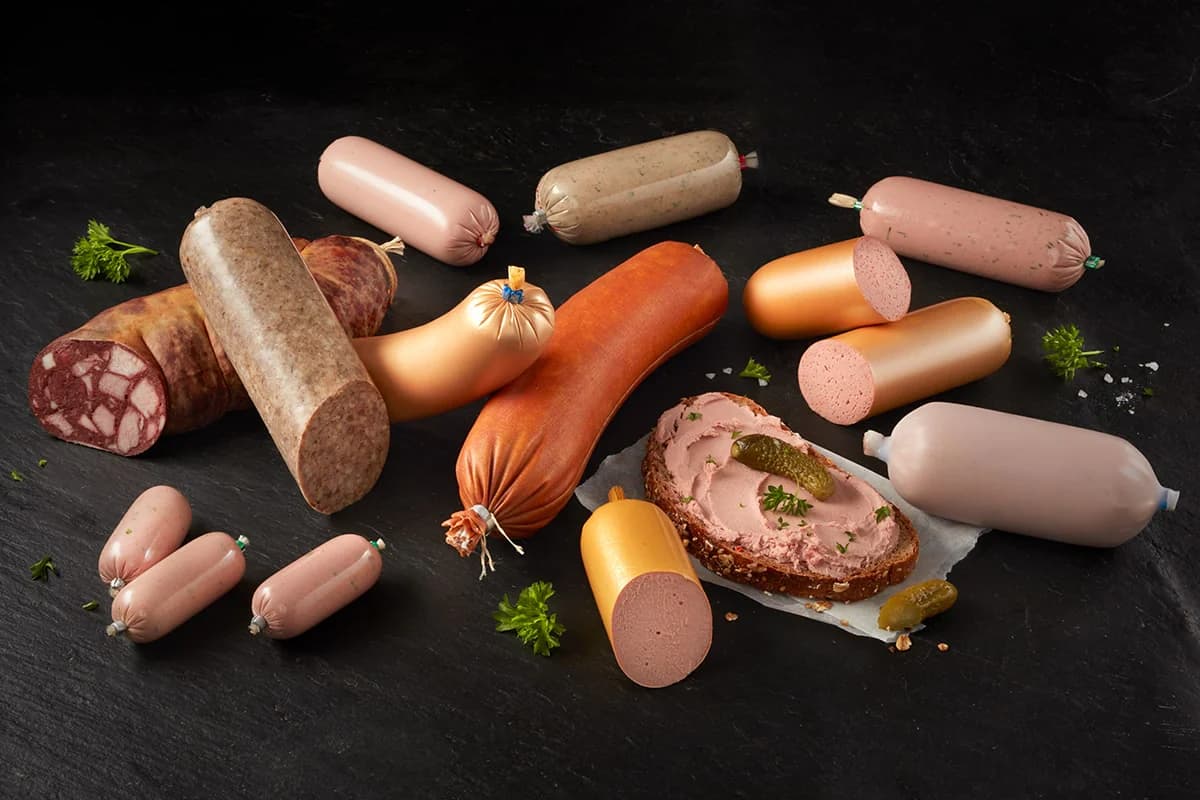
Smoked and cooked sausage
Frankfurts, kransky, hot dogs and cooked rings, hung, smoked and cooked after filling, so the linker and hanger must suit the smokehouse.
36 machines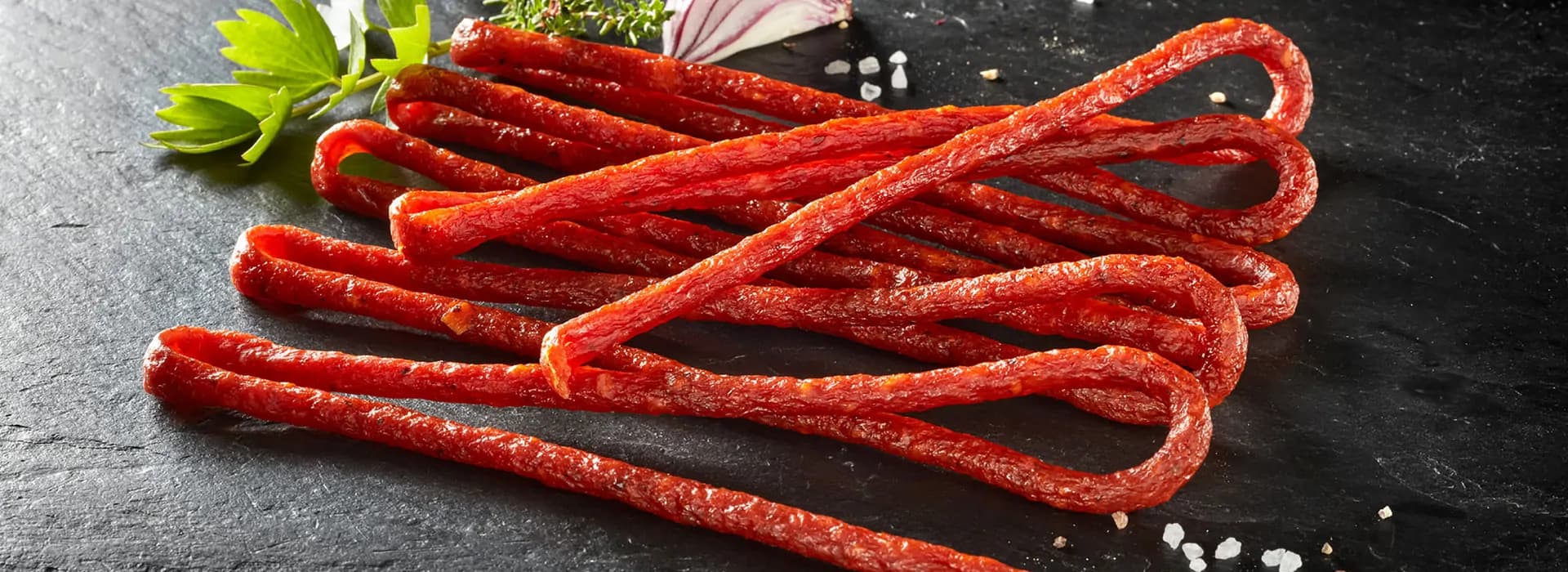
Snack sticks
Long, thin sticks with a tight weight target per piece, often filled into collagen casing and hung for smoking and drying.
28 machines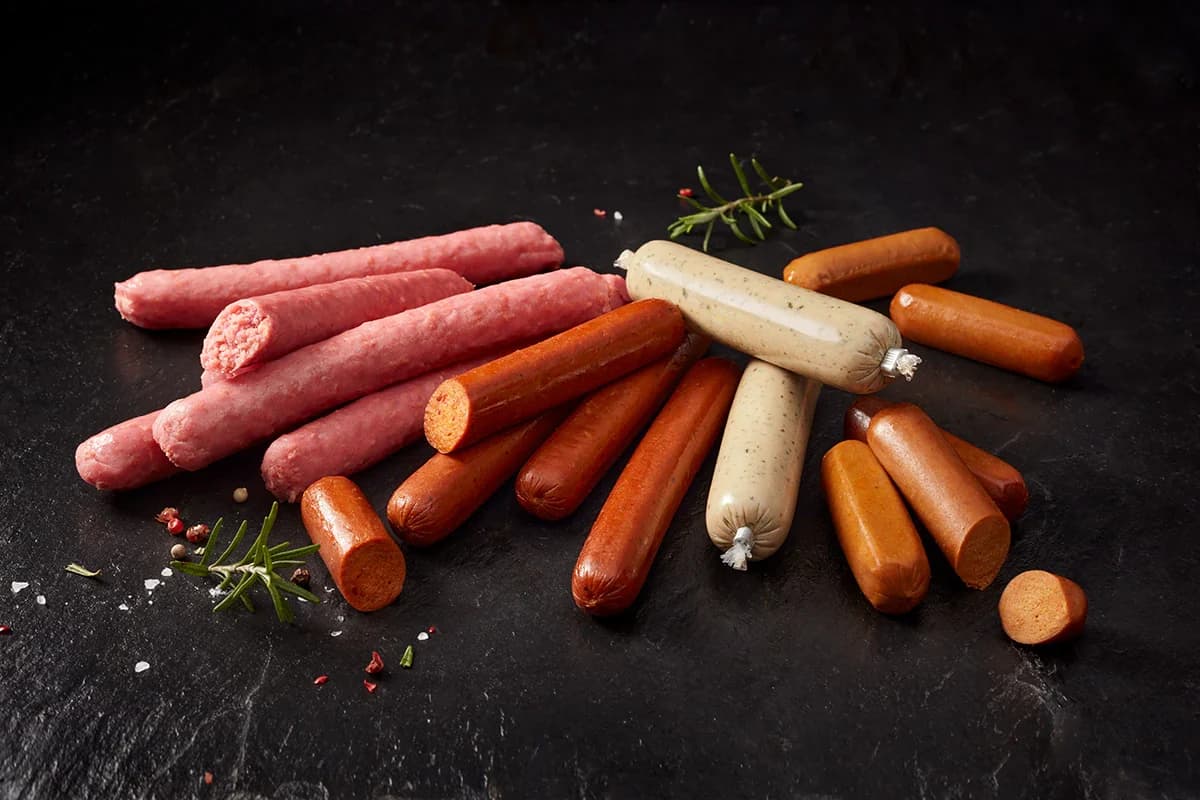
Alternative sausage
Plant-based and meat-free sausages, whose mixes behave differently from meat in the pump; alginate co-extrusion is one casing option.
26 machines
12Support
Trial your recipe, then keep it running
Vemag Australia has offices at Redland Bay, Queensland, and Rosedale, Auckland. Quotations are prepared for your production, from one filler to a complete line, and the sales team can arrange demonstrations.
01
Test your recipe first
Bring your own raw materials and recipe to the Customer Centre and try them on a range of machines in real production conditions, working through the application with specialists before you commit to an investment.
02
Servicing and repairs
Vemag Australia’s trained service technicians cover both Australia and New Zealand. They install new machines, clear faults, carry out repairs and maintenance, relocate machines, and train operators and maintenance staff.
03
Genuine spare parts
The local spare parts department keeps genuine components in stock, helps you identify the correct part for your VEMAG filler or attachment, and offers a blade sharpening service as well.
13FAQs
Sausage filler questions
Is a sausage filler the same as a sausage stuffer?
Yes, the two names describe the same machine. The second is the American term; butchers and smallgoods makers in Australia and New Zealand say filler, or sausage filling machine. A commercial vacuum filler does more than push meat into a casing, though: it meters each portion and can feed a linking line.
Should I choose a vacuum filler or a hydraulic sausage filler?
Decide on volume, how closely portions must match their target weight, whether the filler feeds a linker, and whether it must run without stopping to reload. A hydraulic piston filler suits batch work with hand linking; a vacuum filler suits daily production and linking lines. “Hydraulic” describes the drive: the VEMAG Robot 500 is a vacuum filler built on a hydraulic system. See the filler types table.
How much does a commercial sausage filler cost?
Vemag Australia does not publish prices; each filler is quoted to the enquiry. The figure depends on output, pump type, hopper size, the linking, hanging or cutting machines alongside, the attachments you need, and installation and operator training. Describe your products and weekly volumes when you request a quote, whether for one machine or a complete line.
What size sausage filler does a butcher shop need?
Work from your batch size, weekly kilograms and how often you change product. For shop volumes, start at the compact end of the VEMAG range: the Lucky Linker (40 l hopper, linking built in), Robby (105 l hopper, rotary vane pump) or the HP1 (105 l split hopper). The butcher shop tier sets them beside the DP6 and Robot 500.
How many kilograms of sausages can a filler make per hour?
Among the VEMAG fillers Vemag Australia lists, published maximum filling rates run from 2 t/h on the Lucky Linker to 25 t/h on the XP1; the Robot 500 and XP2 have no published rate. Real hourly output is lower once casing changes, product changeovers, cleaning and waits for meat are counted, and thin casings run slower than wide ones. The model comparison lists every published figure.
Can one filler run natural, collagen and cellulose casings?
Yes. The filler meters the mass the same way whatever the casing; the horn, casing holder and linking machine are what change. The LPG208 and LPG209, for example, take all three at calibres of 13–40 mm. Natural casings vary in diameter along their length, which is where portioning by length helps keep links even.
What is co-extrusion, and do I need it?
Co-extrusion makes the casing at the horn: a thin alginate gel is extruded around the meat as it fills and then set, so there is no casing to load or change. It suits long runs of a uniform product, and VEMAG’s CC215 works at calibres of 8–32 mm. If you sell in natural casings or change products often, filling into casings with a linker may suit better.
Does a vacuum filler remove all the air from sausage meat?
No. The vacuum reduces trapped air as the mass enters the pump, giving a denser fill and more consistent portions, but some air remains. How much depends on the recipe and how it was prepared; cutting or mixing under vacuum beforehand reduces it further, which is why many bowl cutters can work under vacuum.
Can a sausage filler make plant-based sausages or other products?
Yes. A vacuum filler meters any mass it can pump, so it can fill plant-based mixes into casings or alginate, and with other attachments it can portion, form or deposit products beyond sausages. Plant-based mixes behave differently from meat, so trial yours first; the alternative sausage page lists the matching machines.
How is a sausage filler cleaned?
At the end of each production day, and at any changeover where one product must not carry into the next, the hopper, feeder, pump and horn are taken apart or opened and washed, following the manufacturer’s instructions for that model. Allow for strip-down and rebuild time, not only the wash. Vemag Australia’s service team offers operator and maintenance training.
Can I test my sausage mix before buying?
Yes. At the Customer Centre you can put your own raw materials and recipe through several machines in real production conditions, with specialists working on the application alongside you. Bring your usual casings too, so the trial shows how your product fills, links and portions before you commit.
Do you service sausage fillers in New Zealand?
Yes. Vemag Australia’s service technicians cover New Zealand as well as Australia, and there is an office in Rosedale, Auckland. They install, maintain, repair and relocate the machines Vemag Australia supplies and train operators, and the spare parts department keeps genuine components in stock.