
01Definition
What a meat mixer grinder (mixer mincer) does
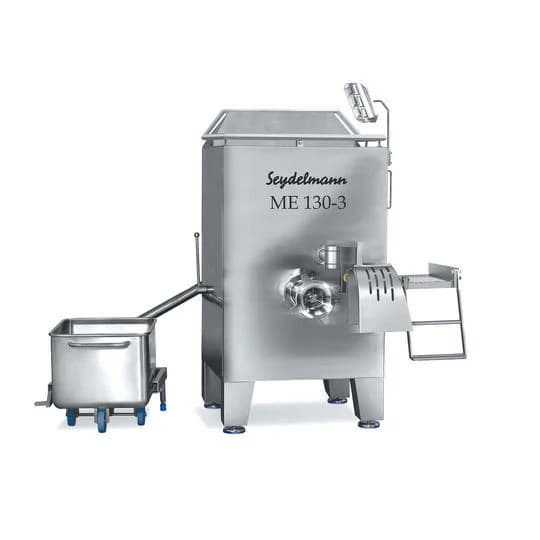
A meat mixer grinder is industrial meat equipment that mixes and minces in one machine. A mixing unit in the hopper turns meat, fat and seasoning into an even batch; a working worm then carries it through the cutting set, where knives turn against a hole plate. Seydelmann calls it a mixing grinder; many butchers say mixer mincer.
Because the hopper that mixes also feeds the worm, a batch goes from loose trim to finished mince without being tipped into a second machine. That saves a transfer, a tub and a wash-down, and salt, seasoning and fat are already spread through the meat when the knives reach it.
A plain grinder only reduces meat; a mixing grinder also does the mixing. A bowl cutter chops with fast-turning knives and can take a mix all the way to a fine batter, while a mixing grinder keeps a distinct grain. The side-by-side comparison weighs these machines against each other.
02Options
Mixer grinder, grinder, bowl cutter or separate mixer?
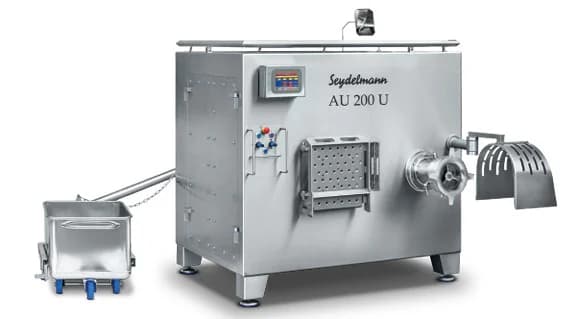
Several machines reduce meat; they differ in what else they do to it. A grinder with a feeding worm carries big pieces to the working worm without bridging. A universal grinder cuts fresh meat, cooked meat and frozen blocks on one worm and plate system. A bowl cutter chops as its bowl turns and can go all the way to a smooth batter. A grinding head on a vacuum filler minces while the filler portions. Only the mixing grinder mixes in its own hopper.
The other common route uses two machines: a standalone mixer seasons the batch, which is then tipped into a grinder for the final mince. Each job gets its own capacity, and one mixer can supply more than one grinder. The cost is a second handling step, a second machine to wash, floor space for both, and a batch that can warm while it waits. Grinding first and mixing afterwards also works, but it puts the finished grain through the mixing action.
| Row | Mixing grinder | Grinder with feeding worm | Universal grinder | Bowl cutter | Grinding head on a filler |
|---|---|---|---|---|---|
| What it does to the meat | Mixes the batch in the hopper, then minces it through the cutting set | Minces; a conical feeding worm pushes large pieces towards the working worm | Minces fresh, cooked and frozen material on one worm and plate system | Cuts with fast-turning knives as the bowl carries the mass around | Minces at the filler outlet as the product is portioned |
| Mixing | Built in: two arms, or paddles as an option | None; mixing happens in another machine | None built in | The knives mix as they chop | None; the mass reaches the filler already mixed |
| Large or frozen pieces | Fresh, slightly frozen and cooked material; not frozen blocks | Large pieces without bridging; some models also take frozen material | Takes frozen meat blocks | Varies by model; some take pre-cut frozen meat | Only the mass the filler feeds it; not a route for frozen blocks |
| Typical result | Evenly mixed mince at its final grain | Mince at the plate’s grain, mixed elsewhere | A uniform grain from varied raw material | Anything from a coarse chop to a smooth emulsion | Mince ground to final size straight into portions or casings |
| Suits | Burger mince, sausage meat and seasoned mixes made batch by batch | High volumes of plain mince, and pre-grinding | Mixed fresh and frozen raw material in large volumes | Frankfurts, pâté and other finely cut products | Mince and sausage lines built around a double-screw filler |
| Batch or continuous | Batch: load, mix, then mince | Continuous for as long as it is fed | Continuous while material keeps coming | Batch, one bowl at a time | Continuous, in step with the filler |
In the Vemag Australia catalogue
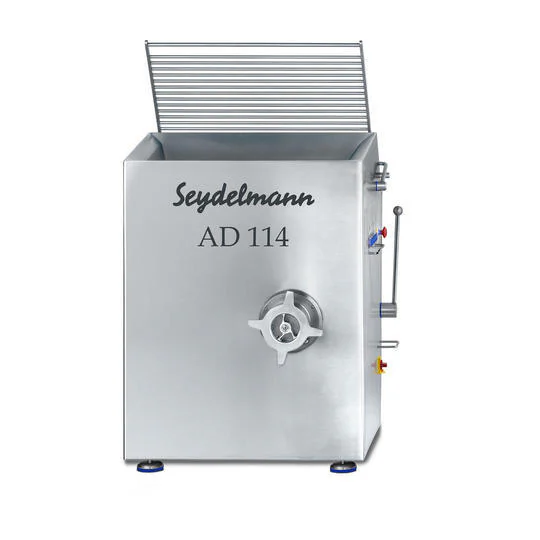
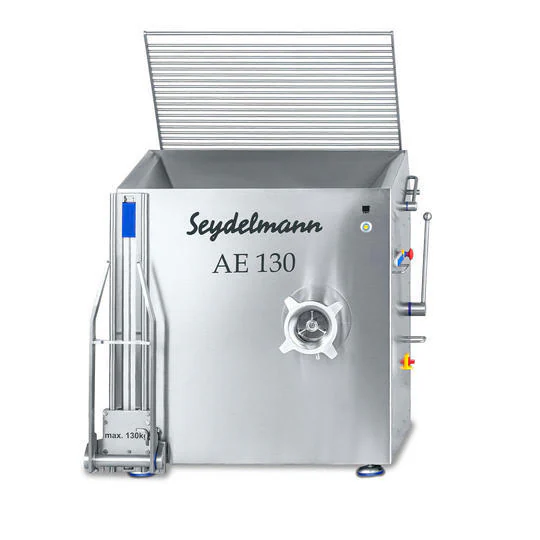
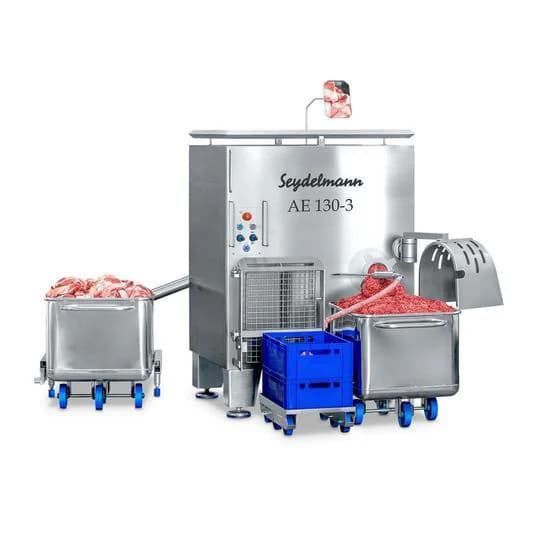
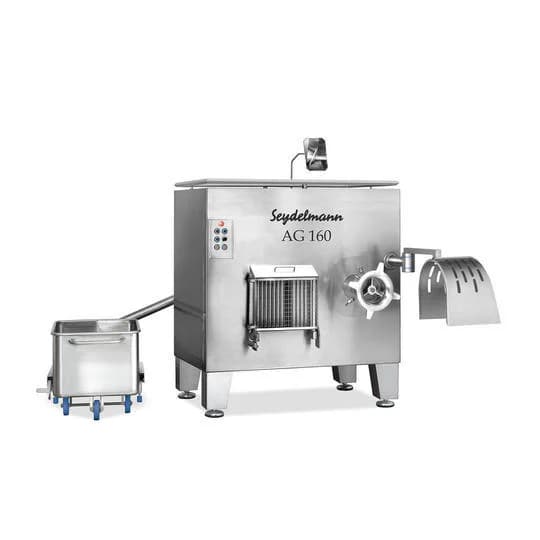
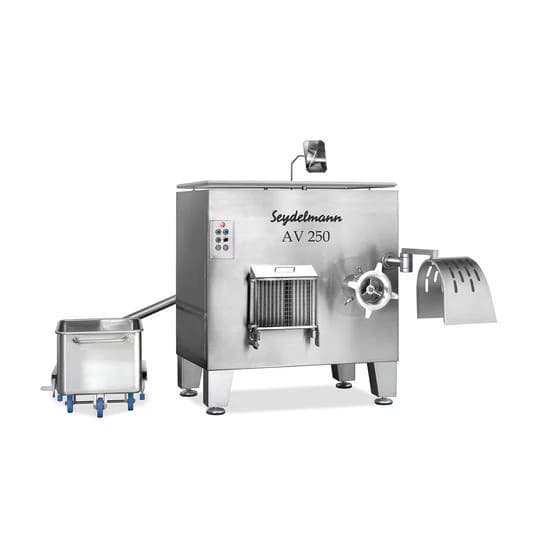
Universal grinder
Bowl cutter
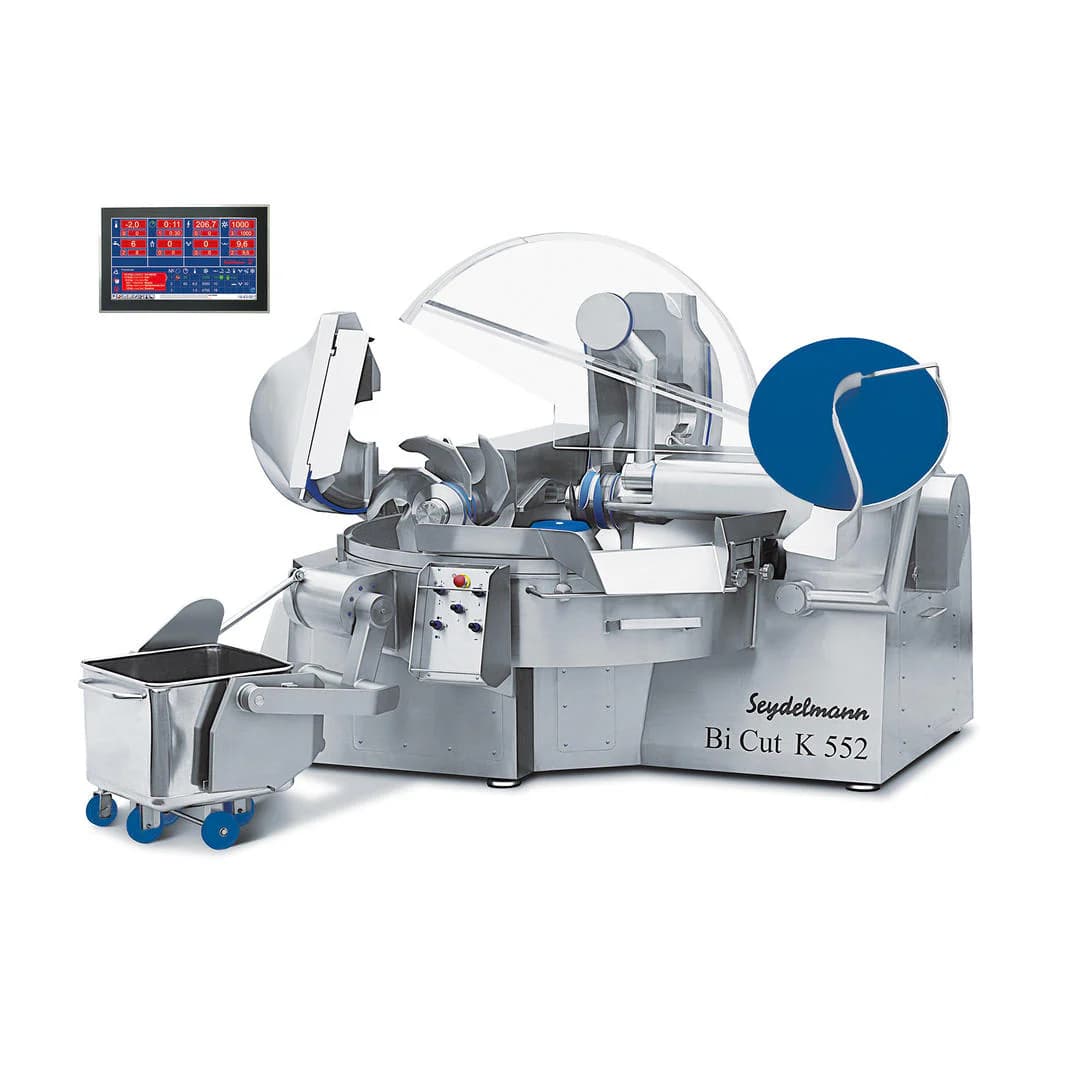
- Bi-Cut K 552 AC-8Bowl Cutter
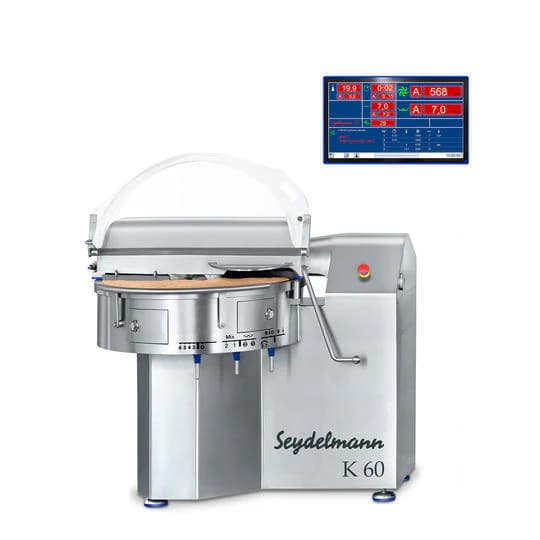
- K 60 High-Efficiency CutterBowl Cutter
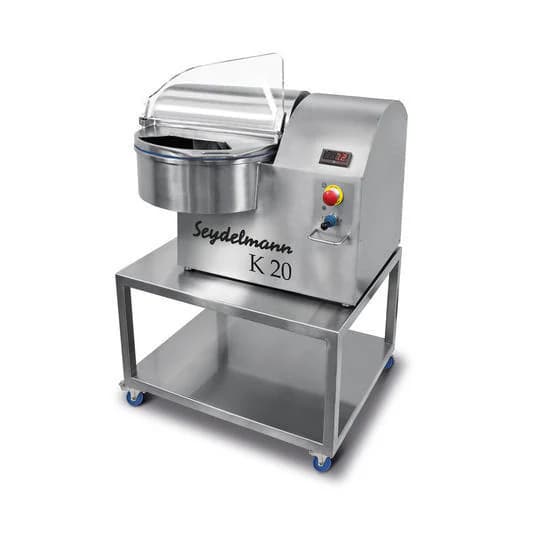
- K20Bowl Cutter
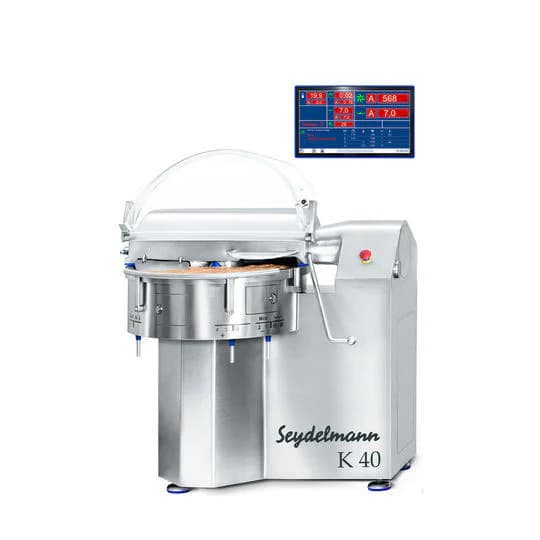
- K40Bowl Cutter
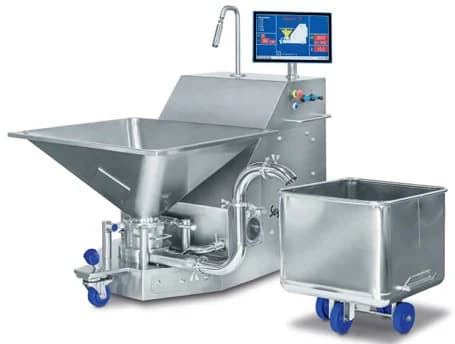
- KK 144 C Vacuum Konti KutterEmulsifier
Grinding head on a filler
- Grinder 980Grinder Attachment
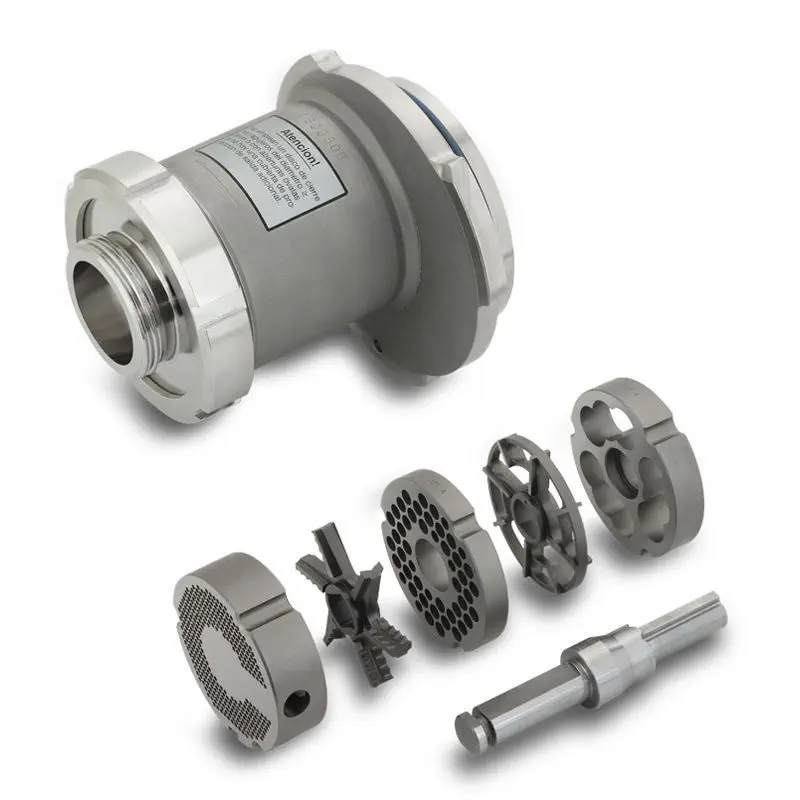
- Grinder 982Grinder Attachment
The catalogue machines of each kind are listed above, under the same headings as the table. If most of your volume is plain mince, a grinder with a feeding worm may be enough; if nearly every batch is seasoned before the final grind, a mixing grinder saves a machine and a transfer. For emulsified products, look at the bowl cutter range.
03How it works
How a meat mixer grinder works
Every batch follows the same path through a mixing grinder. The drawing numbers the five parts it passes, and each step below explains one of them.
Hopper and mixing unit
Trim, fat and dry ingredients are loaded into the hopper, where the mixing unit turns them over until the batch is even. On the Seydelmann machines that unit has two strong arms as standard, with paddles as an option, and the mixing is done before the meat is ground.
Safety guard
The mixing unit runs behind a safety guard with a switch-off contact, so no one can reach a hand into the running arms or paddles. Treat the guard as part of the daily pre-start check, never as an obstacle to work around.
Working worm
At the base of the hopper, the working worm draws the mixed batch forward and presses it into the cutting set. It runs at two speeds, and a short-time reverse gear backs it off briefly, which helps free a build-up at the head before it drives forward again.
Cutting set
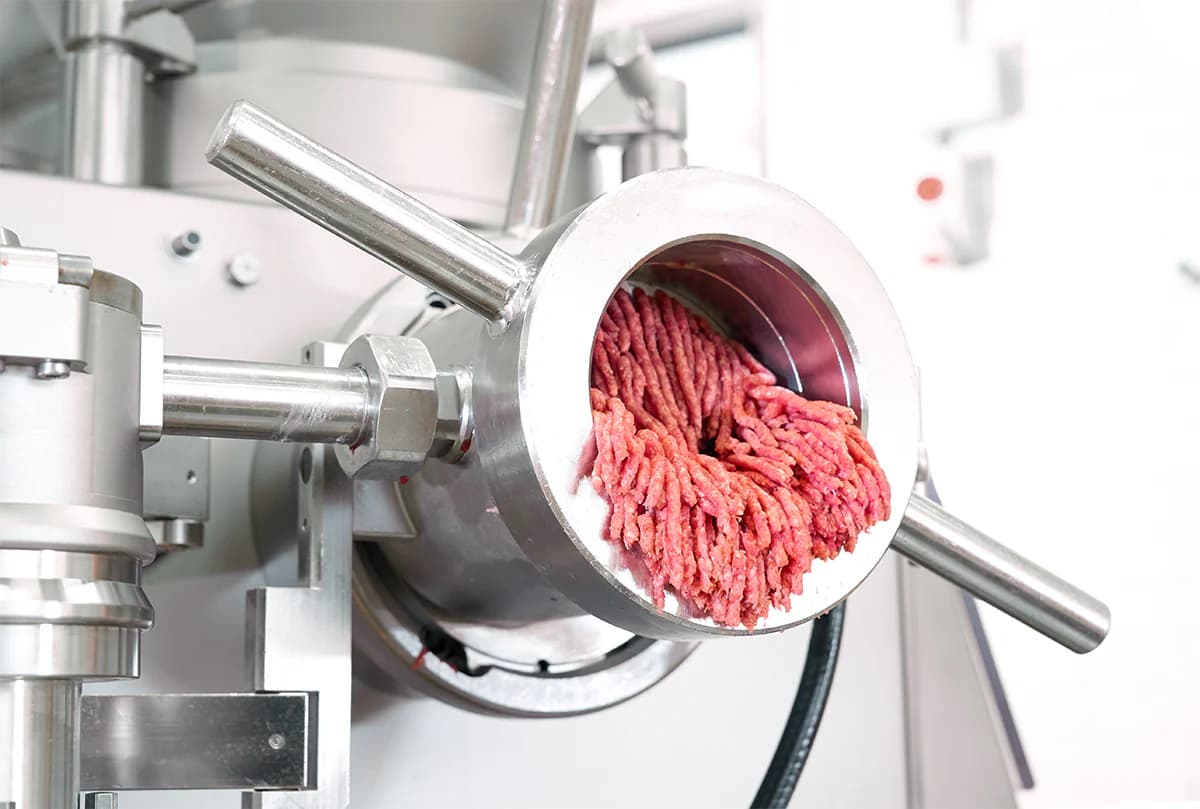
In the head, a pre-breaker typically opens up the mass first; then one or more knives sweep across the face of the hole plates, shearing the meat as it is pressed into the holes, and the final plate sets the grain. An optional separating set holds back hard particles such as bone and sinew.
Outlet
The minced product leaves the head at its final grain and already mixed, so it can go straight to the filler, the burger former or the pack. Plan a tub, trolley or conveyor at outlet height so nothing waits on the machine.
04Mixing tools
Mixing arms or paddles
Seydelmann equips the mixing unit with two strong arms as standard and offers paddles as an option. Its data does not rank one above the other, and on paper neither should you: the right tool depends on how firm, sticky, wet or delicate your mix is.
The notes below describe, in general terms, how each tool moves the mass. To choose, run your own recipe with each where you can and compare the batches: how evenly the seasoning spreads, how the fat looks at the plate, how the mince holds together. Trials and support explains how to ask about a demonstration or trial.
Fitted as standard
Mixing arms
In general terms, mixing arms sweep through the hopper and fold the batch over itself. A narrower tool can pass through a heavy, firm mass without pushing all of it at once, so pieces of trim keep circulating and salt, seasoning and fat are carried through the whole batch. Seydelmann does not publish the shape of its arms, so judge them on your own mix.
Optional
Mixing paddles
In general terms, a paddle presents a broader face to the mass than an arm, so each pass moves a larger share of the batch; some producers prefer that for soft or wet mixes that slide around a narrower tool. Settle the configuration when the machine is specified, ideally after seeing both on your own raw material.
05Batch size
Mixing capacity vs hopper volume
A mixing grinder’s data sheet carries two capacity figures, and only one of them is your batch. Hopper content, in litres, is how big the hopper is. Mixing capacity, in kilograms, is the load the mixing unit is published to handle. Plan every batch on the kilograms.
Seydelmann does not say why the hopper holds more than the mixing unit is rated for, but in general a mixer needs free space above the batch. Fill the hopper to the brim and the arms or paddles have no room to lift and turn the mass: material near the top rides around unmixed, and seasoning ends up patchy through the grind.
The pattern holds across the range: the MD 114 lists a 75 l hopper for 50 kg of mixing capacity, the ME 130 has 170 l for 100 kg, and the ME 130-3 has 300 l for 150 kg. An 80 kg batch would need splitting into two loads on the MD 114 but goes into the ME 130 in one, and split halves can come out slightly different.
06Cutting sets
Cutting sets, hole plates and separating sets
The cutting set decides the grain of the mince. It starts with a pre-breaker, which opens up the mass as the worm drives it into the head. A knife then sweeps across the face of a hole plate, shearing the meat off as the worm presses it into each hole. In a longer set, an intermediate plate and a second knife cut the product again before the final hole plate sets its size.
VEMAG’s published data for its Grinder 980 and Grinder 982 grinding heads shows the two usual layouts. A 3-part set is a pre-breaker, a blade and a final hole plate. A 5-part set is a pre-breaker, blade 1, an intermediate plate, blade 2 and the final hole plate: two cutting stages, generally chosen for a finer or more even result in one pass. The sets for each Seydelmann mixing grinder are settled when the machine is specified.
The number in each Seydelmann model name matches its published hole plate diameter: 114 mm on the MD 114, 130 mm on the ME 130 and ME 130-3. That is the plate’s outside size, which decides which plates and knives fit; it says nothing about the holes. A separating set, optional on all three, holds back bone, cartilage and sinew at the plate; on the Grinder 982, separation takes out rind too.
Cutting sets, as published for the Grinder 980 and Grinder 982 heads
3-part set
- Pre-breaker
- Blade
- Final hole plate
5-part set
- Pre-breaker
- Blade 1
- Intermediate plate
- Blade 2
- Final hole plate
In the order the meat passes through them. With separation, the last blade and plate become a separation blade and separation plate. See the Grinder 980 and Grinder 982.
| Plate | What it gives | Typical uses |
|---|---|---|
| Coarse | Large, distinct particles with visible fat and a loose, open bite | Chunky and country-style sausages, coarse burger mince, and a first pass before a finer plate |
| Medium | An even grain that binds together but still shows some texture | Everyday burger patties, retail mince, rissoles and fresh sausage meat |
| Fine | A close, smooth texture with little visible fat | Finer fresh links, meatballs, fillings and cooked products |
| Separating set | Mince with hard particles such as bone chips and sinew held back | Trim that may carry bone or tough sinew, where the finished mince must be free of them |
Treat the table as a starting point. Your raw material and the product you sell set the plate; settle it by grinding trial batches on two or three plates and comparing the mince — and the fat — from each.
07Temperature
Temperature, frozen material and fat smear
A clean cut depends on three things you control: cold raw material, a sharp knife sitting flat against its matching plate, and a batch that is not worked longer than it needs. When fat warms and softens, the knife drags it instead of slicing it and spreads a thin film over the lean. That is fat smear: a greasy, pasty look that can also dull the colour and weaken the bind.
Worn knives, a knife and plate that no longer meet evenly, and trim that has sat out of the chiller all make smear more likely. Mixing adds friction of its own, so mix until the batch is even, then grind.
On frozen material, read the data closely. Seydelmann publishes its three mixing grinders for fresh meat, slightly frozen meat and cooked products, as well as liver and spinach; none of the three names frozen blocks or a sub-zero temperature, although Seydelmann’s general grinder text also mentions frozen meat. Several grinders with a wide conical feeding worm, and the universal grinder, do name frozen material, from frozen pieces down to −10 °C on the AE 130 to frozen meat blocks on the AU 200 U. Each is listed below with its published wording.
- Keep trim and fat in the chiller until the batch is loaded.
- Have knives and plates reground as matched pairs, so each knife sits flat on the plate it runs against.
- Mix until salt and seasoning are evenly through and the mix has the bind the product needs; beyond that, extra time in the hopper mainly adds warmth.
- Look at the first mince off the plate: separate, clean-edged particles show a clean cut, while a greasy film points to smear.
- Where one pass would load the knife too heavily, many producers grind coarse first and finish on a finer plate.
The mixing grinders take
“fresh meat and slightly frozen meat as well as cooked products”
In the words of the MD 114, ME 130 and ME 130-3 data.
08Sizing
Sizing a meat mixer grinder
Size a mixer mincer on two numbers: the kilograms in your usual batch, which the mixing capacity must cover, and the kilograms an hour you need through the plate. Treat published hourly output as a ceiling, not a working rate: loading, mixing, emptying and cleaning all eat into a working hour. The model comparison sets the three side by side.
Then look at the whole day: how many mixes you run, how often the machine is stripped between them, how it is loaded, and where the mince goes next. One size up can cost less in lost time than a smaller machine run at split batches, but a batch far below the mixing capacity may not turn over as well in a large hopper.
Tier 150 kg batches
Meat mixer grinders for butcher shops and smallgoods kitchens
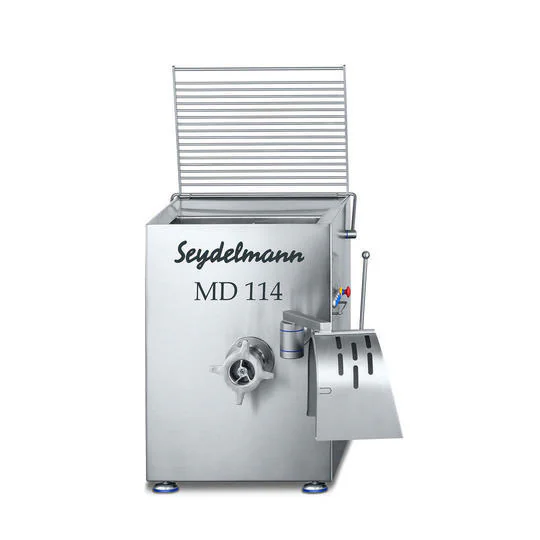
A shop or smallgoods kitchen usually mixes one recipe at a time — burger mince, pork sausage meat, a batch of rissole mix — and changes flavour several times a day. The MD 114 is the compact end of the range: a 114 mm plate, 50 kg of mixing capacity in a 75 l hopper, a published hourly output of 1,000 kg/h, a 7/9 kW motor with a two-speed working worm, and 580 kg on the floor. It suits batches counted in tens of kilograms. It is the smallest mixing grinder in the range, so a shop mixing only a few kilograms at a time may be better served by a plain grinder and a separate mixer.
Tier 2100 kg batches
Meat mixer grinders for mince and burger production
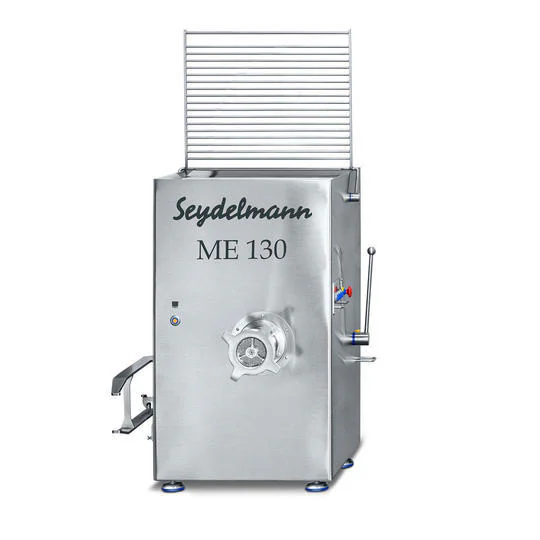
Once mince and burger mix go out to other shops, food service or retail packs, batches grow and the grinder often feeds a former or filler rather than the counter. The ME 130 steps up to a 130 mm plate, a 170 l hopper and 100 kg of mixing capacity, with a published hourly output of 3,000 kg/h from a 14/18 kW drive, and it weighs 750 kg. Its 100 kg batch is double the MD 114’s, which counts when a forming line is waiting on the next load.
Tier 3150 kg batches
High-volume meat mixer grinders
When a plant runs long shifts on a few recipes, batch size starts to matter more than grinding speed. The ME 130-3 keeps the ME 130’s 130 mm plate, 3,000 kg/h published output and 14/18 kW drive, but carries a 300 l hopper and 150 kg of mixing capacity. It weighs 950 kg, or 1,100 kg with a loading device, so check floor loading early. The bigger batch means fewer loads per shift at the same published output, not a faster grind.
Before you buy
Mixer grinder buying checklist
- Your usual batch in kilograms, against the published mixing capacity, not the hopper litres.
- The hourly output you need once loading, mixing and cleaning are counted.
- Whether the mixing unit can run on its own with the worm stopped, so a batch can be mixed and checked before any of it is minced.
- Whether the knives and plates you already own fit the new head’s 114 mm or 130 mm cutting system, or a full new set is needed.
- The cutting sets to be supplied with the machine: how many knives and plates, and which final plates.
- Standard arms or optional paddles, decided after seeing both on your recipe where possible.
- Your raw material: fresh, slightly frozen or cooked, or frozen blocks that need a different kind of grinder.
- Whether your trim calls for a separating set.
- How batches reach the hopper, and for the ME 130-3 whether a loading device suits your room.
- Floor space, floor loading and the electrical supply where the machine will stand.
- How long the hopper, mixing unit, worm and cutting set take to clean, and which parts come out, watched and timed before you order.
- A trial or demonstration with your recipe, servicing across Australia and New Zealand, and access to spare parts and blade sharpening.
09The range
The Seydelmann mixing grinders compared
The table lines up the three Seydelmann mixing grinders in the Vemag Australia catalogue on the figures a purchase turns on: hole plate diameter, published hourly output, motor rating, hopper content, mixing capacity and weight. Below it, a chart places them by output among every grinder in the catalogue that publishes an hourly figure, so you can see where the mixing grinders sit among the feeding-worm and universal grinders.
| Model | Hole plate | Output | Motor | Hopper | Mixing capacity | Weight |
|---|---|---|---|---|---|---|
| MD 114Butcher shops and smallgoods kitchens | 114 mm | 1,000 kg/h | 7/9 kW, two-speed worm | 75 l | 50 kg | 580 kg |
| ME 130Mince and burger production | 130 mm | 3,000 kg/h | 14/18 kW, two-speed worm | 170 l | 100 kg | 750 kg |
| ME 130-3High-volume batches | 130 mm | 3,000 kg/h | 14/18 kW, two-speed worm | 300 l | 150 kg | 950 kg; 1,100 kg with loading device |
kg/h, as published
Published as a range, charted at its maximum: AU 200 U 6,000–16,000 kg/h.
The figures are the manufacturer’s published data, and the hourly outputs are ceilings rather than working rates. What a machine achieves in your plant depends on the product, the plate and cutting set fitted, and the raw material’s temperature, so read the table as a guide to scale and ask whether your own recipe can be trialled at the Customer Centre.
10The line
Where a mixer grinder sits in the line
In a typical line the mixing grinder sits between the chiller and the machine that fills or shapes the product: trim and fat go in, seasoned mince at its final grain comes out. It is common practice to pre-grind trim coarse on one of the plain grinders first, then mix and finish it on the mixing grinder, spreading the cutting over two passes.
The other route is a grinding head mounted on a double-screw vacuum filler. VEMAG’s Grinder 982 suits the HP series and grinds at up to 8.7 t/h, depending on product; with its separation device it also takes out bone, rind and sinew. The Grinder 980 suits HP series fillers and the Robot 500, depending on product, reaching up to 4 t/h with optional separation. Both grind to final size while the filler portions, but neither is a mixer, so the mass still needs mixing upstream.
Stage 01Covered here
Mixing and grinding
A standard grinder can pre-cut trim coarse, and the mixing grinder then seasons, mixes and minces each batch to the grain the product needs.
9 machinesStage 02
Emulsifying
For frankfurts, pâté and other fine products, a bowl cutter takes the meat past mince to a smooth batter, often starting from a coarse pre-grind.
5 machinesStage 03
Filling and portioning
A vacuum filler takes the finished mince into its hopper, draws off air trapped in it, and meters it into casings, trays or forming devices.
12 machinesStage 04
Forming burgers
Patties, meatballs and other portions are shaped from the minced mass to a set weight, so an even mix at the grinder shows up as even portions here.
15 machinesStage 05
Linking and hanging
Once filled, sausage meat from the mixing grinder is twisted into links, divided to length or hung on smoke sticks on its way to cooking.
22 machinesStage 06
Packing
Mince, patties and sausages are sealed into retail trays or bulk food-service packs on a thermoformer or other packaging machine before chilled dispatch.
18 machines
11Hygiene
Hygiene and cleaning
A mixing grinder has more product-contact surface than a plain grinder: the hopper and mixing unit as well as the worm, its housing and every piece of the cutting set. All of it is washed after every shift and between recipes that must not meet, so how the machine is built goes a long way to deciding how long that takes.
The published data for all three Seydelmann mixing grinders describes the same construction. Before you order, ask to see the cutting set and worm come out and go back in, and the hopper and mixing unit cleaned, and put a stopwatch on it: that is the routine your team will repeat at every changeover.
- The machine frame is closed, with the technical parts housed inside it instead of exposed to the wash-down.
- The motors are sealed against moisture, and the waterproof panel box sits inside the machine body.
- Surfaces are rounded, finely polished and sloped, so cleaning water runs off rather than pooling.
- Covers are set into the stainless steel frame and the bottom is closed, so water stays out and dirt has no opening to cling to.
- The worm housing, the worm, and the union nut or bayonet lock are made of solid stainless steel.
12Applications
Mixer grinders by product
The mixing grinders appear on five of the catalogue’s product pages. Each page lists the machines matched to that product within the wider meat processing equipment range.
Ground meat
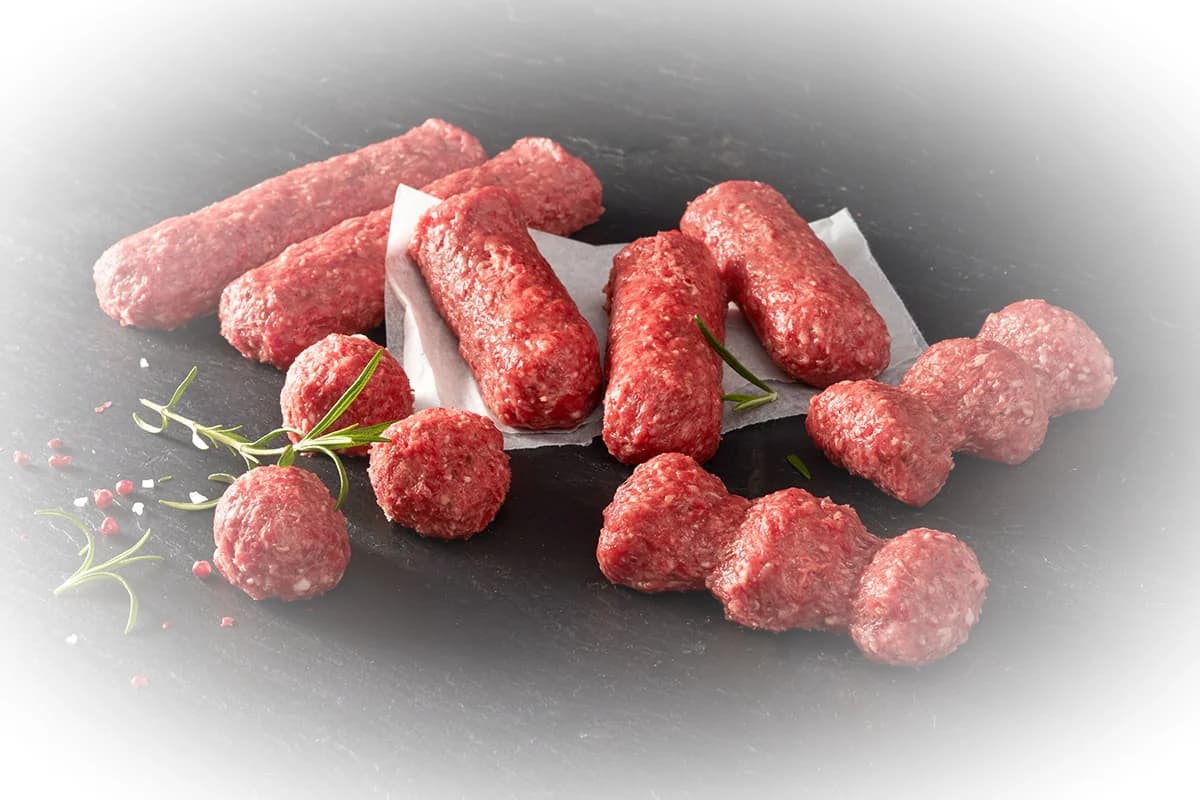
Retail mince, burger mix and meatball mass, where the mixing grinder takes trim, fat and seasoning to an even, final grain in one machine.
41 machines
Smoked and cooked sausage
Coarse components for smoked and cooked lines, and pre-grinding of meat that is later cut to batter in a bowl cutter.
36 machines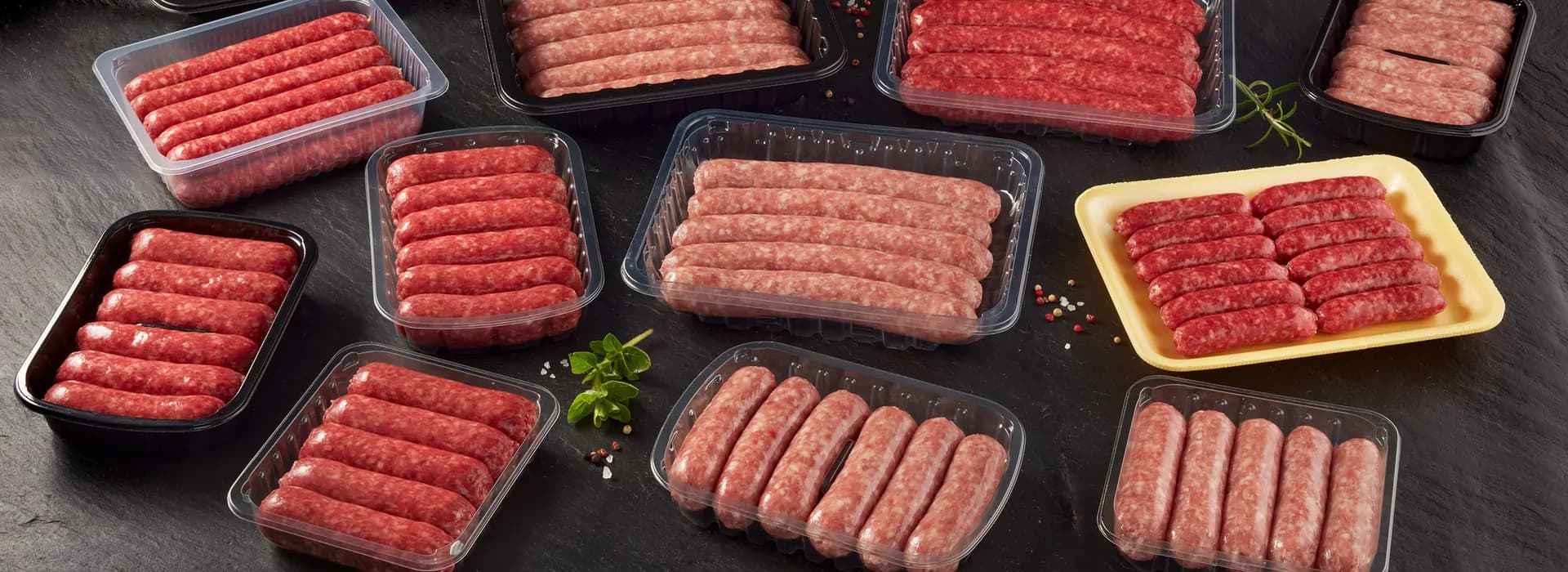
Fresh sausage
Sausage meat mixed with its salt, seasoning and water, then minced to the grain each link calls for, ready to go to the filler.
45 machines
Snack sticks
Seasoned meat mixed and minced to an even grain before the filler portions it into narrow casings.
28 machinesCooked meat and deli
Cooked products and liver, both named in the mixing grinders’ published data, prepared for pâté, fillings and other deli products.
63 machines
13Support
Test your mince first, then keep the knives cutting
Vemag Australia, the official Seydelmann distributor across Australia and New Zealand, works from offices at Redland Bay in Queensland and Rosedale in Auckland. Each quotation is built around your production, from a single mixing grinder to a full mince line; ask the sales team about a demonstration.
01
Trial at the Customer Centre
Bring your own trim, fat and recipes and put them through machines under real production conditions, alongside specialists in the application, so you see the result before choosing an investment.
02
Installation and servicing
Trained service technicians work across Australia and New Zealand, installing new machines, clearing faults, handling repairs and maintenance, moving machines to a new site, and training your operators and maintenance staff.
03
Parts and blade sharpening
The local parts department keeps genuine components on the shelf, helps identify the right part for VEMAG equipment, and runs a blade sharpening service worth building into any grinder’s routine.
14FAQs
Meat mixer grinder questions
What is the difference between a mixer grinder and a meat grinder?
A meat grinder only minces: its worm drives meat into knives turning against a hole plate. A meat mixer grinder adds a mixing unit to the hopper, so the batch is mixed with its fat, salt and seasoning before the same worm takes it to the cutting set. That is usually the deciding question: if you season most batches before the final grind, one machine does both jobs. See the comparison table.
Is a mixer mincer the same as a mixer grinder or mixing grinder?
Yes. Mixer mincer is the name many Australian and New Zealand butchers use, mixer grinder or meat mixer and grinder is common in equipment listings, and mixing grinder is Seydelmann’s own term. All of them describe a grinder with a mixing unit built into its hopper. The words are sometimes swapped around, too: a mincer mixer is the same machine.
Should meat be mixed before or after grinding?
It depends on the product, and practice varies. Mixing before the final grind spreads salt, seasoning and fat while the pieces are still whole, so the knives cut a batch that is already even; that is how a mixing grinder works. Mixing afterwards also works, but extra handling of finished mince can warm it and smear the fat. Many producers pre-grind coarse, mix, then finish on the final plate.
How much meat does a mixer grinder mix per batch?
Go by the published mixing capacity, not the hopper volume. On the three Seydelmann mixing grinders it is 50 kg for the MD 114, 100 kg for the ME 130 and 150 kg for the ME 130-3, in hoppers of 75 l, 170 l and 300 l. The hopper holds more than the batch, which in general leaves the arms or paddles room to turn it over. More in mixing capacity vs hopper volume.
Mixing arms or paddles: which should I choose?
Neither is the right answer for every mix. Seydelmann fits two strong arms as standard and offers paddles as an option, and which works for you depends on how your batch behaves in the hopper: firm or soft, sticky or loose, coarse or fine. Where you can, run your own recipe with each and compare evenness and fat definition at the plate. There is more on how each tool moves the mass.
Can a mixer grinder handle frozen meat?
Slightly frozen, yes; frozen blocks, no. The model data for the MD 114, ME 130 and ME 130-3 names fresh meat, slightly frozen meat and cooked products. Seydelmann’s general grinder text also mentions frozen meat, but none of the three mixing grinders names frozen blocks or a temperature below zero. For frozen raw material, look at grinders whose data names it: the AE 130 takes frozen pieces down to −10 °C, the AE 130-3 is published from −18 °C to 85 °C, the AG 160 and AV 250 take pre-cut frozen meat, and the AU 200 U universal grinder cuts frozen meat blocks.
Which hole plate should I use for burger mince or sausage meat?
There is no single answer: your recipe and the texture you sell decide it. As a rule, a coarser final plate gives burger mince a looser, more open bite with visible fat, a medium plate suits everyday retail mince and fresh sausage meat, and finer plates close the texture for smoother links. Settle it with trial batches on two or three plates.
What does a separating set do?
A separating set changes the end of the cutting set so that hard particles — bone chips, cartilage and sinew — are held back instead of passing into the mince. It is optional equipment on all three Seydelmann mixing grinders. On VEMAG’s filler-mounted heads, the Grinder 980 can separate bone and sinew when the function is switched in, and the Grinder 982 takes out rind as well.
How do I stop fat smearing when mincing?
Keep fat and lean cold right up to loading, keep knives sharp and matched to their plates, and don’t mix or grind longer than the batch needs. A coarse pre-grind before a finer final pass eases the load on each knife. If mince comes off greasy or pasty, check knife and plate wear first. The temperature and fat section covers the causes.
Can a mixer grinder make plant-based mince or pet food?
In the catalogue, the ME 130 is listed for the pet food industry, and both the MD 114 and the ME 130 are listed for alternative protein, alongside meat and sausages. Plant-based and pet food mixes behave differently from meat trim in the hopper and at the plate, so trial your own recipe before settling on the model, the mixing tool and the cutting set.
Do I need a mixer grinder if my vacuum filler has a grinding head?
Possibly not, if your mass arrives already mixed. A Grinder 980 or 982 on a double-screw filler grinds to final size as the filler portions, and both can separate hard particles, but neither is a mixer. If salt, seasoning or fat still has to be worked through the batch, that happens upstream, in a mixer or a mixing grinder. The Grinder 982 page lists the fillers it fits.
How much does an industrial meat mixer grinder cost?
Prices aren’t published: Vemag Australia quotes each machine against the enquiry. The figure moves with the model and its mixing capacity, arms or paddles, the cutting sets and any separating set, how the machine is loaded, installation, and staff training. Send your batch sizes, hourly output and products with your enquiry, whether for one commercial meat mixer grinder or a complete mince line.