
01Scope
What ingredient handling means in a meat plant
The term stretches a long way. In a flour mill or a snack factory it usually means silos, bulk-bag stations, pneumatic conveying and automatic dosing of powders. In a meat or smallgoods plant most of the ingredients are chilled trim, fat, frozen blocks, ice, water and a short list of dry additives, and handling them is about getting each one into the grinder, the bowl, the filler hopper or the brine tank at the right temperature and in the right amount.
That second kind is what our range covers: Seydelmann grinders built to be loaded mechanically, mixing grinders that season a batch before it is minced, cutters and a Holac dicer with published loading options, a VEMAG vacuum filler that runs continuously on conveyor feed, Fomaco brine mixers and tanks, and the weighing and metal detection that check raw material and brine on the way through.
For what happens after this point, see our guide to meat processing systems, and for the whole catalogue by machine category, the food processing equipment guide.
- Covered here: loading grinders, cutters and dicers; breaking down frozen and large raw material; blending a batch before mincing; feeding a vacuum filler; making up, holding and filtering brine; and weighing and metal checks on the way in.
- Not covered: silos, bulk-bag dischargers, pneumatic conveying and automatic weighing or dosing of dry powders. None of these is in our catalogue.
02Stages
Ingredient handling equipment, stage by stage
Each stage below names catalogue machines whose own published data describes that work, and opens the machine type page where the full group is listed. Read them as illustrative configurations: a stage here is not a line we have supplied, and machines named in different stages have not been matched to one another.
Stage 1Grinders & mincers
Loading the grinder without lifting by hand
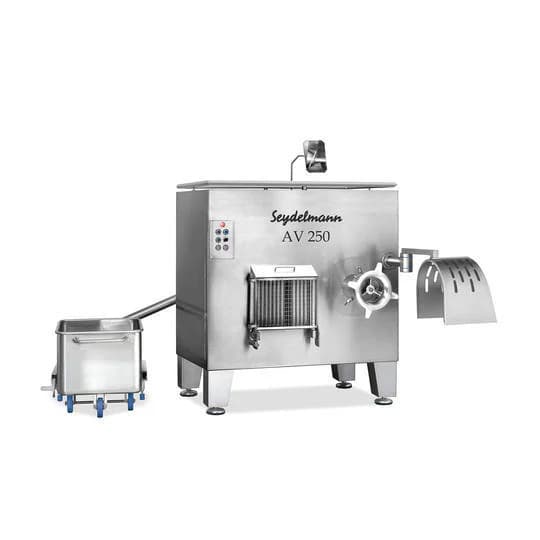
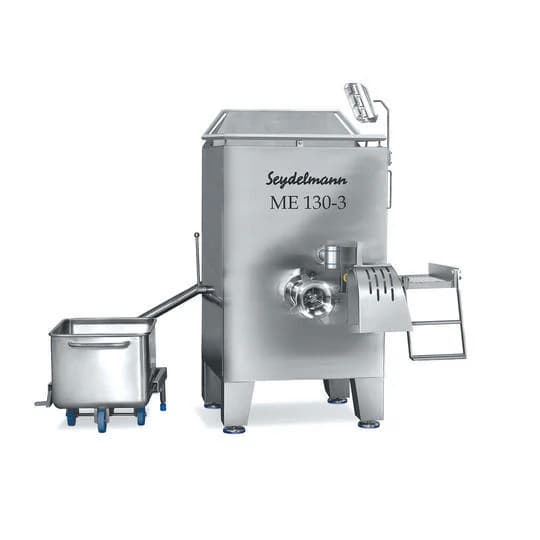
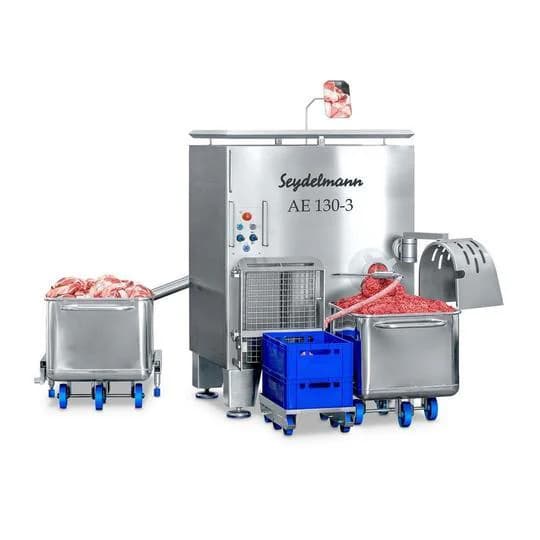
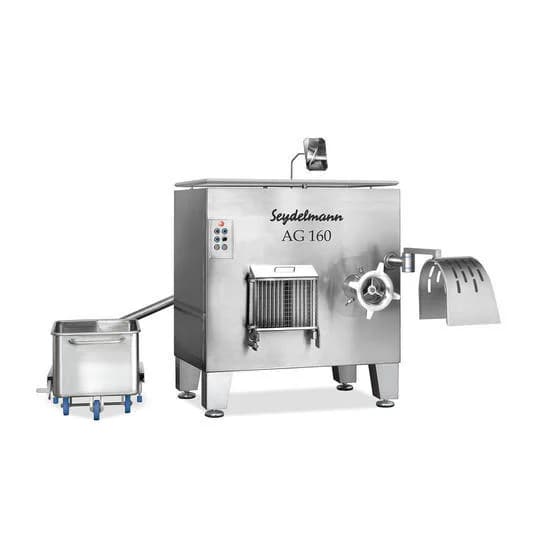
Tipping trim into a grinder by hand caps what a shift can move and puts people beside the feed. The Seydelmann AG 160 automatic grinder can be loaded by an integrated hydraulic loading device or a vertical loading device, or fed by angled conveyor belts or screw conveyors, and a loading device for large containers is available with a larger hopper. Its listing adds that the conveyor belts can be fitted with metal detectors on request. The AV 250 is listed with the same loading options and a 250 mm hole plate, and the data for the AE 130-3 and ME 130-3 gives each machine's weight with a loading device fitted, so ask about loading when you compare them.
Stage 2Grinders & mincers
Taking frozen blocks and large pieces
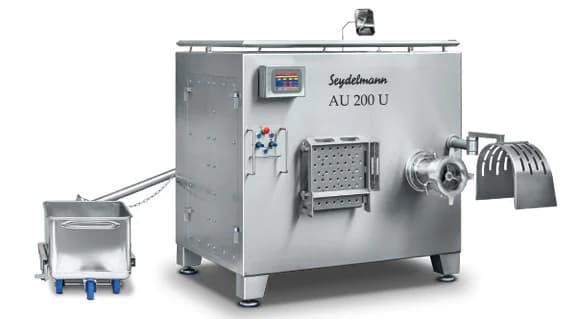
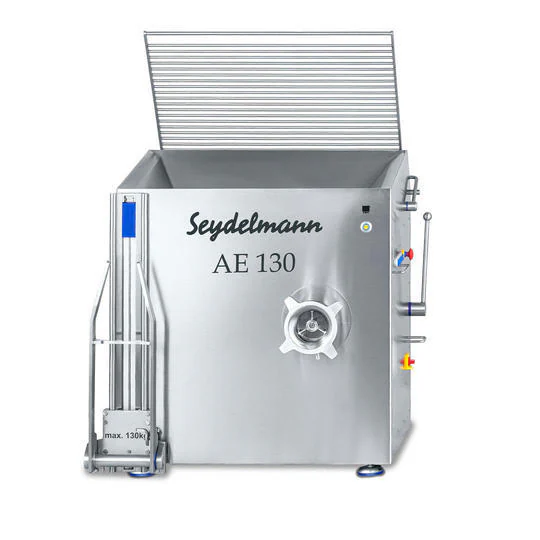
Frozen raw material keeps longer and evens out supply, but it is hard on a grinder's feed. A wide conical feeding worm carries large pieces to the working worm without them bridging over it: on the AE 130 that covers frozen pieces down to −10 °C, and the AE 130-3 is listed for fresh, frozen and cooked material from −18 °C to 85 °C. The AG 160's feeding worm is described for pre-cut frozen meat and large pieces of meat or fat. The AU 200 U universal grinder cuts fresh meat and cooked and frozen meat blocks with one working worm and cutting plate system, from a 570-litre hopper.
- AU 200 U Universal Grinder
- AE 130Grinder
- AE 130-3Grinder
- AG 160Grinder
Stage 3Grinders & mincers
Blending meat, fat and seasoning before mincing
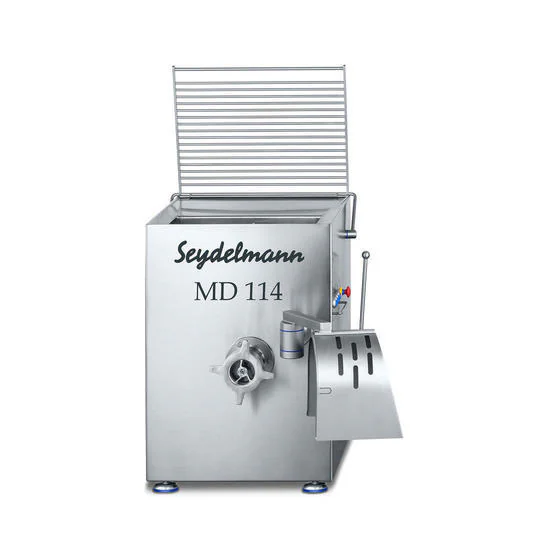
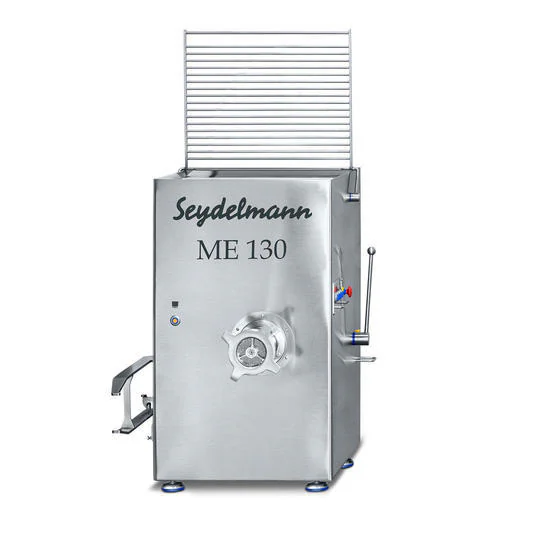
Salt, seasoning and other dry additives have to be spread evenly through the meat before it is minced, or the product changes from one portion to the next. A mixing grinder does both jobs at one station: two mixing arms, or paddles as an option, work the batch in the hopper, and the worm then carries it to the cutting set. The published mixing capacities are 50 kg for the MD 114, 100 kg for the ME 130 and 150 kg for the ME 130-3. Our meat mixer grinder guide explains how to size one for the batches you run.
Stage 4Bowl cutters & emulsifiers
Loading the bowl cutter
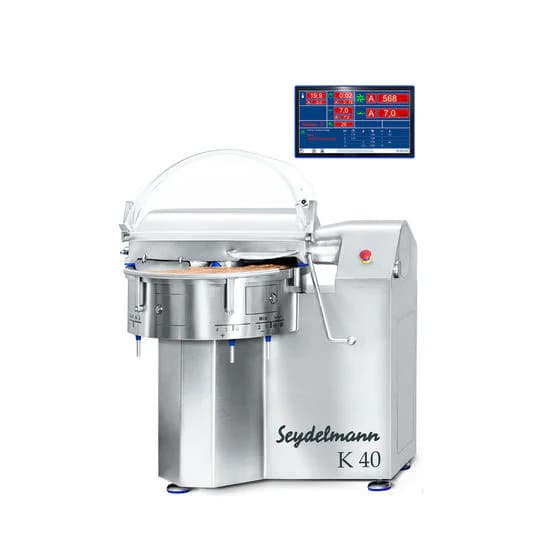
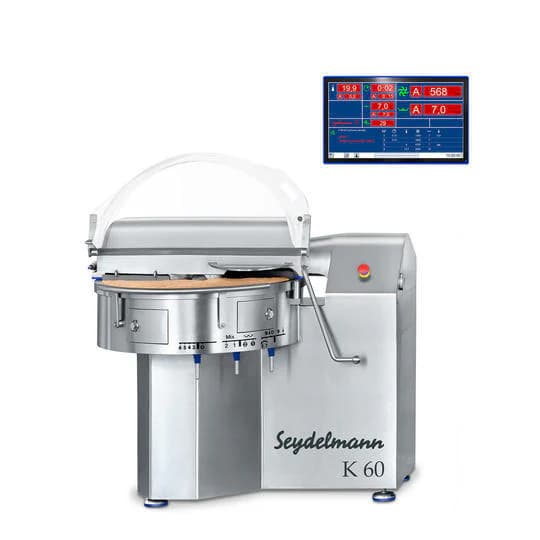
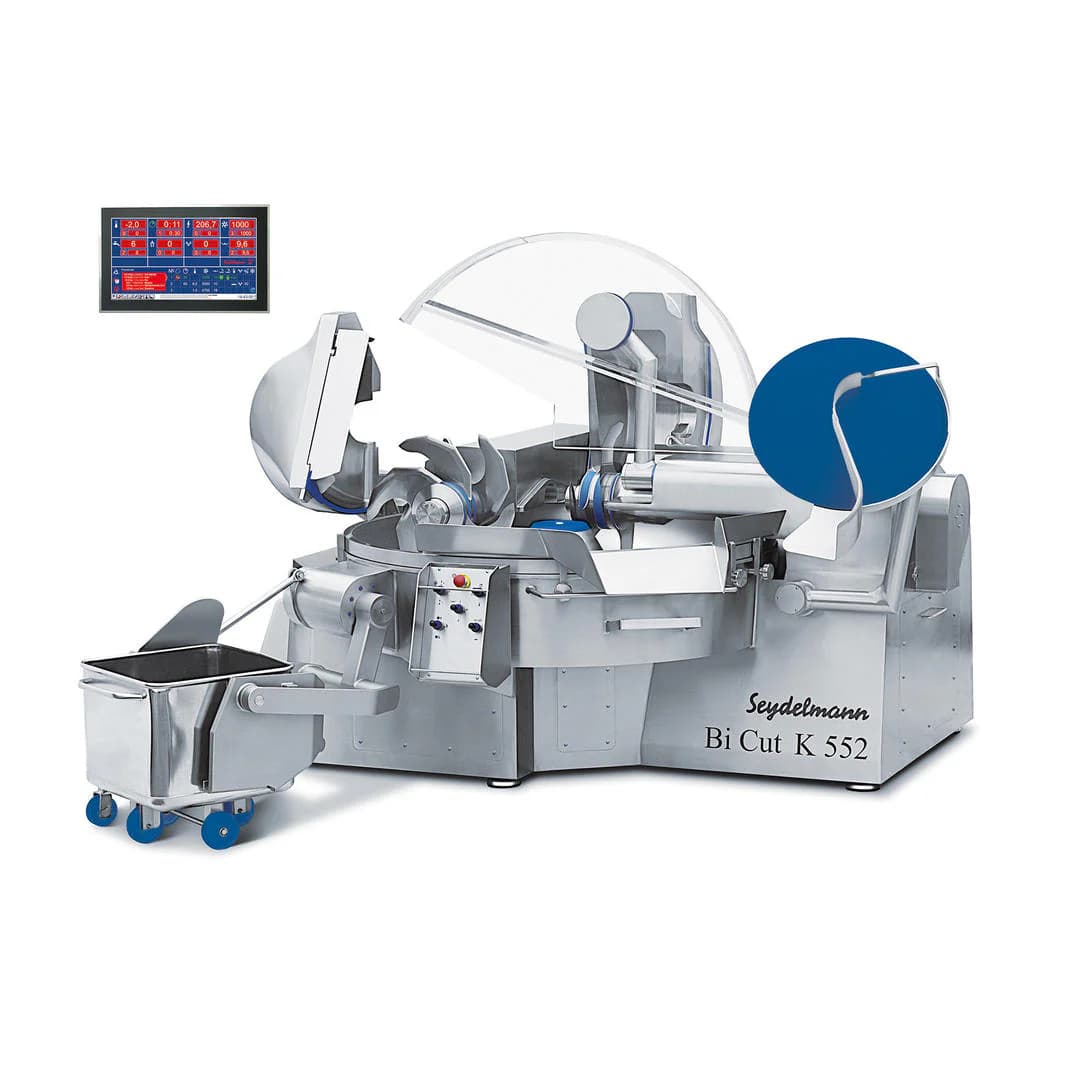
For frankfurts, polony and dry sausage, the meat, fat, ice and additives go into the bowl together. The K40, with a 40-litre bowl, and the K 60, with a 60-litre bowl, both list manual loading. The Bi-Cut K 552 AC-8 has a 550-litre bowl and lists two loading options, the BW 200 and BW 300, so ask us what each involves for your plant. For frozen raw material, the K40 is listed for pre-cut frozen meat from −12 °C and the Bi-Cut K 552 AC-8 for fresh and frozen meat from −18 °C. The bowl cutter and emulsifier guide compares the cutters by size.
- K40Bowl Cutter
- K 60 High-Efficiency CutterBowl Cutter
- Bi-Cut K 552 AC-8Bowl Cutter
Stage 5Slicers & dicers
Feeding a dicer
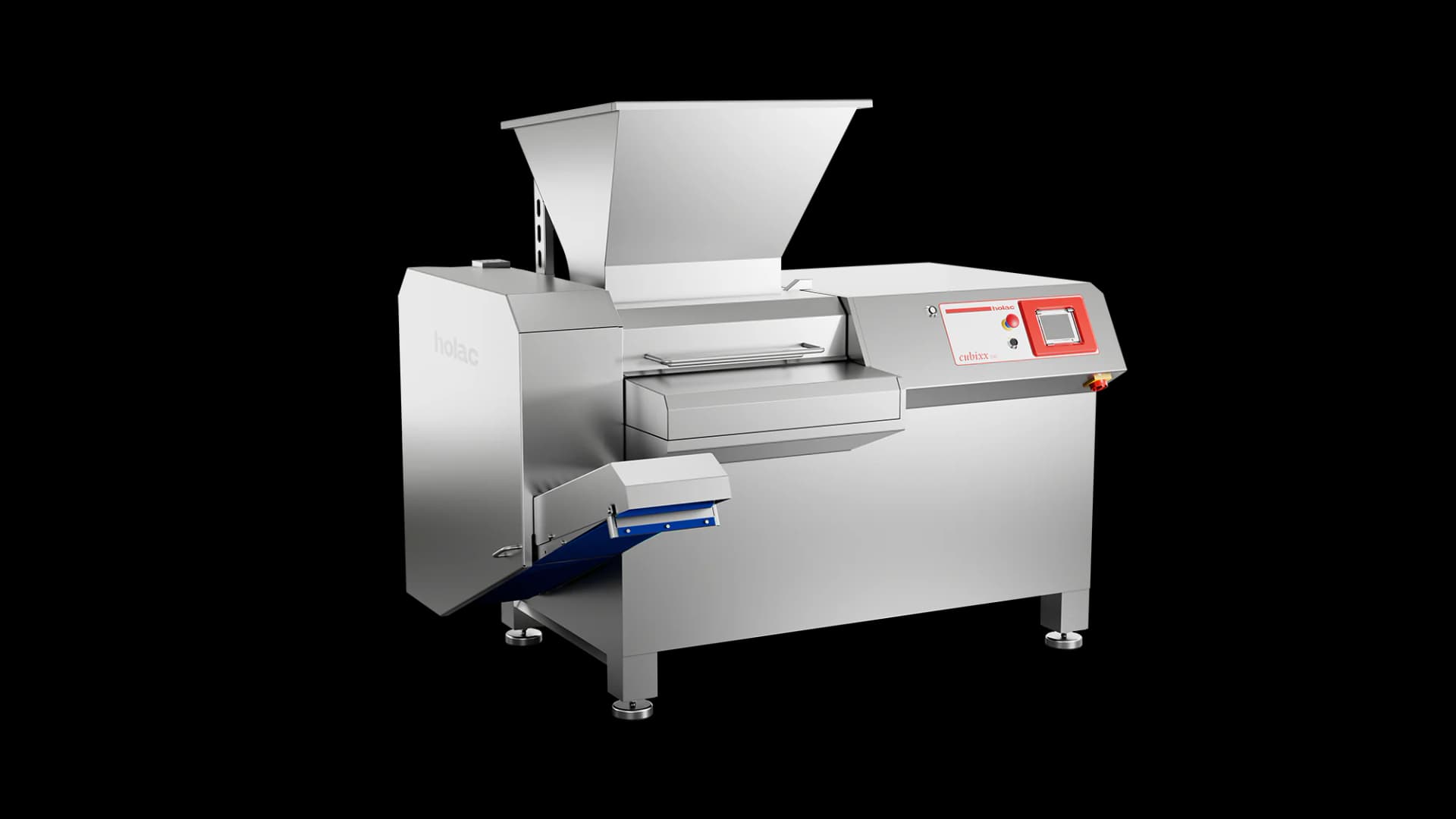
Diced meat, bacon and cheese are often ingredients in their own right, bound for pizzas, salads or prepared meals. The Holac Cubixx 150 LP loads its product magazine through a hydraulically driven sidewall and cuts off with a guillotine blade, and its data lists fully automatic loading from a feeding conveyor or from 200-litre trolleys by a hoist lifter. It takes loose and pre-formed products, meat, bacon, sausage and cheese among them, and carries the cut product away on an integrated discharge conveyor.
- Cubixx 150 LPDicer
Stage 6Vacuum fillers
Feeding the vacuum filler
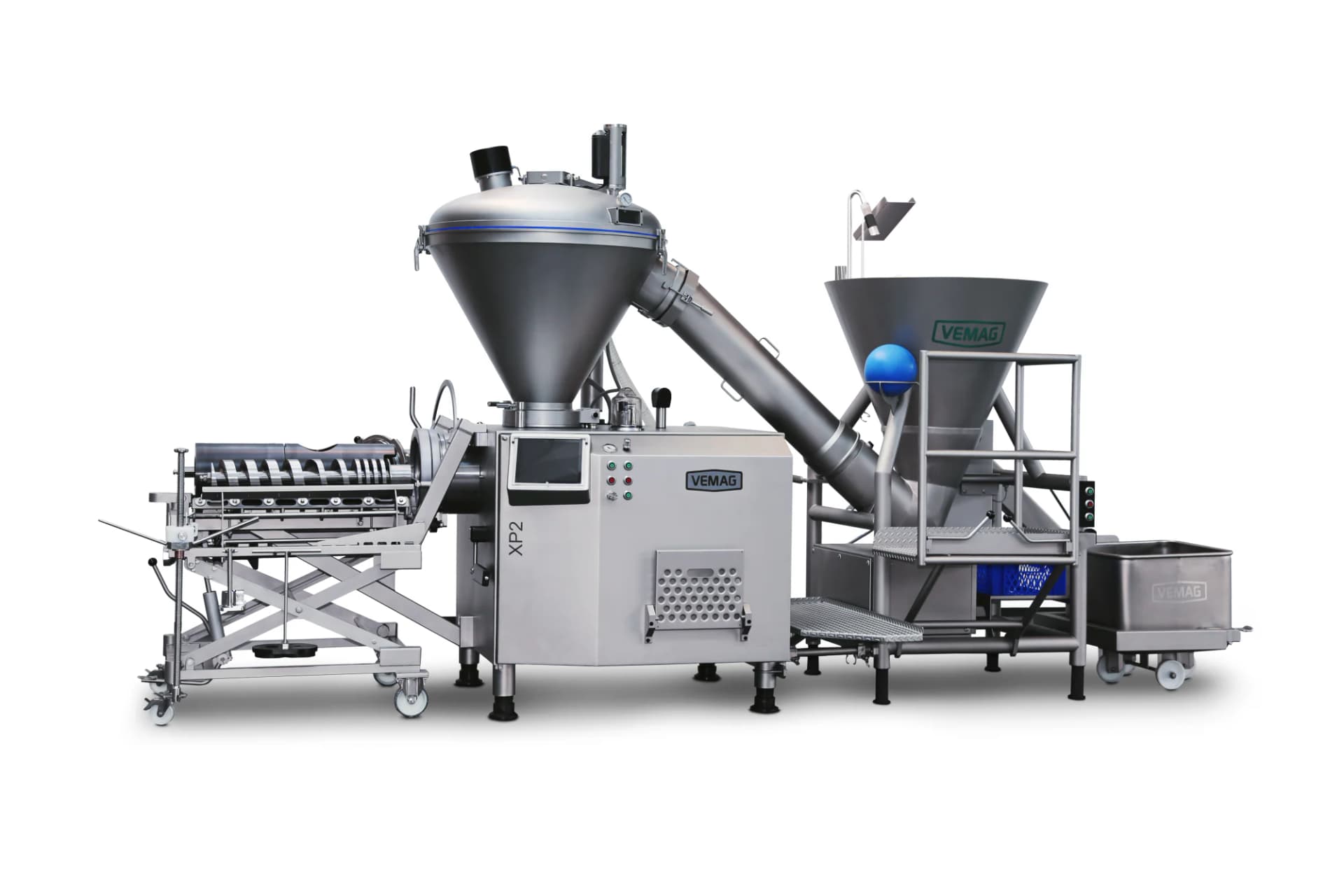
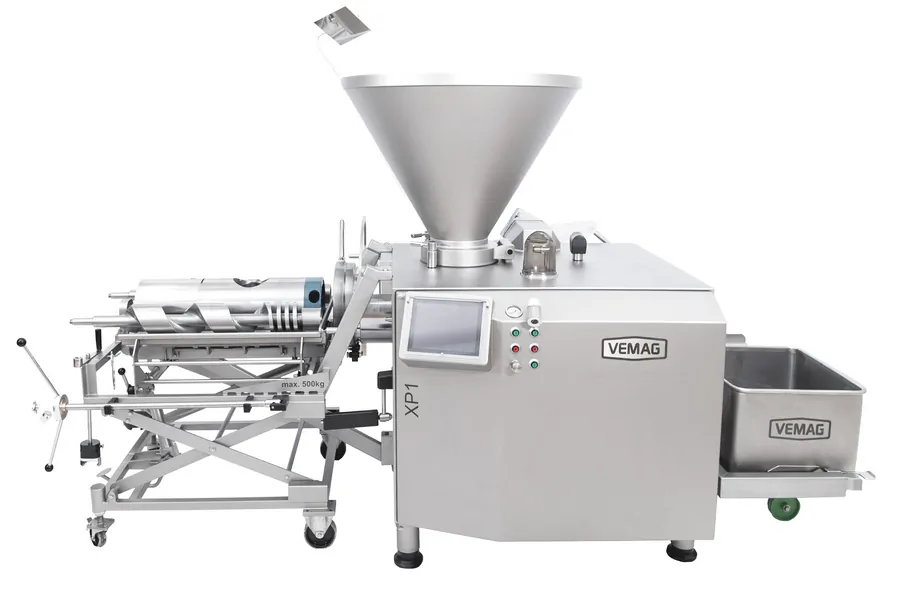
Where mince or sausage meat is made in volume, the vacuum filler can take on the grinding as well. The VEMAG XP2's listing says it handles minced meat with a frozen meat content above 70 per cent and needs product fed by belt or worm conveyor for continuous operation, into a 350-litre hopper. The XP1 and XP2 both list a 160 mm inline grinder. On HP series fillers, the VEMAG Grinder 982 grinds to final particle size while the filler portions, and with its separation device it removes bone, rind and sinew at the same time, so there is less handling between grinding and portioning.
Stage 7Brine mixers & tanks
Making up brine
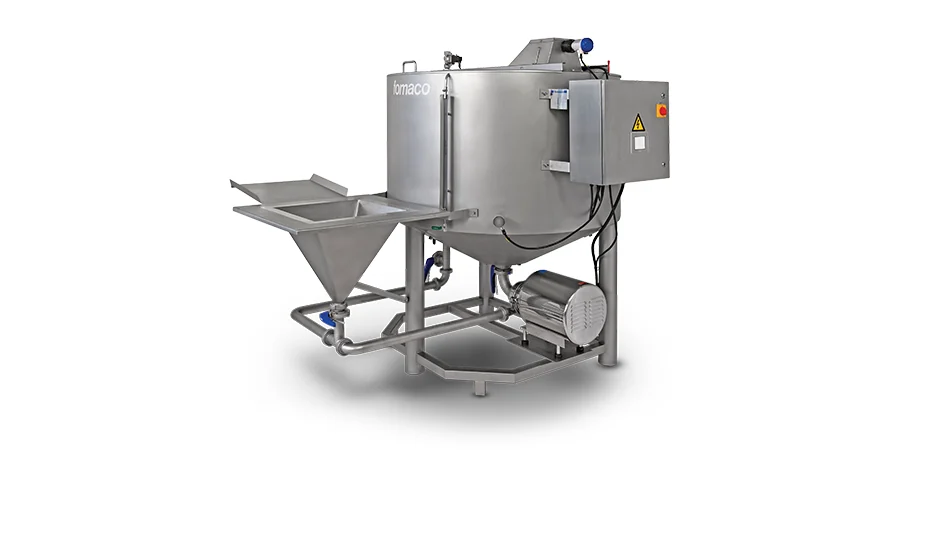
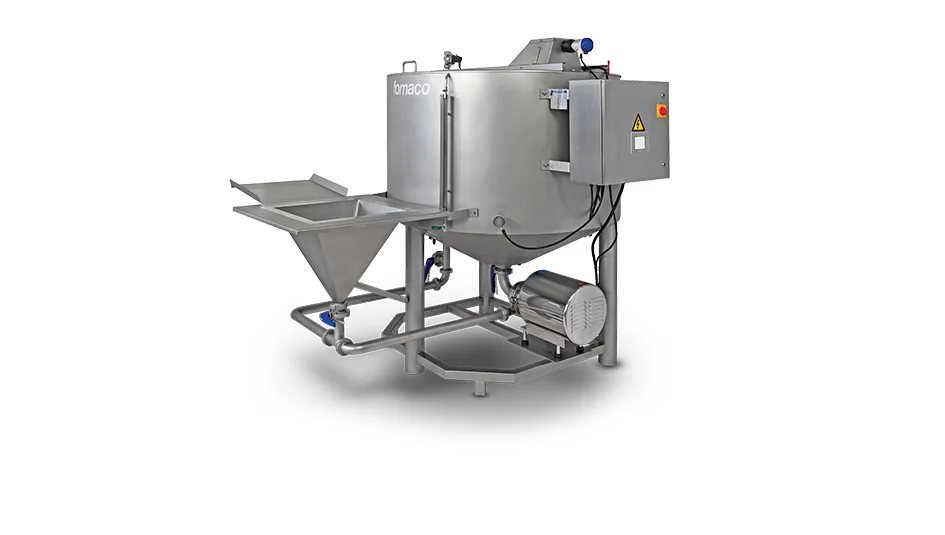
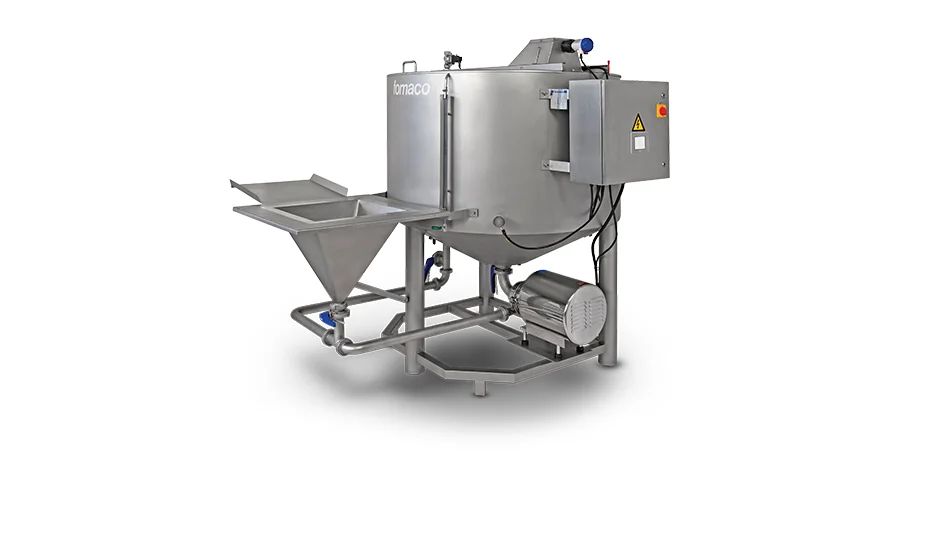
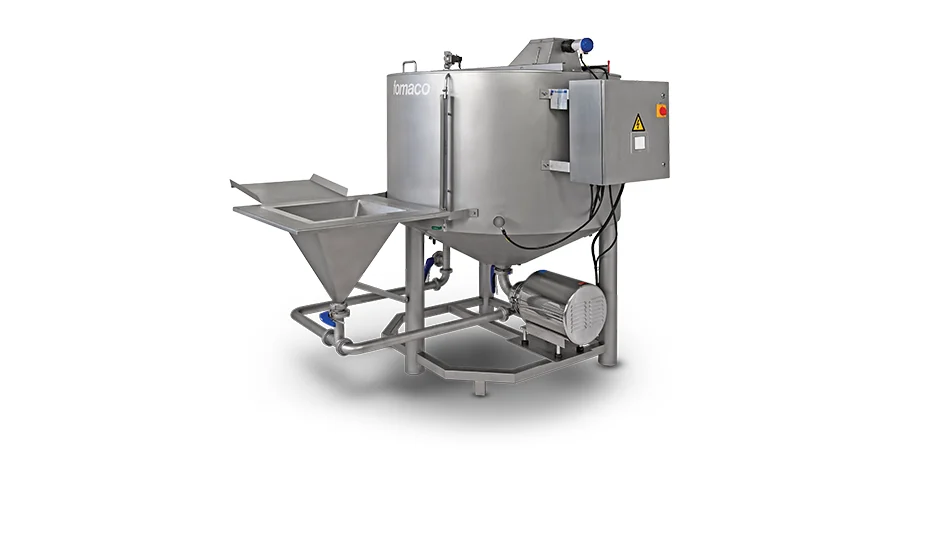
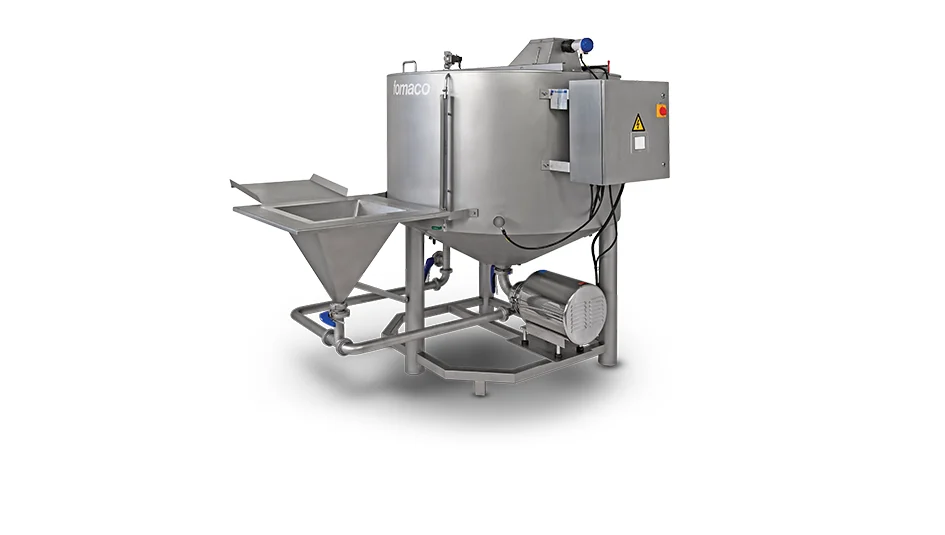
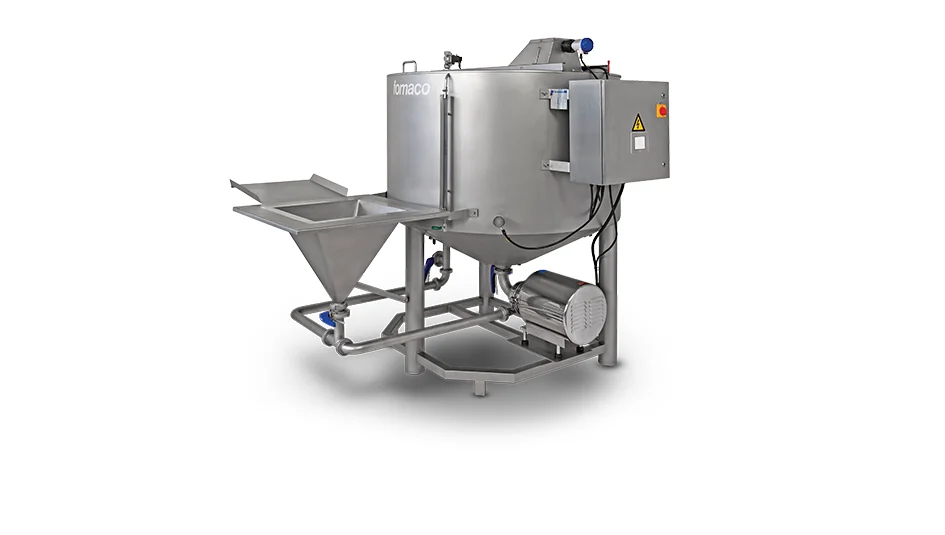
Brine is the ingredient a whole-muscle line makes for itself, and any variation in it shows up in the bacon or ham. Fomaco's FBM brine mixers, from the FBM 500 to the FBM 3500, fill the tank with water to the set level on their own, so the operator only has to add the dry ingredients through an ergonomically designed 40-litre hopper. A Venturi system draws the powder into the water for a quick, even mix, and every model in the range lists an IP 68 control panel.
Stage 8Brine mixers & tanks
Holding and filtering brine
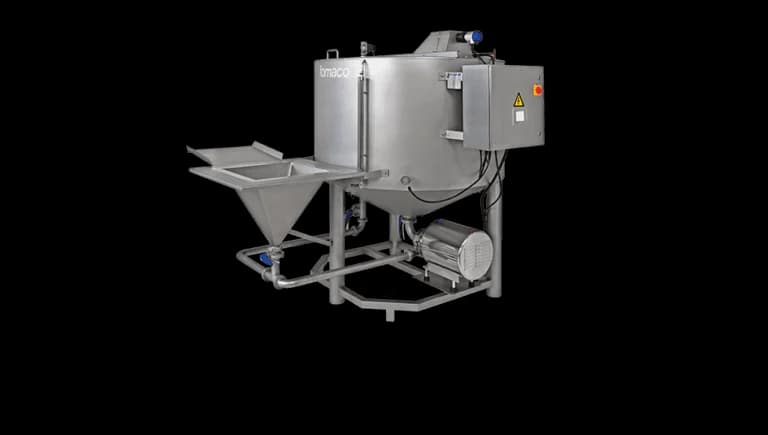
Mixed brine has to stay even until the injector draws it, and brine that runs back from the injector is filtered before it goes round again. The Fomaco FST 3500 storage tank holds prepared brine and, for very heavy brines and functional ingredients, can be supplied with a variable-speed ProShear mixer. On the return side, the Fomaco CBF 500P belt filter has a built-in conveyor belt and a 330-litre volume, is listed for the FGM 48, 64, 88 and 112 injectors, and is described as the step up from rotary filters for medium and large production.
- FST 3500Brine Storage Tank
Stage 9Inspection & weight control
Weighing and metal checks on the way in
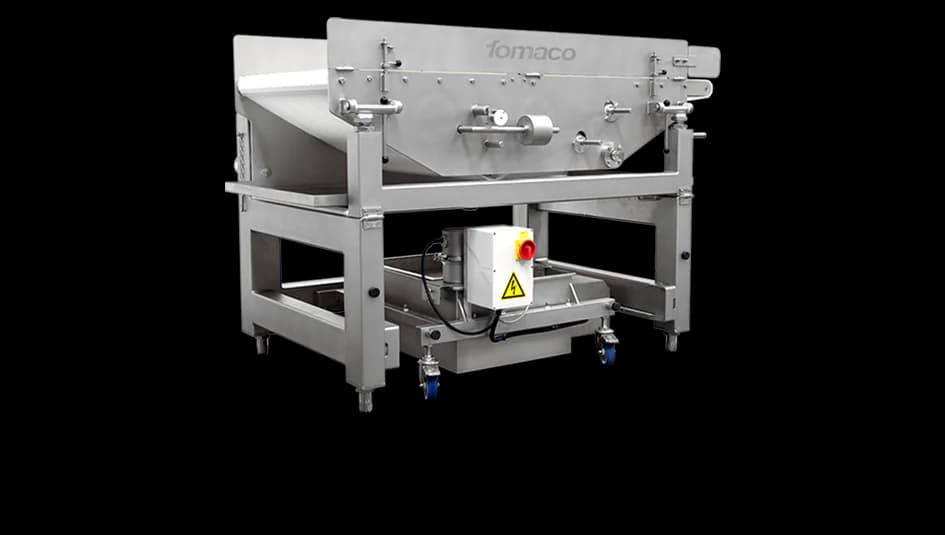
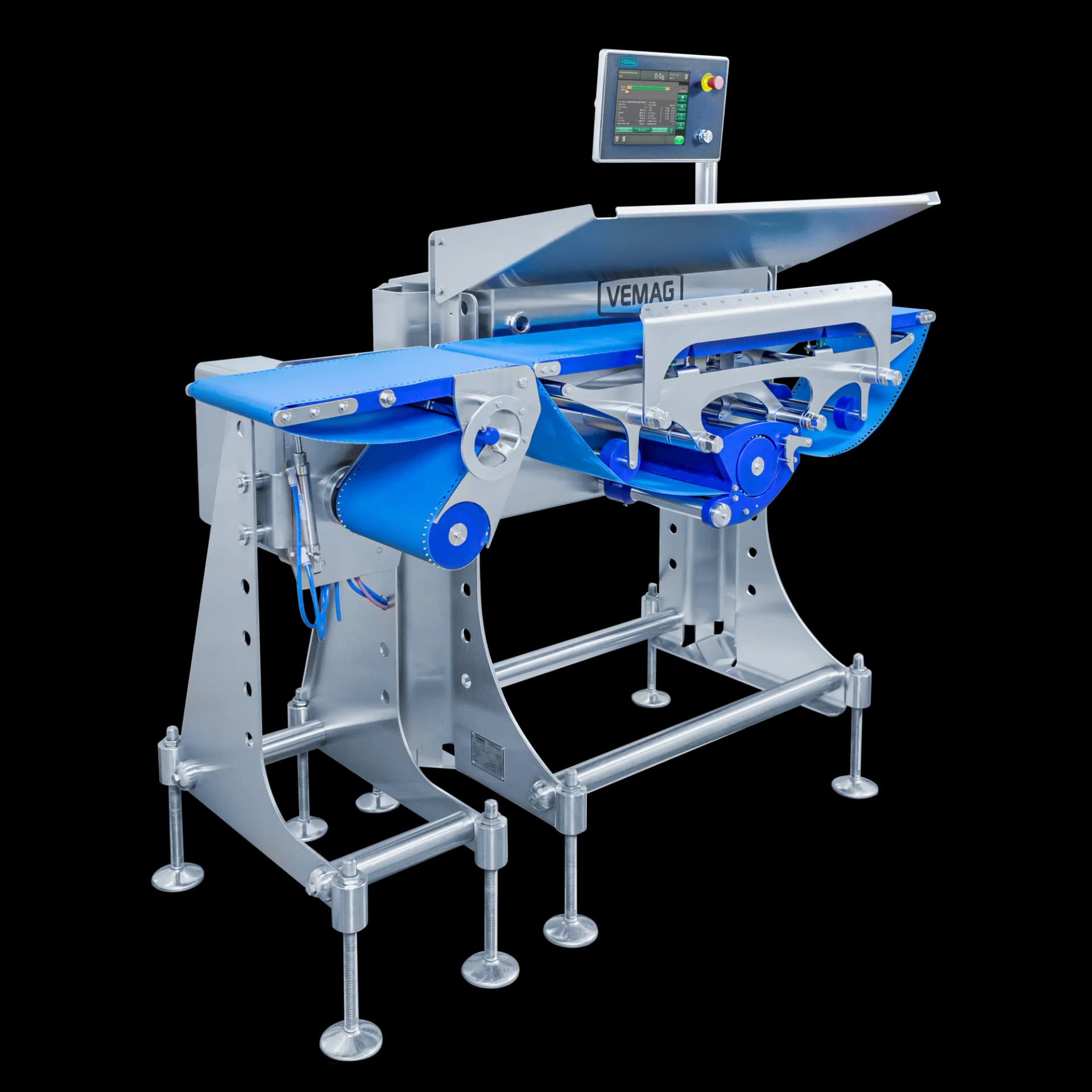
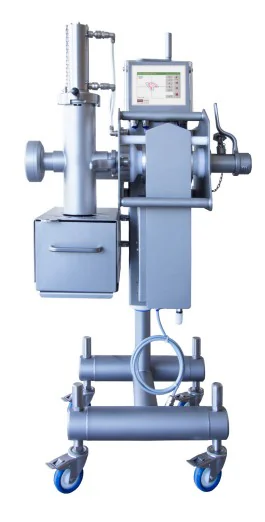
Natural raw materials vary from batch to batch, so weight is worth checking where it can still be corrected. Fomaco's IWC units weigh product on Eilersen digital load cells and are listed for the FGM 48, 64, 88 and 112 injectors; weighing before and after injection shows how much brine the meat has taken up. On mince and forming lines, the VEMAG VPC716 weighs every portion, adjusts the vacuum filler from what it measures and sends portions outside tolerance to an ejection belt. For foreign bodies, the Pulsotronic M-Pulse2pro Inflex 65 is a mobile, height-adjustable metal detector built for use with stuffers and filling machines.
- IWC 48Weight Control Unit
- IWC 112Weight Control Unit
- VPC716Checkweigher
- M-Pulse2pro Inflex 65Metal Detector
03Illustrations
How ingredient handling could look for four products
The table lines those stages up against four common products. Each column is an illustration built from machine types in our catalogue, not a line we have installed, and the machines a column implies have not been matched to one another. The right set-up depends on your raw material, your recipe, your volumes and what is already on the floor.
| Row | Burgers and fresh mince | Frankfurts and polony | Bacon, ham and whole muscle | Diced meat and cheese |
|---|---|---|---|---|
| Raw material arrives as | Chilled trim and fat, sometimes frozen blocks | Lean and fat trim, with ice, salt and seasoning | Whole muscle pieces, plus water and dry cure ingredients for the brine | Logs, slabs or blocks of meat, bacon, sausage or cheese |
| Loading and size reduction | An automatic grinder with a loading device, or a universal grinder for frozen blocks | A coarse pre-grind, then into the bowl cutter | Brine made up in a brine mixer | Into the dicer's magazine by conveyor, or by trolley and hoist |
| Blending | A mixing grinder, with seasoning added in the hopper | In the bowl, as the batter is cut | Brine kept moving in a storage tank, with a high-shear mixer for heavy brines | None before dicing |
| On to the next machine | A vacuum filler, or a filler with an inline grinder fed by conveyor | The vacuum filler's hopper | The injector, with a belt filter on the brine return | A discharge conveyor to the next step |
| Checks | Portion weighing after forming, and metal detection | A metal detector at the filler | Weighing before and after injection | Metal detection or X-ray before packing |
The ground meat, smoked and cooked sausage, bacon, whole muscle and shredded and diced cheese pages list every machine tagged for each product.
04Buying
What to settle before choosing ingredient handling equipment
Handling equipment is specified around two things: the raw material and the machine it feeds. A few facts about each narrow the choice quickly.
- What arrives, and how cold: chilled trim, frozen blocks or a mix. The mixing grinders are listed for fresh and slightly frozen meat, the AE 130 for frozen pieces down to −10 °C and the AU 200 U for frozen meat blocks, while the bowl cutters publish lower limits of −12 °C for the K40 and −18 °C for the Bi-Cut K 552 AC-8.
- How it moves now: by hand, in trolleys or bins, or on a conveyor. Tell us the containers you already use, because a loading device is specified around them.
- Batch or continuous: a mixing grinder or a bowl cutter works one batch at a time, while a filler with an inline grinder, fed by conveyor, can run without stopping.
- How much brine, and for how many injectors: the number of injectors and the brine each batch takes decide the size of the mixer and tank. The FBM range runs from the FBM 500 to the FBM 3500.
- Where checks belong: metal detection on the belt into a grinder, a detector at the filler, or weighing before and after injection. Decide which faults you need to catch, and where they can still be put right.
- Cleaning: raw material is at its most exposed while it is being handled. The listings for several Seydelmann grinders, the mixing grinders among them, describe a closed stainless steel machine frame with rounded, sloped surfaces so water drains off, and the same question is worth asking of every loader, conveyor and tank you consider.
We have not put loading rates or brine volumes on this page, because they depend on your product and recipe. Send us those details with the machine the material has to feed, and we will work out what the handling needs to keep up with.
05Support
Trials, installation and support in Australia
Our sales team quotes on single machines and on complete production lines, and our own service technicians and spare parts desk look after the equipment we supply. You can bring your own raw material to our Customer Centre and see how it runs before you commit.
01
Customer Centre
Run your own raw material and recipes on our machines under real production conditions, with our specialists beside you.
02
Sales and quotations
Quotations for one machine, an add-on to equipment you already run, or a whole line.
03
Service
Installation, maintenance, repairs and operator training from our service technicians.
04
Spare parts
Genuine parts held in stock, and help identifying the part your machine needs.
06FAQ
Ingredient handling equipment questions
What is ingredient handling equipment?
It is the equipment that moves raw materials from storage into the first processing machine and gets them ready on the way: loading, breaking down frozen material, blending, weighing, and making up liquids such as brine. In a meat plant that means grinder and cutter loading, mixing grinders, brine mixers and tanks, and the weighing and metal detection around them.
Does Vemag Australia supply silos or bulk powder handling systems?
No. Our catalogue has no silos, bulk-bag dischargers, pneumatic conveying or automatic dosing systems for dry powders. Our range starts where meat, fat, ice, water and the dry additives for a batch or a brine go into the machine that prepares them.
Can a grinder take frozen meat blocks?
Some can. The Seydelmann AU 200 U universal grinder is described as cutting fresh, cooked and frozen meat blocks with the same working worm and cutting plate system, the AE 130 takes frozen pieces down to −10 °C, and the AE 130-3 is listed from −18 °C to 85 °C. The mixing grinders are listed for slightly frozen meat rather than blocks.
How is an automatic grinder loaded?
The AG 160's listing gives the options: an integrated hydraulic loading device, a vertical loading device, angled conveyor belts or screw conveyors, and a loading device for large containers with a larger hopper. Which one suits depends on the containers your raw material arrives in and the space around the machine.
What does a brine mixer do?
It turns water and dry ingredients such as salt, cure and phosphates into an even brine for the injector. Fomaco's FBM mixers fill to a set water level automatically, take the dry ingredients through a 40-litre hopper and use a Venturi system to draw the powder into the water. A storage tank such as the FST 3500 then holds the brine for the injection line. See all of them on the brine mixers and tanks page.
Can I trial my raw material before buying?
Yes. Our Customer Centre lets you test your own products on our machines under real production conditions. Tell us your raw material and the machine you are considering when you enquire, and we will say which machines are available for the trial.
How much does ingredient handling equipment cost?
We do not publish prices, because the figure depends on the machine, its loading equipment and options, and what it connects to. Send us your raw materials, volumes and the machine they feed, and our sales team will prepare a quotation. Our page on food processing machinery for sale explains how buying works.