
Industrial meat grinders
An industrial meat grinder is chosen on four things: the raw material it has to take, how it is loaded, the output you need through the plate and whether bone and sinew must come out on the way. This page sets the Seydelmann grinders and VEMAG grinding heads in our catalogue against those questions.
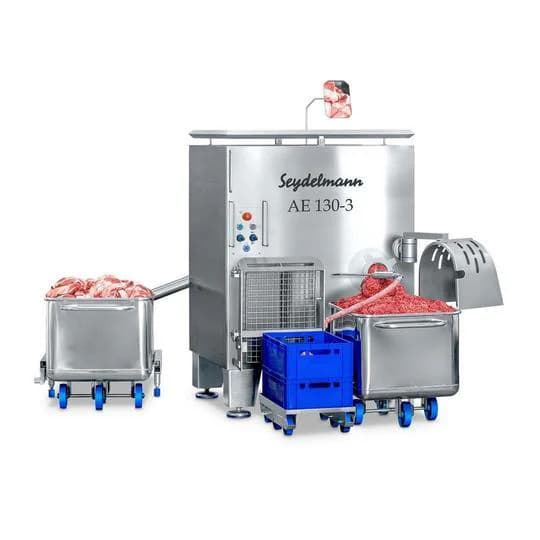
Four kinds of meat grinder in the catalogue
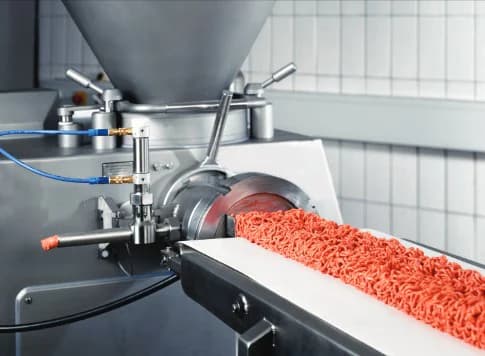
The machines on this page fall into four groups. They all mince meat through a hole plate. What separates them is how the meat reaches the worm and what happens to it at the outlet.
- High-efficiency grinders (Seydelmann AD 114 and AE 130): a 2-speed working worm and a wide conical feeding worm in a closed stainless steel frame. They are loaded by hand or from a tipper.
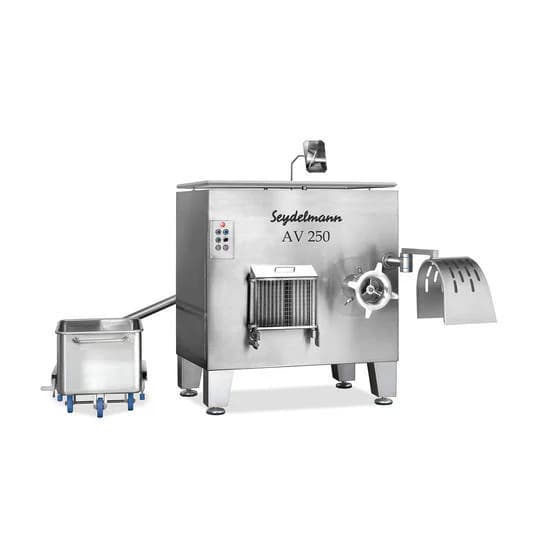
- Automatic grinders with a loading device (Seydelmann AE 130-3, AG 160 and AV 250): bigger hoppers, with loading by an integrated hydraulic loading device, a vertical loading device, angled conveyor belts or screw conveyors.
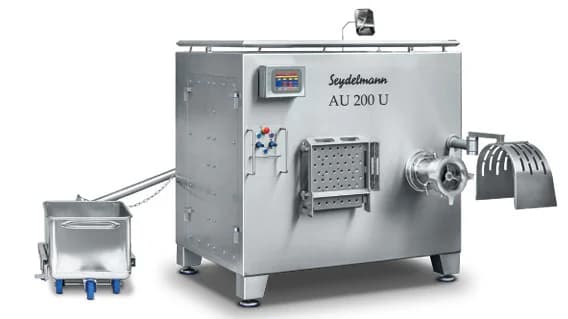
- A universal grinder (Seydelmann AU 200 U): fresh meat, cooked meat and frozen blocks go through one working worm and one cutting plate system.
- Grinding heads on a vacuum filler (VEMAG Grinder 980, Grinder 982 and Grinder 985): the meat is ground to final size as the filler portions or fills it, so there is no separate mincing step.
If every batch is seasoned before the final mince, a grinder with a mixing unit in the hopper may suit you better. See our meat mixer grinders guide for the MD 114, ME 130 and ME 130-3.
Grinders and grinding attachments
Each card opens the machine’s own page, with its published technical data and brochure where one is available. The figures quoted below come from that data.
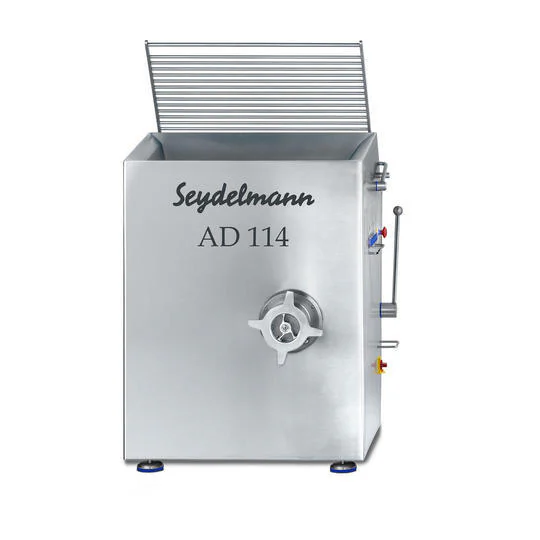
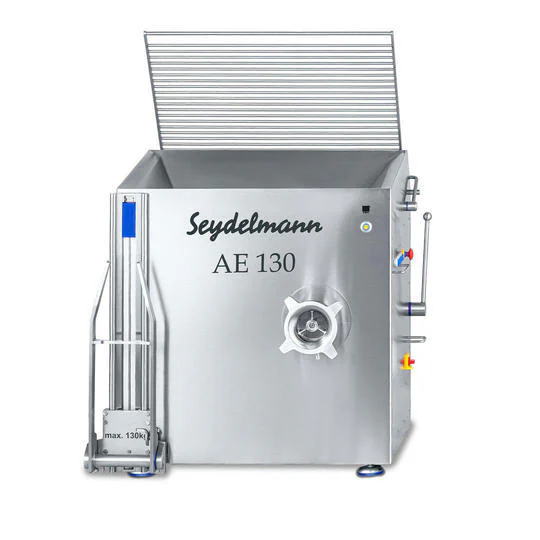
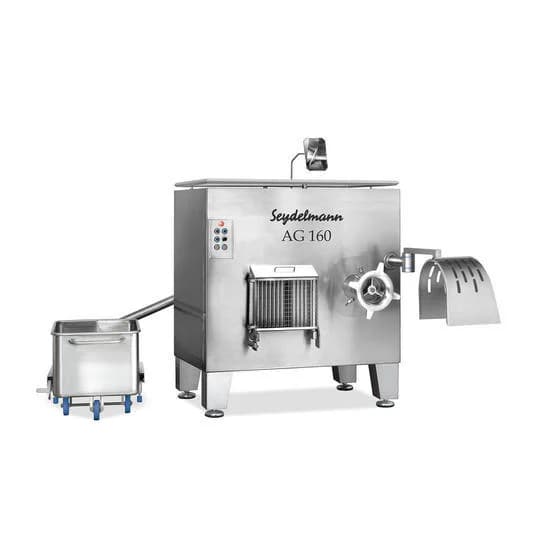
Match the grinder to the temperature of your raw material
Start with the coldest meat you plan to put through the machine, because the published temperature ranges differ more than the outputs do.
Seydelmann lists the AD 114 for fresh meat, slightly frozen meat and cooked products. The AE 130 extends that to frozen pieces down to -10 °C. The AE 130-3 is published for product from -18 °C to 85 °C. The AG 160 and AV 250 take fresh or cooked meat, pre-cut frozen meat and large pieces of meat or fat. The AU 200 U is built to cut fresh, cooked and frozen meat blocks without changing the worm or plate system.
Filler-mounted heads work in a narrower window. VEMAG lists the Grinder 985 for grinding and filling masses down to -1 °C, and it is not suitable for separation. Tell us the temperature your meat actually reaches the grinder at, not the temperature it leaves the freezer.
Hopper size and how the meat gets in
Hopper content ranges from 100 litres on the AD 114 to 570 litres on the AU 200 U. A large hopper is only useful if you can fill it safely and quickly, so plan the loading method alongside the machine.
The AE 130-3, AG 160 and AV 250 are each published with a weight both without and with a loading device. Seydelmann also offers a loading device for large containers where the hopper volume is increased, and conveyor belts can be fitted with metal detectors on request. Bring the size of the bins or trolleys you already use so the loading height can be checked against them.
Taking out bone, cartilage and sinew
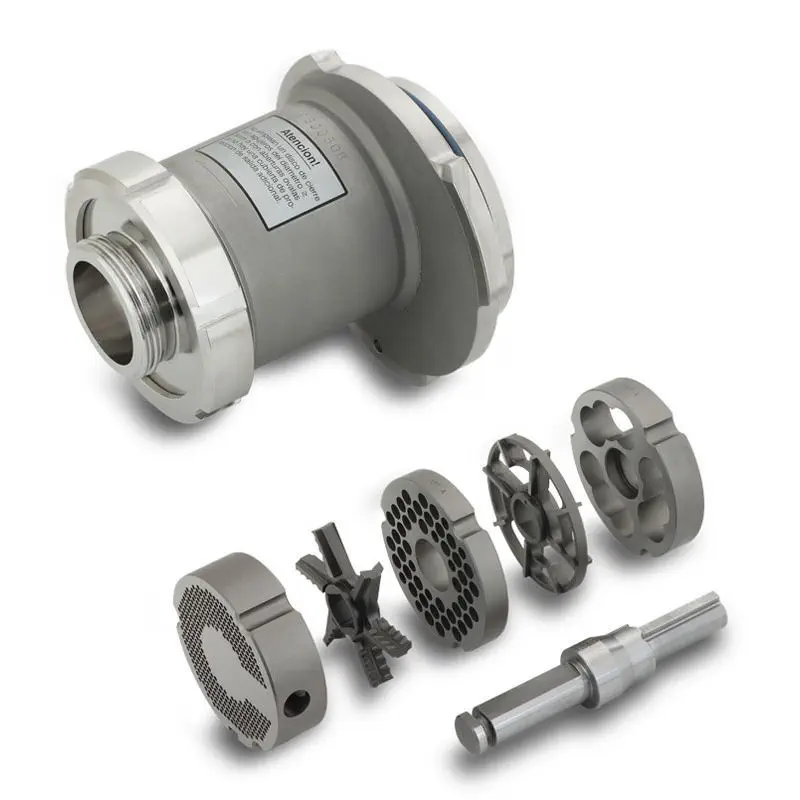
Separation happens at the cutting set: a separation blade and separation plate draw off hard particles while the meat passes through. Decide early whether you need it, because not every grinder in this range offers it.
The VEMAG Grinder 982 is a separation grinder for the HP series vacuum fillers, published at up to 8.7 tonnes an hour depending on product. The Grinder 980 suits HP series fillers and the Robot 500, depending on product, with separation as an option and output up to 4 tonnes an hour. The Minced Meat Attachment 801 can be retrofitted to the Grinder 982 for minced meat production, and the Separator 813 provides continuous separation at VEMAG grinders.
To see how a grinding head joins the filler that portions the mince, read about vacuum fillers for meat.
Reading the published output figures
Seydelmann publishes 1,500 kg/h for the AD 114, 3,000 kg/h for the AE 130 and 3,500 kg/h for the AE 130-3. The AG 160 and AV 250 are each listed at up to 14,000 kg/h, and the AU 200 U at 6,000 to 16,000 kg/h. Hole plate diameters run from 114 mm to 250 mm.
Treat each figure as the most the machine can do with a favourable product and plate. Your working rate depends on the final hole size, how cold the meat is, how often you stop to load and how long cleaning takes between recipes. Compare machines on the kilograms you need to put through in a shift, then leave room for the stops.
Large pieces of meat and fat can also be pre-cut on a continuous dicer before grinding. Our meat dicers page covers the VEMAG VS150 and the Holac Cubixx range.
Request a meat grinder quote
Send us the products you mince, the raw material temperature at the grinder, the hole sizes you use, your target kilograms per shift and how the meat is delivered to the machine. Say whether the mince goes on to a filler, a former or a packing line, and whether separation is needed.
Vemag Australia is the official Seydelmann distributor across Australia and New Zealand. You can arrange a trial with your own raw material at the Customer Centre, and trained technicians install and service machines in both countries.
Industrial meat grinder questions
Is a meat grinder the same as a mincer?
Yes. Mincer is the usual word in Australian and New Zealand butcher shops, and grinder is more common in equipment catalogues. Both describe a machine that forces meat through a hole plate with a turning knife.
Which grinder takes frozen meat?
In the published data, the AE 130 handles frozen pieces down to -10 °C and the AE 130-3 is listed from -18 °C. The AU 200 U cuts frozen meat blocks on the same worm and plate as fresh meat. The AG 160 and AV 250 take pre-cut frozen meat.
Can I grind and fill in one step?
Yes, with a grinding head on a VEMAG vacuum filler. The Grinder 980 and Grinder 982 fit HP series fillers, and the 980 also suits the Robot 500, depending on product. The meat is ground to final size as it is filled or portioned.
What is the difference between a meat grinder and a mixer grinder?
A grinder only minces. A mixer grinder has a mixing unit in its hopper that blends meat, fat and seasoning before the mince. The meat mixer grinders guide compares the Seydelmann mixing models.
Do you supply butcher shop mincers?
This page covers grinders for production plants and smallgoods kitchens. The AD 114 is the smallest plain grinder in our catalogue. Send us your weekly volume and we can tell you whether it fits.
Contact
Discuss your meat grinder
Share your products, raw material temperature and output with Vemag Australia.
- Australia(07) 3829 3868
- New Zealand+64 9 415 0137
- Salessales@vemag.com.au