
Pet food extruders
Pet food extruders should be specified around the prepared mixture, the shape leaving the outlet and any filling or casing. Vemag Australia helps producers assess VEMAG feeding, portioning and coextrusion arrangements for pet food products. Start with the product and required process, then define the equipment, tooling and handling needed to make it.
Define what extrusion needs to do for your product
Describe the result you want before choosing a machine: an unfilled stick or strip, a shaped portion, a filled snack with an outer mass, or a sausage product with a casing. Include a drawing or finished example, together with the condition of the mixture when it reaches the forming stage.
An enquiry for pet food extruders also needs to identify the process itself. Moving a prepared mass through a forming outlet, combining a filling with an outer mass, and cooking a recipe during extrusion are different requirements. If heating, cooking, pressure or moisture change is part of the project, specify those requirements separately so the complete process can be assessed. A vacuum filler and forming attachment should not be assumed to perform a cooking-extrusion step.
Our pet food equipment catalogue covers the wider production stages. This guide focuses on specifying the feeding-to-portion arrangement and the questions to settle when an extrusion or coextrusion project is discussed.
Feeding, portioning and coextrusion equipment
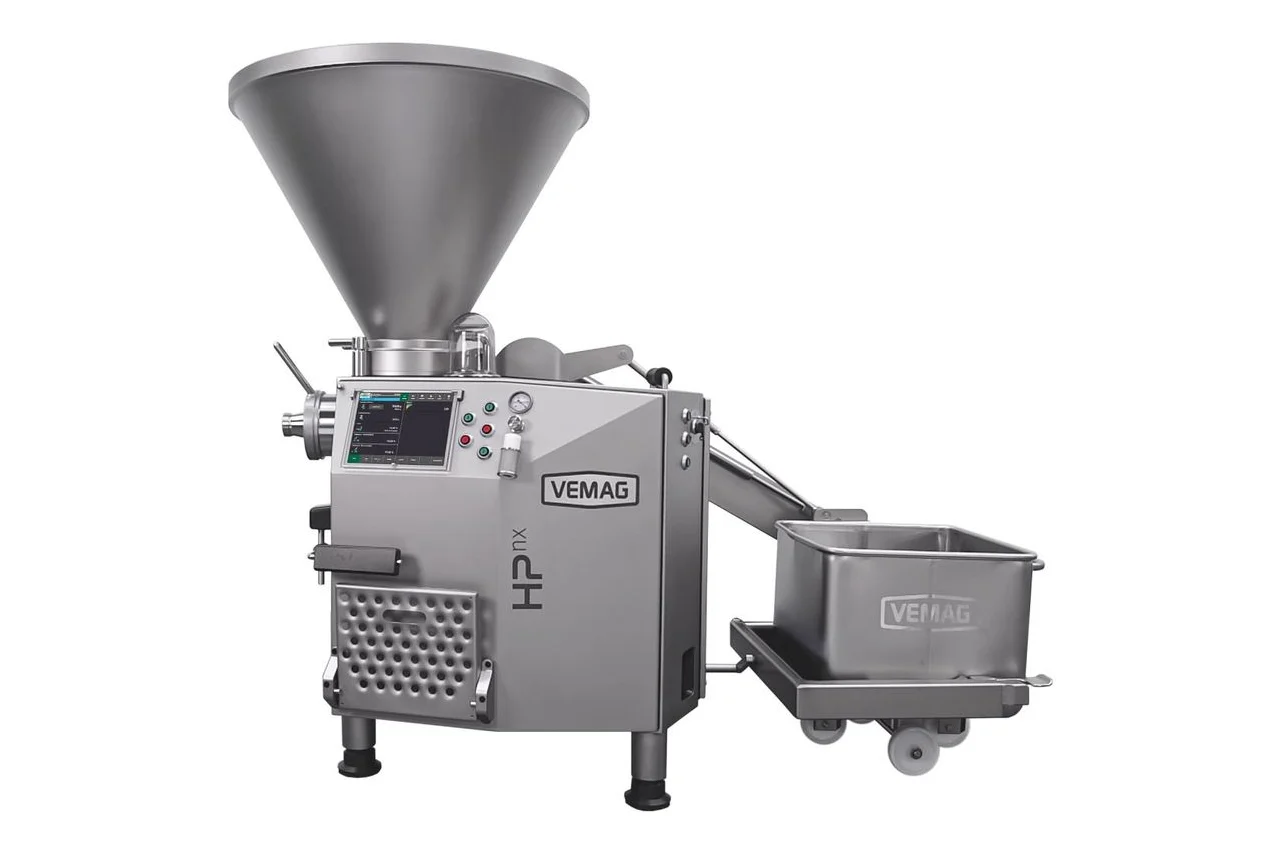
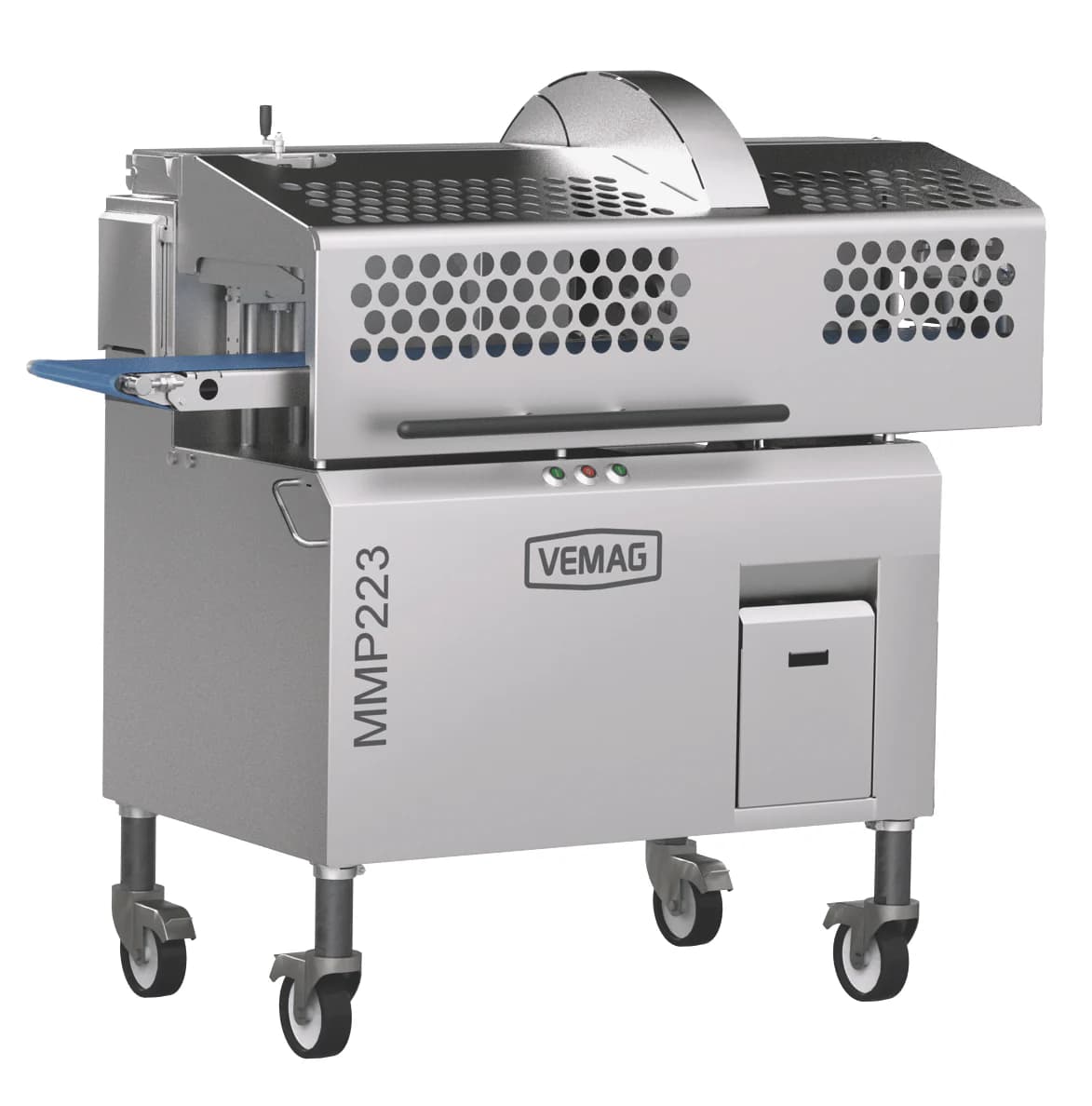
VEMAG’s pet-food snacks guidance pairs the HPnx vacuum-filler family with the MMP223 for sticks, strips and formed snacks. The HP10NX shown below is a local catalogue model in that family. The filler supplies the mass; the MMP223 attachment portions the product. Specify the required shape, outlet and handling arrangement with the team.
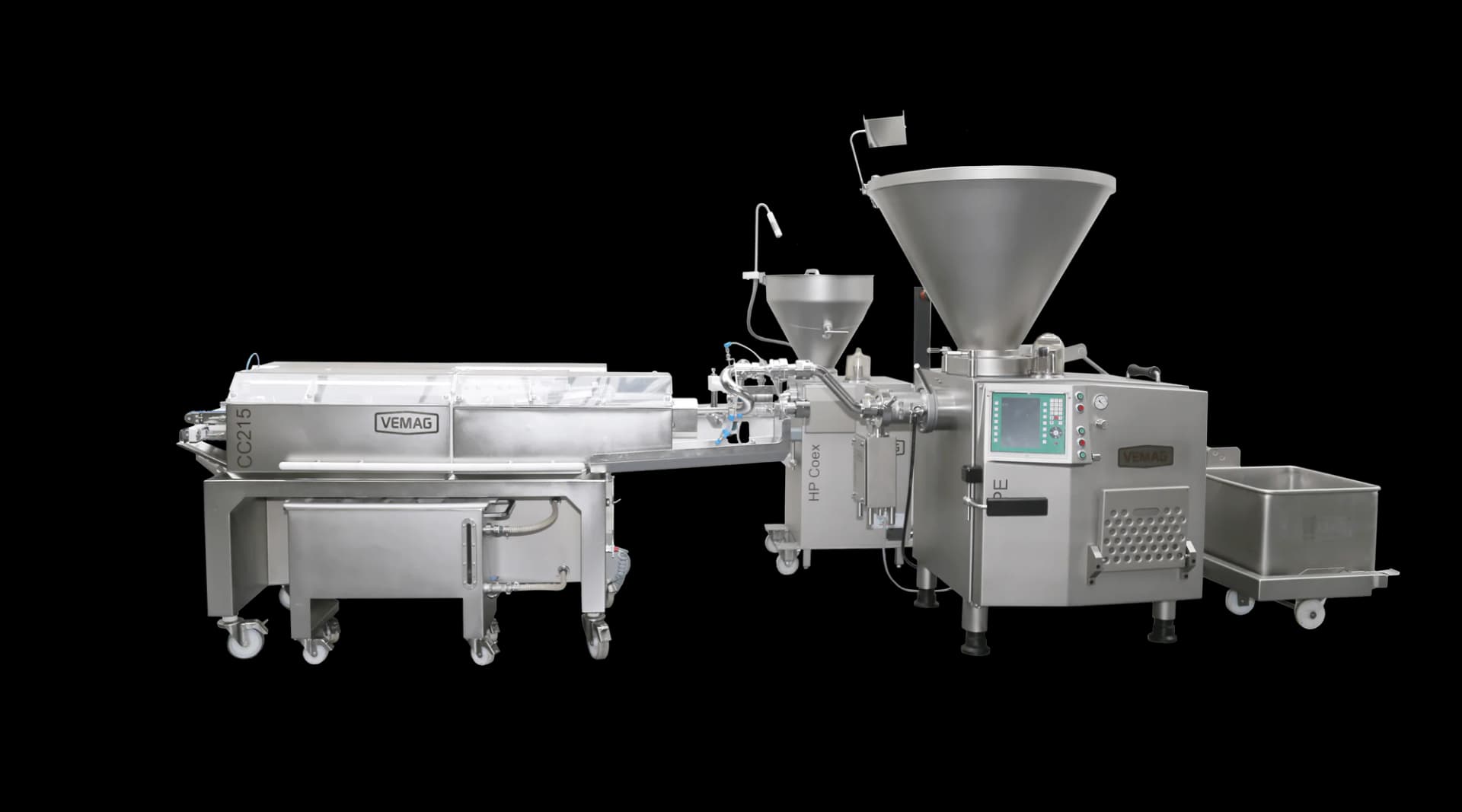
For pet-food sausage products, the same manufacturer guidance identifies the CC215 alginate coextrusion line. It applies an alginate casing around the product. This is a different configuration from a snack with one food mixture enclosed inside another, so include the intended casing or outer material in the enquiry.
These machines are shown for their documented roles, rather than as one pre-matched line or three interchangeable extruders. Confirm the exact filler, attachment version, controls, tooling and recipe requirements before selecting a system.
Separate unfilled products, filled snacks and casings
VEMAG’s pet-food brochure describes coextrusion with a filling positioned inside an outer product and the ends closed. For a filled snack, provide the two recipes and the desired cross-section. Confirm the proposed coextrusion equipment and closure method for those mixtures; a standard portioning attachment does not by itself establish a filled-product configuration.
Sticks, strips and portions
Define the outlet cross-section, cut length and portion weight. Discuss the MMP223’s documented pet-food portioning role alongside the required feeding and discharge arrangement.
Filled products
Specify the inner filling and outer mixture separately, including the required filling position, ratio and whether the ends must be closed.
Alginate-cased products
The CC215 is documented for sausage products in alginate casing. Describe the intended product and casing requirement when discussing this route.
For selecting a former around a treat’s geometry and receiving arrangement, compare pet treat forming machines, including nozzle forming, round snacks and tray placement.
Prepare the mixture and product specification
Give the team the recipe as it will be processed, including preparation method, particle sizes, working temperature and any pieces or fibres whose appearance matters. Explain whether it arrives as one uniform mass or as separately prepared materials. Include the normal batch size and how it will reach the hopper.
For a filled product, describe the filling and outer mass independently. State the amount of each in a finished piece and the appearance you need after cutting and later processing. Include the smallest and largest product sizes you intend to run so the outlet and change parts can be discussed.
- Raw material: ingredients, preparation, particle dimensions, consistency and temperature at the feeding stage.
- Finished portion: weight, cross-section, length, shape and the variation you need to achieve.
- Filled products: inner and outer recipes, target ratio, filling position and end-closure requirements.
- Production pattern: required saleable output, batch sizes, product changes and available operators.
- Next step: the receiving belt, tray or process, with any spacing or orientation requirement.
Plan the process around the outlet
Map the steps on both sides of the extrusion or forming arrangement. Identify preparation equipment, how the mixture reaches the filler, the method of separating portions and the point where product is handed to the next operation. Include any existing machinery that the new equipment must work around.
If the product is subsequently cooked, dried, cooled or packaged, show that step on the process plan. Identify which supplier or existing equipment provides it and the condition the product must reach before transfer. Agree the required interface rather than assuming that catalogue machines automatically form a complete line.
Where more than one lane is required, specify the number of lanes, pitch, portion spacing and how output is measured. Ask for the flow distribution, cutting and downstream handling to be assessed together. A rate given for a base filler does not establish the output of a different recipe through a complete extrusion setup.
Preparation and the wider process
Browse the pet-food catalogue for grinding, emulsifying, filling, inspection and packaging stages.
Feeding-machine options
Compare the vacuum-filler range and discuss the feeding element and attachment required for your mixture.
Use a product trial to confirm the configuration
Discuss a Customer Centre trial with your actual recipe and required product format. Confirm the proposed equipment and trial arrangements first. Agree which mixture condition and preparation method the trial should reproduce so its result can inform the project specification.
Set the acceptance criteria before the run. Assess the portion weight, shape and release from the outlet; for filled products, examine the filling position, ratio and closure. Follow the product through the intended next step where that is part of the agreed trial scope.
Record the filler, feeding element, attachment, outlet parts, settings and product conditions used. Include product changes and cleaning access in the assessment. Ask which requirements have been demonstrated and which remain to be resolved before the final quotation.
Request a pet food extrusion quotation
Send the recipe brief, product drawing, portion weight and required output, together with details of the equipment before and after the proposed system. Include the site location, available space, utilities and any installation constraints.
Ask the quotation to identify the feeding machine, attachment, forming or coextrusion tooling, separation method and product-handling scope. List any cooking or other process requirements explicitly so the team can confirm the proposed solution and the responsibilities of each supplier.
Questions about pet food extruders
What information should I send when asking about pet food extruders?
Send the recipe and its condition at the machine, the required shape and portion weight, the production target and what happens next. For filled products, provide both recipes and the inner-to-outer ratio. State any cooking, heating or pressure requirements separately.
Which catalogue equipment has documented pet-food applications?
VEMAG’s pet-food guidance identifies the HPnx family with the MMP223 for portioned snacks and the CC215 for alginate-cased sausage products. The HP10NX, MMP223 and CC215 are in the local catalogue. Their roles differ, so the complete configuration must be specified for the intended product.
Is alginate coextrusion the same as a filled snack?
An alginate system applies a casing around the product. A filled snack combines an inner food mixture with an outer food mixture. Describe the required inner and outer materials so the appropriate arrangement can be assessed.
Can a vacuum filler replace a cooking extruder?
A vacuum filler meters and feeds the mixture. That function does not establish the heating, pressure or cooking process required for a particular product. Include those requirements in the enquiry and have the complete process confirmed before choosing equipment.
How many lanes and what output can the system provide?
Specify the required output, lane count, recipe, portion and downstream handling. The proposed flow distribution, attachment and receiving equipment determine the complete arrangement; capacity and performance need confirmation for that configuration.
Can we trial our own pet-food recipe?
Discuss a trial at the Customer Centre. Supply the recipe, product specification and required downstream step so the team can confirm the equipment and the scope to assess.
Contact
Discuss your pet food extrusion project
Send your recipe, product shape and filling requirements. Discuss the feeding and forming process, a product trial and the equipment scope to include in your quotation.
- Australia(07) 3829 3868
- New Zealand+64 9 415 0137
- Salessales@vemag.com.au