
Soft cheese forming equipment
Choose soft cheese forming equipment around the piece you want to sell: its shape, weight and condition when it reaches the tray. Vemag Australia can discuss forming attachments, product handling and a trial with your own cheese mixture.
Define the formed cheese portion first
A cream cheese ball, a short roll and a shaped snack each need a clear product specification. Start with the prepared cheese mass and draw the portion at the point where it leaves the forming equipment. Add the intended weight, dimensions and appearance in its final pack.
This guide focuses on forming a prepared soft cheese mass into individual pieces. For a product sold as a spread in a cup or jar, use the dairy and cheese equipment guide. For a firm block that needs cutting into pieces, explore slicers and dicers.
VEMAG’s manufacturer guidance documents cream cheese forming applications. The useful next step is to establish whether your mixture holds the required shape through forming, transfer and packing. Include your actual recipe and working conditions in that assessment.
Forming equipment with documented cheese applications
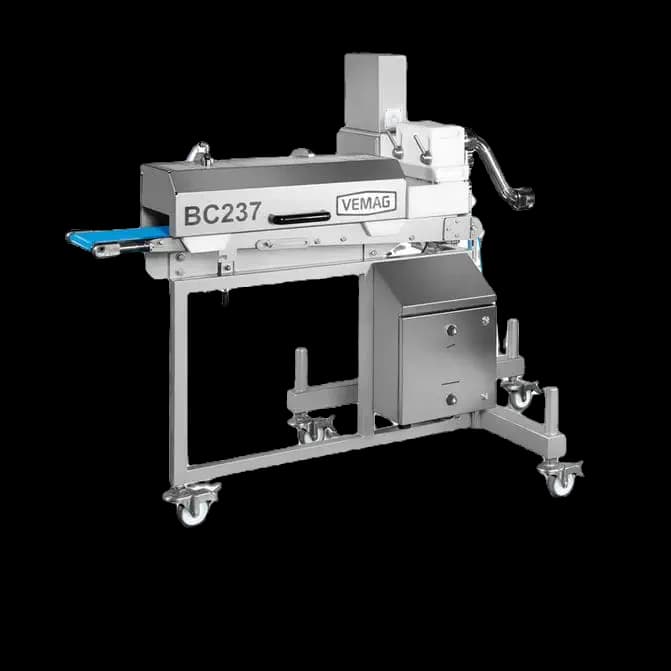
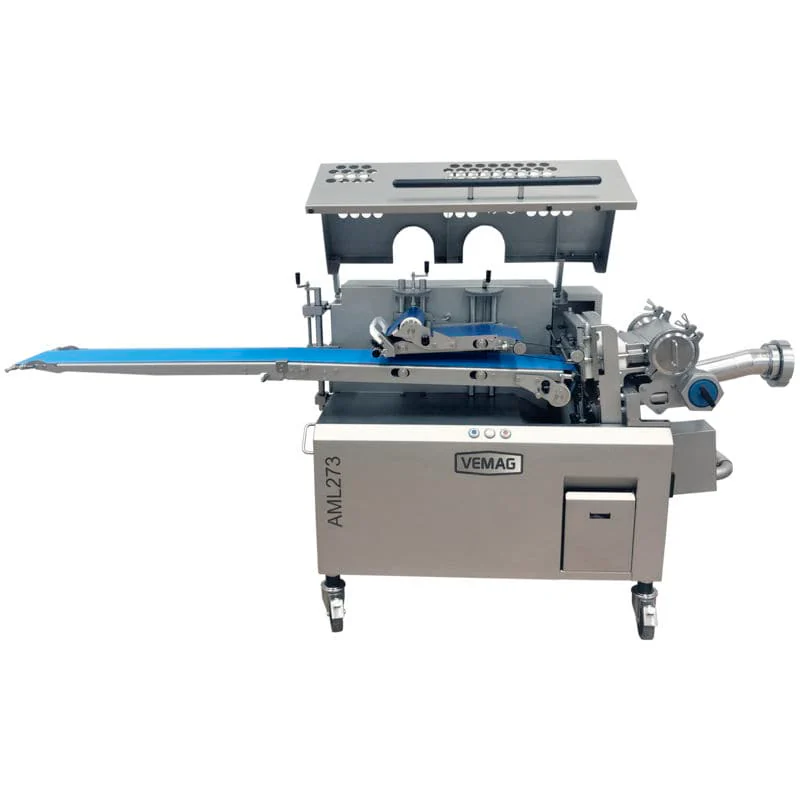
The BC237 and AML273 are real machines in our catalogue with cream cheese applications documented by VEMAG. They address different parts of the specification: creating shaped portions and, for the AML273, placing formed products into trays.
Treat the machine cards as starting points for a configuration discussion. Confirm the feeding machine, attachment version, tooling and receiving arrangement together for your cheese.
The vacuum filler range supplies the feeding and portioning stage. VEMAG illustrates the Robot500 with BC237 cream cheese ball production. Confirm the exact equipment combination with the team before specifying an attachment for a filler already on site.
Match the forming task to the product format
Cream cheese balls
VEMAG documents the BC237 for cream cheese balls. Specify the fresh portion’s diameter, weight and surface appearance, then assess the complete feed and forming arrangement.
Round or long pieces placed into trays
VEMAG describes the AML273 for round and long cream cheese products with automatic tray placement. The product shape and receiving tray pattern belong in the same brief.
Spreads filled into containers
A product that takes its final form from the cup or jar needs container-filling guidance. Explore the dairy guide’s filling section and discuss container dimensions and filling requirements.
If you want a filled cheese ball, describe the outer cheese and inner filling separately. Ask for a configuration assessment for that product; the standard unfilled BC237 listing alone does not establish the required coextrusion setup.
Give the forming team the cheese at its working condition
Specify the product as it enters the machine. Include the cheese type, recipe, batch preparation and intended temperature at the hopper. Explain how long it normally waits between preparation and forming, and whether its condition changes over that period.
Bring details of herbs, vegetables or other inclusions, including their size and distribution. State whether those pieces must remain visible in the finished portion. If you run several recipes, identify the most difficult product and the changeovers you need to make.
Include photographs or examples showing acceptable shape and surface finish. Identify faults you need the trial to detect, such as a smeared edge, a portion that stays on the outlet or a piece that loses its shape during transfer. Assess these against your own mixture rather than a demonstration product.
- Cheese recipe and preparation method, with the intended working temperature.
- Target weight, dimensions and acceptable variation for the formed piece.
- Inclusion sizes and the appearance required after forming.
- Batch size, holding time and normal recipe changes.
Specify the tray and every transfer after forming
For direct tray placement, supply a tray drawing or an actual example. Record its internal dimensions, usable area, depth and required pattern of cheese portions. Show where pieces should sit and the clearance you need between them.
If pieces leave onto a belt, provide the belt width, transfer height and required spacing. Map each subsequent movement into cooling, coating or packing equipment used in your process. Agree where the product will be inspected so a good shape at the former is followed through to the pack.
Discuss whether a tray or conveyor format change requires different tooling, settings or handling equipment. Ask the quotation to identify the scope of product placement and the interfaces with your existing line.
Our cheese snacks and sticks application page provides a wider catalogue view. Packaging selection and forming selection should use the same portion dimensions and pack layout.
Assess repeated portions with your own cheese
Discuss a Customer Centre trial with Vemag Australia. Agree the product, machines available, trial conditions and receiving arrangement before making plans.
Use an acceptance sheet that follows the portion from the forming outlet to the agreed next step. Record the recipe condition, feeder, former, tooling and settings used. Include a representative production period and a product or format change where agreed in the trial scope.
State the required output in acceptable portions per hour or shift. Assess that requirement alongside the receiving process, normal handling work and cleaning pattern. Confirm the working result for the proposed system before building a production plan around it.
- Measure portion weight and dimensions against your specification.
- Inspect separation, surface finish and shape retention at the agreed checkpoints.
- Check placement against the actual tray or belt pattern.
- Review product remaining in the equipment, cleaning access and changeover work.
- Record results that are confirmed and any engineering questions still open.
Request a soft cheese forming quotation
Send your cheese specification, portion drawing, target weight and receiving tray or belt details. Include the site location, available space, required output and any existing filler or handling equipment you want to retain.
Ask for a quotation that identifies the feeding machine, forming attachment, tooling, controls and discharge arrangement. Confirm the trial scope, installation and training requirements, and the responsibilities for connecting to equipment already in your plant.
Questions about soft cheese forming equipment
Which machines have documented cream cheese forming applications?
VEMAG documents BC237 cream cheese ball production and AML273 forming of round and long cream cheese products with automatic tray placement. Both models appear in our catalogue. The exact feeder, tooling and configuration need to be assessed for your product.
Can one setup form every type of soft cheese?
Suitability depends on the prepared cheese mass, its working condition and the required shape. Provide the recipe and product specification, then assess repeated portions through the proposed forming and handling arrangement.
What is the difference between forming and filling a cup?
Forming creates an individual piece with a specified shape. Container filling places a measured quantity into a cup or jar. Tell the team which format you sell and how the product should look in its pack.
Can formed cheese go straight into trays?
The AML273 has a documented cream cheese application with automatic tray placement. Supply your tray dimensions, portion pattern and product requirements so the proposed arrangement can be checked.
Can we use a vacuum filler already in our plant?
Provide its model, version and existing attachments. Confirm the forming attachment, controls and connection requirements with Vemag Australia. A general machine description is not a confirmation that every feeder and attachment combination suits your cheese.
What should we supply for a product trial?
Agree the trial scope with the team, then prepare your cheese mixture, working-condition details, portion drawing, target weight and tray or belt specification. Define the acceptance checks for shape, weight, release and placement before the trial.
Contact
Discuss your soft cheese forming project
Send your cheese specification, portion drawing and tray details. Discuss forming equipment, a product trial and the scope to include in your quotation.
- Australia(07) 3829 3868
- New Zealand+64 9 415 0137
- Salessales@vemag.com.au