
Fish portioning machines for formed fish products
Choose fish portioning machines around the material you start with and the shape you want to sell. Vemag Australia’s catalogue includes the APF253 for round, oval and custom-shaped fish products, and the DJM-VF06 range listing names fish sticks. Start with your fish mixture, target portion and handling requirements to assess the right forming approach.
Start with fish mixture or whole fillets
A fish mixture can be portioned and formed into a shape. A whole fillet needs a cutting process if the aim is to reach a fixed weight. Establish this difference before comparing machines: the equipment on this page forms prepared mixtures; it is not a catalogue of fixed-weight fillet cutters.
For a formed product, specify the composition of the mixture, its temperature at the former and the dimensions of the finished portion. Describe whether the product should leave as a round, an oval, a stick or another shape. Include what happens immediately afterwards, such as transfer to a tray or another process.
For whole-fillet cutting, send the species, incoming size range and target portion specification so the team can confirm whether any suitable option is available. The current catalogue does not establish a machine that cuts whole fish fillets to a nominated weight. For other further-processing stages, see our seafood processing equipment guide.
Compare APF253 forming and DJM-VF06 plate forming
The APF253 Automated Product Former is described for small and mid-sized companies making round, oval or custom-shaped products from meat, vegetable or fish. It is a relevant starting point for a shaped fish mixture. Confirm the proposed tooling, feed arrangement and portion specification with the team; its catalogue entry does not give a fish-specific output or weight range.
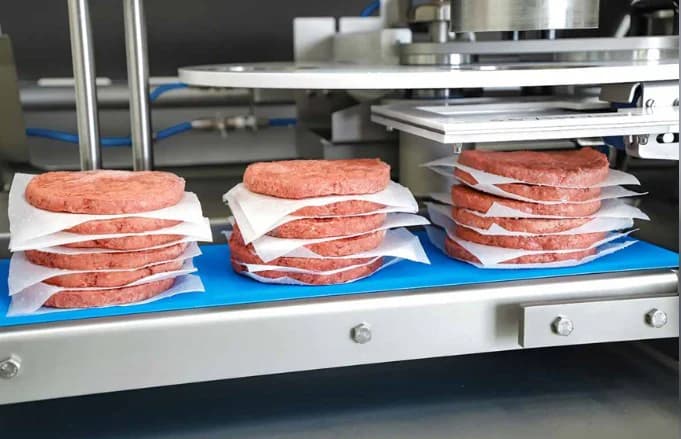
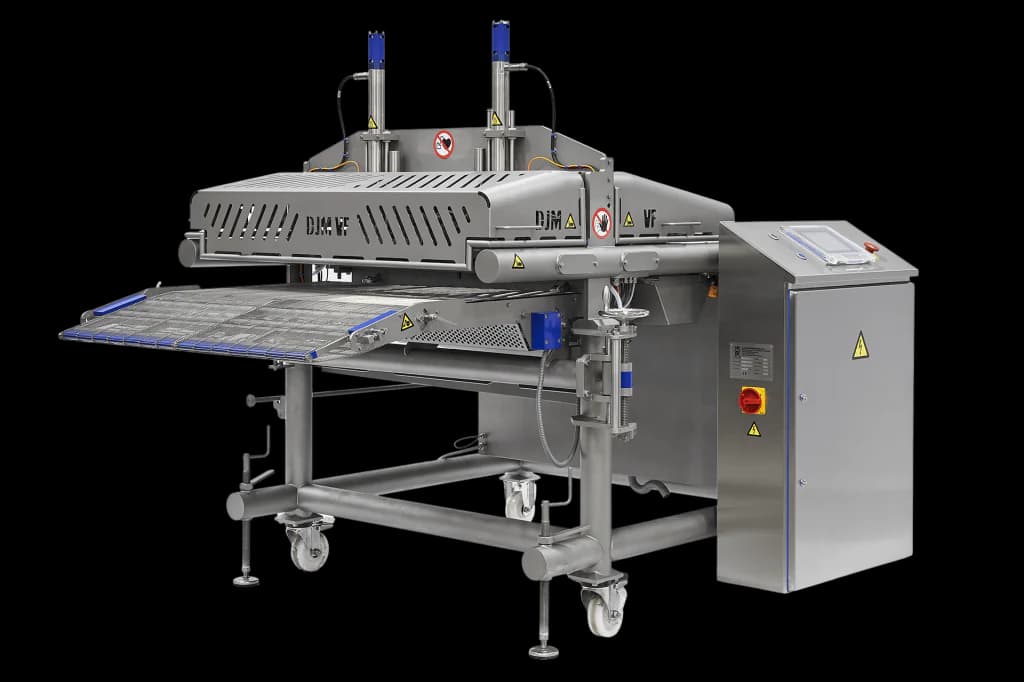
The DJM-VF06 listing describes the VacForm range developed for hamburgers, with fish sticks, schnitzels, chicken nuggets and vegetable products also possible. It also describes an optional automatic paper interleaver. Ask which machine version, forming plate and handling arrangement suit your fish stick recipe. The published chicken and burger capacities are not fish output guarantees.
These listings support two forming approaches to discuss. They do not establish that either machine will handle every species, recipe or inclusion, or that the two machines operate together as a line.
Define the portion before choosing the former
Keep the portion weight and dimensions in the same specification. State the acceptable variation you need and how it will be assessed during a trial. Ask for confirmation against the proposed machine and recipe before treating either value as an agreed production result.
Round, oval or custom shapes
The APF253 listing explicitly names these formats for fish, meat and vegetable products. Supply a drawing with the required width, length and thickness.
Fish sticks
The DJM-VF06 range description names fish sticks as a possible product. Discuss the version, forming plate and release of the portion with your recipe.
- Recipe and condition: species or blend, preparation method, ingredient proportions, particle size and working temperature.
- Portion: target weight, dimensions, shape and acceptable variation, with a drawing or example finished product.
- Handling: spacing between portions, tray dimensions, whether paper separation is needed and the destination of the formed product.
- Production plan: required saleable output, shift pattern, batch sizes and changes between recipes or shapes.
Plan the preparation and the handoff
Forming starts with the mixture presented to the machine. For chopping, mixing and emulsifying fish, the Seydelmann K40 bowl cutter explicitly names fish in its catalogue description. It is preparation equipment rather than a fish portioner. The required preparation method depends on the texture of the finished product.
Map the movement from the prepared mixture to the former, then from the former to the next stage. Identify existing equipment, transfer heights, tray or belt dimensions, operator access and the space needed for cleaning and changeovers. Ask the team to confirm any proposed interface instead of assuming catalogue machines are compatible.
If your product needs coating, frying, freezing or filleting, include that requirement in the project brief. Those machine types are not established offerings in this catalogue. Define which stages your existing equipment or another supplier will provide.
Preparation equipment
Compare batch chopping and emulsifying equipment, including the K40 listing that names fish.
Wider seafood process
Explore injection, cutting, forming, smoking and packaging, with the evidence and limits for each stage.
Use a product trial to settle the specification
Discuss a trial at the Customer Centre using your own fish mixture and intended portion format. Agree what the trial needs to show before it starts: the shape, portion weight, release from the forming area and presentation at the next handling step.
Bring the recipe and production brief together with any trays, drawings or handling requirements. Record the machine version, tooling, settings, mixture condition and results so the quotation can refer to the configuration actually assessed. Ask which requirements have been confirmed and which still need engineering review.
- Check the required shape and dimensions across repeated portions.
- Assess weight variation against your stated requirement using an agreed weighing method.
- Observe portion release and transfer to the intended tray or handling arrangement.
- Include the recipe or shape changeovers that matter to the normal production plan.
Request a fish portioning equipment quotation
Send the product specification, target portion and required output, together with the site location and equipment you already use. State whether you are replacing a hand-forming step, adding another shape or planning a new process.
Ask the quotation to identify the selected former, tooling, feeding and discharge arrangements, any trial work and the scope of installation and support. Product suitability, achievable output and the interfaces with other equipment should be confirmed for your project.
Questions about fish portioning machines
Which machines in the catalogue explicitly name fish forming?
The APF253 listing names round, oval and custom-shaped products from fish, meat or vegetables. The DJM-VF06 range description names fish sticks among its possible products. Confirm the version and configuration for your recipe.
Do these machines cut whole fillets to a fixed weight?
The machines shown here form prepared mixtures. Their listings do not establish fixed-weight cutting of whole fish fillets. Supply your fillet and target-weight specification if that is the process you need, so the team can confirm the scope.
Can I specify fish cakes or other custom shapes?
The APF253 listing supports round, oval and custom shapes from fish. A particular fish cake recipe, dimensions and portion weight still need assessment. Supply the mixture specification and intended shape rather than assuming the listing validates every formulation.
What output can I expect from a fish former?
The catalogue does not give a validated fish-specific production rate for these options. Define your required saleable output and discuss the actual mixture, portion size, machine version, feeding and handling arrangement. Do not use chicken-nugget or burger capacity figures as a fish production promise.
Can the mixture be prepared with a bowl cutter?
The K40 listing explicitly includes chopping, mixing and emulsifying fish. Whether that preparation produces the texture required by your forming process should be assessed with your recipe and proposed equipment.
Can we arrange a product trial before ordering?
Discuss a trial with Vemag Australia at the Customer Centre. Provide your recipe, portion specification and handling requirements so the team can agree the trial scope and the equipment to assess.
Contact
Discuss your fish portioning process
Send your fish mixture, required shape and portion specification. Discuss the forming approach, a product trial and the equipment scope to include in your quotation.
- Australia(07) 3829 3868
- New Zealand+64 9 415 0137
- Salessales@vemag.com.au